


DC3 Drama Takes Director Versappen to the max
DIRECTED BY WIM VERSTAPPEN/DUTCH/1974
BLU-RAY STREET DATE: SEPTEMBER 16, 2025/CULT EPICS

Despite what the Wikipedia page of this film’s producer Pim de la Parra says, 1974’s Dakota is not part of an “erotic tetralogy.” While it is true that Dakota’s production company, the Dutch breakout $corpio Films- started and ended by partners de la Parra and Wim Verstappen- made its reputation and fortune in movies with envelope-pushing sexual aspects (1971’s Blue Movie, 1973’s Frank en Eva, 1975’s Mijn Nachten met Susan, Olga, Albert, Julie, Piet & Sandra), the only real close connection in this somber, largely silent, and fully clothed story is between calloused older pilot Dick de Boer (played to a jaded tee by Kees Brusse) and his trusty Dakota/DC3. The plane and staying in the air with it might be the only things that truly matter to him. It may not exactly be Top Gun-level heat, but I’ll take this film over that one in a heartbeat.
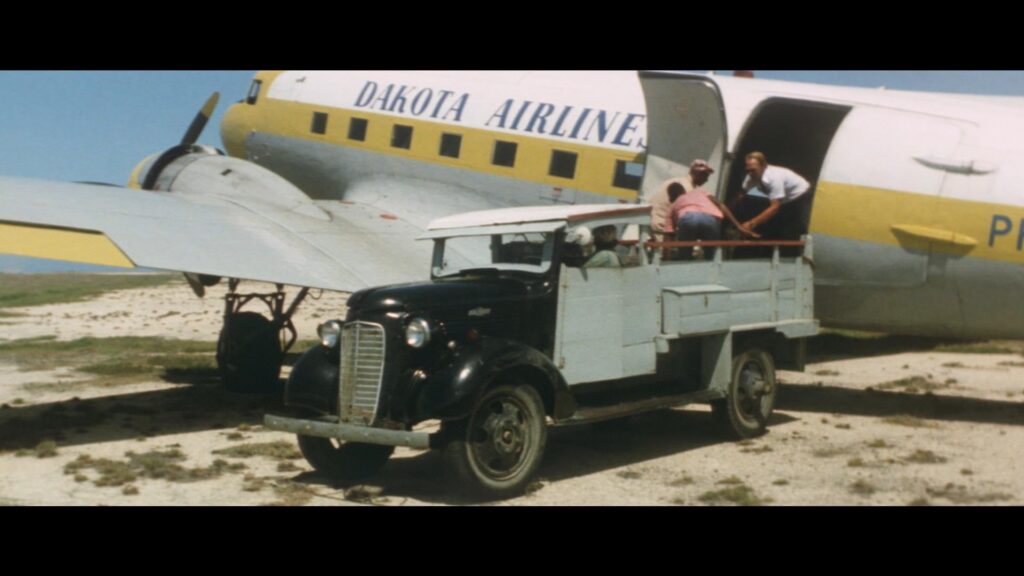
Director Wim Verstappen wastes no time engaging in some very deliberately paced process-of-flying-a-plane stuff, helped along mightily by the picturesque cinematography of future Twister and Speed helmer Jan de Bont and then de Bont’s replacement, Theo van de Sande. After a long slow plane prepping & take-off sequence, the empty Dakota lands in Aruba. The pilot, de Boer- an older gentleman we don’t yet know but will, and is obviously working alone- seems unstressed and dutiful. Whoever this guy is, he knows this plane and perhaps the plane knows him. Even in the brief moments on the tarmac in Aruba, making a pickup of some sort and aided by a few other guys, there’s no dialogue to speak of. This continues for the longest time, only some momentary control tower chatter breaking it up. I should mention he dumps his cargo in midair over a designated if non-descript area. Shady, but part of the job.
Later, de Boer is offered an absurdly high payment of $200/hour for his services for ten days. Simply flying around an attractive young rich woman (Monique van de Ven). The deal’s too good; he smells a rat. Then he’s brought around to accepting the gig. Later, on the beach with her, the water is bright aqua blue, but the sky is grey. Which is more telling? He’s told she’s bad luck, but he’s already deduced that.
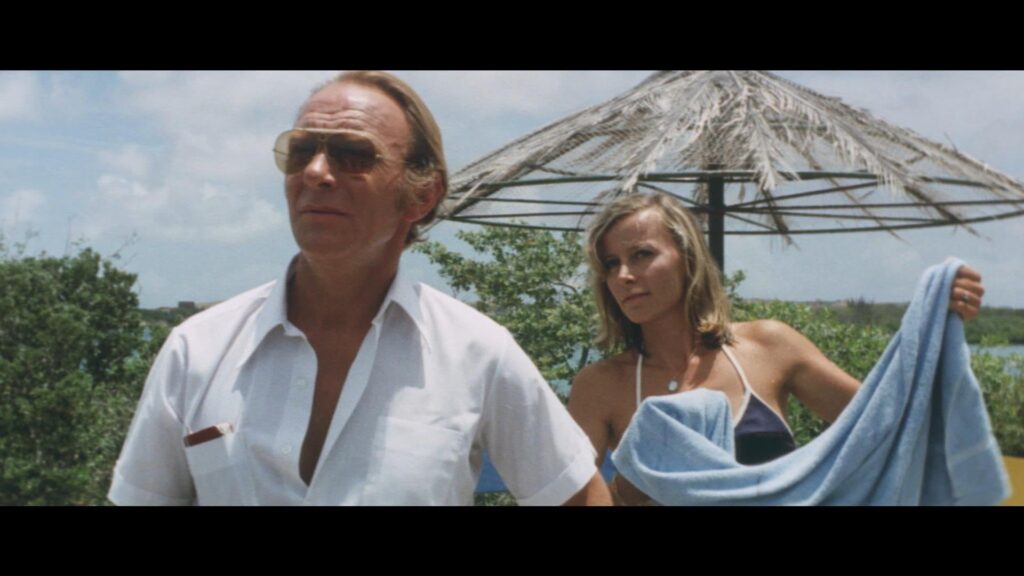
What happens next- or perhaps, doesn’t happen- may surprise you. Van de Ven evaporates out of the movie, and another woman (Willeke van Ammelrooy) steps in as the intrigue/gig shifts. By this point in Dakota, it’s clear that Verstappen isn’t concerned with narrative economics. Or rather, he is concerned with them, but only on his specific decompressed terms. He openly luxuriates in his beauty shots of the plane, nearly in silhouette, flying in front of a golden hour sunset. There are those who looked at these sequences and accused the filmmaker of letting his cinematographers direct the movie. Nah. Dakota may not exactly be Verstappen to the max, but he’s certainly not here to lose this race, as it were.
The new restored 2K transfer on display on the recent Cult Epics Blu-ray edition gets no complaints from me. Care has obviously been taken to ensure that the era-appropriate haziness evident throughout the picture stays intact, as it’s a key flourish that contributes greatly to Dakota’s intended half-awake ambiance. Whether this stated “half-awake ambience” is appropriate for a film about legal risk and contraband is a different discussion. On this subject I’ll simply say that Verstappen certainly made a fairly unique choice in this regard. Rather than being the ticking-clock pulse-pounder that most directors would come back with, Verstappen bends the material into a process-heavy semi-meditative observation on the stale hubris, isolation, and loneliness of de Boer.
Dutch film historian Peter Verstraten is back for another Cult Epics audio commentary, detailing the careers of Verstappen and his key cast and crew before getting into the very troubled specifics of Dakota’s production. The sheer amount of behind-the-scenes drama and toil in the making of Dakota leaves little question as to why it was Verstappen’s final film for his company, $corpio. According to Verstraten, several relationships- some personal, some professional- crashed and burned amid the unhappy production of Dakota. It takes Verstraten a while to get around to such choice details, opting to spend at least the first thirty minutes treading general $corpio Films material familiar to anyone who’s previously waded into Cult Epics Dutch cinema bonus features. Adding to the challenge of these commentary passages is Verstraten’s distractable and all-over-the-place focus, veering from Verstappen’s humble origins to the actors on screen to plenty of detail about Dutch star Sylvia Kristel, who has nothing to do with Dakota. But patience is rewarded, as Verstraten eventually finds his groove in breaking down the specifics of this movie’s fraught creation.

Two video bonus features are included, each running about twenty minutes and made up of shot-on-the-fly 16mm footage. The first and most apt is labeled Dakota Press Flight, wherein the $corpio Films private jet- ostensibly the same Dakota that we learn in the commentary that de la Perra gifted to Verstappen- suffers an engine problem midflight, not unlike a situation in the film Dakota. No one seems to get too distressed about having to make an emergency landing, and presumably the people get to wherever they were headed. Weirdly though, there’s a half-dozen or so quick snippets of a vintage hardcore porn film randomly edited into this. Viewer advisory?
Lastly, there’s Cannes Film Festival 1978, wherein Verstappen and company attend Cannes on behalf of his latest film, Pastorale 1943. While there, the WWII drama receives plenty of lip service but gathers no real traction. Subsequently, everyone is miserable and complaining about the festival, lamenting that it’s not what it used to be. I’m guessing that this documentary short was included as an extra on Dakota’s disc due to the awkward moments of actress Monique van de Ven trying to “congratulate” Verstappen on his new movie, and him telling the cameraman that he’s still upset with her for walking off one of his previous films, which cost him half a million dollars. Presumably, that’s why van de Ven simply vanishes out of Dakota.
Throw in an array of trailers for related disc releases and a brief photo gallery of promotional stills, all which Cult Epics has done, and you’ve got yourself a quality Blu-ray edition of a previously scarce film for English-speaking cinephiles. It all comes wrapped in a handsome slipcase adorned with beautiful new artwork design by artist Juan Esteban R. The key slipcover image is repeated on the case insert, which is reversible as to feature the original Dutch poster art.
Dakota is slow cinema long before slow cinema was trendy. Mix in a compellingly steely lead performance by Kees Brusse, some stunning flight photography, and strong hints of aviation love that wouldn’t be out of place in a Hayao Miyazaki film, and the melancholy Dakota is ready for takeoff.
Bonus Materials
- New Restored 2K Transfer
- Audio Commentary by film historian Peter Verstraten
- Dakota Press flight
- Cannes Filmfestival 1978 (Vara Visie)
- Photo Gallery
- Scorpio Films Trailers
- New artwork design by Juan Esteban R.
- Reversible sleeve with original Dutch poster art
- Slipcase