


Digging to China, and Beyond!

Every so often it’s good to push ourselves in our film viewing. This month, we’ve opted to push ourselves all the way to China. China, and its surrounding applicable countries, as the loosey-goosey parameters for this edition of ZekeFilm Film Admissions is (as you can see) films of the spoken languages of either Mandarin or Cantonese. Though for good measure and full inclusivity, any associated language would qualify. But there’s only so much room on the marquee, donchaknow!
Despite the cineaste devotion to Hong Kong Second Wave auteur Wong Kar-Wai and past western mainstream embracing of Ang Lee and John Woo (among others), Southeast Asian cinema and the like generally remains at arm’s length or further for many an American moviegoer, and even many critics. That’s why this entry of Film Admissions is about expanding our own filmic horizons as well as yours. Which is true no matter what languages we’re dealing in. This time, we’ve got a diverse array of admissions, spotlighting a food-centric rom-com, a supernatural horror film, an undeniably cool modern classic, a must-see Jackie Chan action spectacle, a foundational wuxia adventure, a poignant eulogy involving said foundational wuxia adventure, and in case that’s not enough, the first four films of an acclaimed historical action series starring Jet Li. Off to the literal other side of the world…
– Jim Tudor
Once Upon a Time in China
Director Tsui Hark / Cantonese, English, French / 1991
Once Upon a Time in China II
Director Tsui Hark / Cantonese, English, Mandarin / 1992
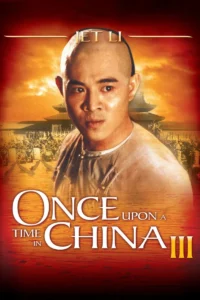
Once Upon a Time in China III
Director Tsui Hark / Cantonese, English, Russian, Mandarin / 1992
Once Upon a Time in China and America
Director Sammo Kam-Bo Hung / Mandarin, English, Cantonese / 1997
by Erik Yates


For my film admission I chose the Cantonese “Kung Fu” epic Once Upon a Time in China. I enjoyed it so much that I continued watching Once Upon a Time in China II and Once Upon a Time in China III. This particular trilogy is considered peak martial arts cinema and is credited with helping launch the international success of Jet Li. The film series follows Chinese folk hero Wong Fei-hung (Jet Li) during the late Qing Dynasty in the late 1890’s. The nation of China is dealing with the influx of Western nations’ imperialism as well as the internal corruption of the warring groups within China itself. The first film is epic in scope and scale with director Tsui Hark shifting from small, cramped indoor studio sets, that produced older Hong Kong cinema, to using wide-angle lens, and large outdoor sets. The ongoing tension of tradition butting heads with the ever-encroaching moderation is a large theme in this series. There is much comedy in the first entry that is capably handled, as is the hinted-at romance between Wong Fei-hung and the 13th “Aunt”, played wonderfully by Rosamund Kwan. The real star of this first entry, however, was the wire work, with a special focus on what is dubbed “the ladder fight”, with shifting bamboo ladders in a vertical battleground. These stunts and fight scenes are simply amazing.
The second film is arguably the strongest narrative in the series as Wong Fei-hung finds himself battling against the martial art cult The White Lotus Sect and a corrupt military official. The dangers of fanaticism and superstition take center stage as internal ignorance in the name of “pure” traditions prove as dangerous as the modernization of the western nations still aiming to tame China. Donnie Yen (IP Man, John Wick IV, Rogue One) goes head-to-head with Jet Li in this film, and it is worth the price of admission.
The third film continues to trim Wong Fei-hung’s larger martial arts school cast by moving the action to Beijing where the Empress agrees to let her military leaders host a Lion Dance Tournament to showcase national pride as a distraction to the crumbling power her empire holds under the influence of the western imperialism arriving daily on China’s shores. This tournament opens up internal fighting and the weakening of China which distracts them from the threat of western nations who see the tournament as an opportunity for assassination to advance their agenda. This film features more physical comedy and faster pacing in the narrative than the other two.

After these 3 films, Jet Li stepped down and the role of Wong Fei-hung was recast for Once Upon a Time in China IV and Once Upon a Time in China V, which I did not watch (and they weren’t readily available for streaming). After finishing the third installment, I did see that Jet Li returned to the series, along with Rosamund Kwan (who left for part IV). This return was for 1997’s Once Upon a Time in China and America. Here we see Wong Fei-Hung head to America to visit his former student Bucktooth (from the first film). We see martial arts blended with the classic American Western, with tropes like cowboys, native Americans, bank robberies, saloon fights, and more. We would see this sort of blending a few years later when Jackie Chan and Owen Wilson starred in a martial arts meets western-styled buddy film called Shanghai Noon (2000). Once Upon a Time in China and America serves as a bookend to the series where Wong Fei-hung is defending Chinese immigrants from western oppression in the west, when the first three films saw him defending China itself against Western encroachment.
The next year, Jet Li would take the American box office by storm serving as the main antagonist in Lethal Weapon IV starring opposite Mel Gibson and Danny Glover, being cast on the strength of these films. They are fantastic martial arts films that address China prior to the communist takeover, though Once Upon a Time in China and America also was filmed and released in 1997 as Hong Kong was re-uniting with mainland China after the British controlled it for over 100 years. Modernization vs. Tradition playing out in real life as the backdrop of a film series that wrestled with those same themes.
Rigor Mortis
Directed by Juno Mak / Cantonese / 2013
by Sharon Autenrieth
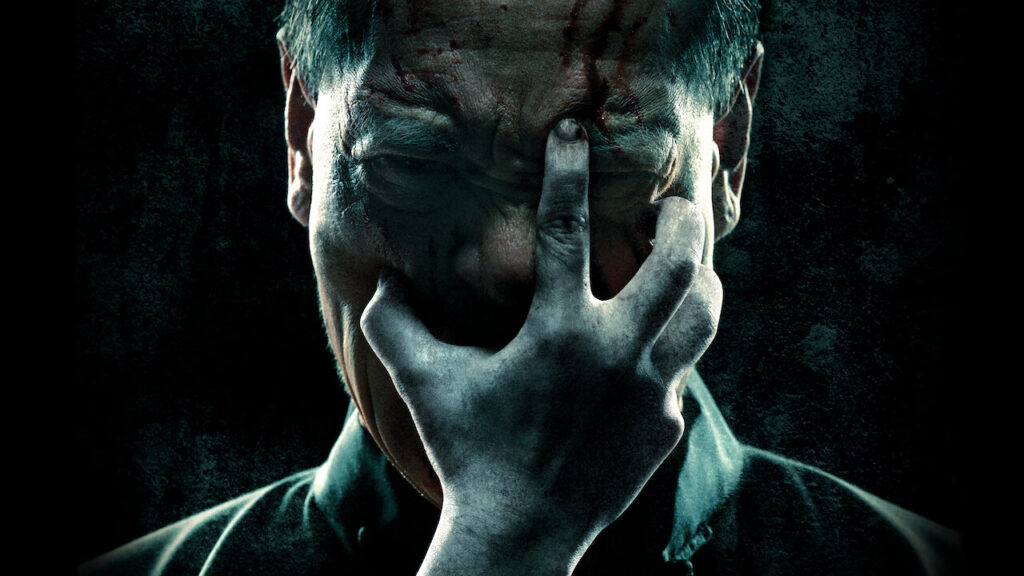

Sometimes, after agreeing to review a movie, I find that I’ve bitten off more than I can chew. That’s how I feel about Rigor Mortis (2013), not so much because of the film itself as because of the genre to which it is paying homage. In other words, how can I properly talk about a movie revisiting Hong Kong cinema’s 80s hopping vampire movies when I’d never heard of hopping vampires until researching Rigor Mortis? So I admit my cultural ignorance, and wish I could go down the rabbit hole of reading about jiangshi (the hopping vampires of Chinese folklore) and watching all of the Mr. Vampire movies, the franchise that directly inspired Rigor Mortis. Perhaps I will, but reviews have deadlines, so that research will have to wait.
Director Juno Mak was only 29 when he made Rigor Mortis, which directly honors films made when he was a small child. Mak’s film doesn’t just borrow the vampire conventions of the Mr. Vampire franchise, Mak intentionally utilized several of the actors from the older films, including Rigor Mortis leads Siu-Ho Chin and Anthony Chan. The most significant difference is in tone. The Mr. Vampire series is horror-comedy. Rigor Mortis is definitely not a comedy, although there are some wryly amusing details, including the fact that vampire hunter Yau (Chan) spends the entire movie in underwear and an open bathrobe.
The central character in Rigor Mortis is Siu-Ho Chin: yes, the character shares the same name as the actor in the role. Chin is an actor, a veteran of horror films – and if you wonder whether I am now describing the work of the actor in Rigor Mortis, or the character the actor is playing, the answer is yes. The role is self-referential, but quickly departs from reality when Chin checks into a bleak hotel and immediately tries to hang himself. In his dying moments he is possessed by two malicious female spirits, but then saved from both death and spiritual oppression by Yau. It is the first but far from the last scene in the movie in which martial arts and spiritual warfare collide.
Chin’s acting career has seen better days, but his despair is rooted in the loss of his wife and child, presumably through divorce. Having been spared from death by Yau, he slowly finds himself drawn into the strange world of his new apartment building. It is a self enclosed community: the residents eat together (the living and the dead), look out for each other, care for each other in their own ways. Yau, a vampire hunter who hasn’t had vampires to hunt in ages, sells glutinous rice to the residents. Auntie Miu (Hee Ching-Paw) mends clothing: Uncle Yin (Hoi-Pang Lo) watches out for the strange young woman, Yeung Feng (Kara Wai) and her silent white haired son, Pak (Morris Pak) who wander the halls. Even the spirits who inhabit the building – and there are a lot of them – are mostly peaceful. But there is trauma here, too. Feng has a tragic story behind her strange behavior which also explains the vengeful twin spirits who attacked Chin. And shortly after Chin survives his suicide attempt, things get worse when Auntie Miu’s husband, Tung (Richard Ng), dies in an accident. Auntie Miu is so overwhelmed at the idea of life alone that she consults Gau, an old acquaintance who practices some very dark arts. Gau offers to bring Tung back, but in Buffy parlance, he comes back wrong – as a hopping vampire. Sweet old Auntie Miu’s refusal to face her grief leads her deeper and deeper into complicity with evil, and Hee Ching-Paw portrays her descent to devastating effect.
The last act of Rigor Mortis is a stand off against evil, led by Yau and Chin. Some of the effects haven’t aged well, but Tung is a genuinely horrifying adversary and the cost of fighting him is high. The film’s title is drawn from the hopping vampire lore, in which vampire bodies suffer the decay of death and are therefore visibly rotting and stiff. In other words, Tung is not one of those seductive and languorous Western vampires, and the special effects makeup used on his face is one of the more effectively jarring things in a film that is too heavy on CGI.
American horror has focused so heavily on grief and trauma over the last 12 years or so that there’s been some blowback of the “enough already” variety. But there’s no denying that Rigor Mortis (which predated most of the American films I am thinking of) shares the trauma theme, and does it well. Rigor Mortis is about what comes of unresolved pain. Feng and Auntie Miu are both still alive and yet unprocessed grief has turned Feng into a ghost and slowly turns Miu into a monster. Better off are Yau, who shares meals with the dead, and Uncle Yin, who encourages Chin to get off on the right foot with ghosts who inhabit his apartment. They seem equipped to navigate a world in which life and death are always intersecting. Whether Chin, who is initially an unbeliever, will learn to navigate this world is an open question.
Chungking Express
Directed by Wong Kar-Wai / Cantonese, Mandarin / 1994
by Robert Hornak
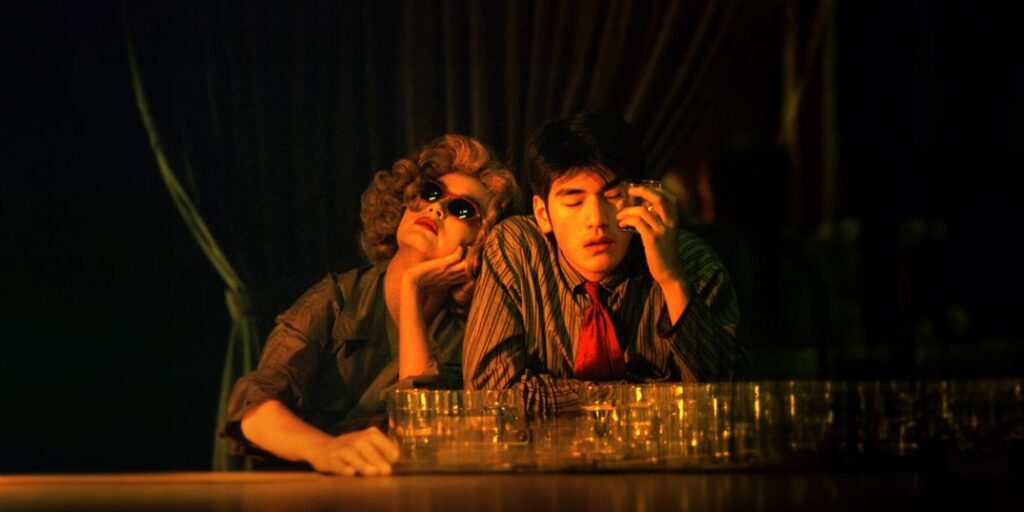
For sure a sad admission, but I’d heard of Wong Kar-Wai for thirty years without ever checking out plots, what his style was, anything about his life, politics, or common themes, until his stuff became more than just a blind spot but a seemingly willful head turn away. And I don’t know if just one movie can tell you any of that analytical stuff in any meaningful way, but I’ll admit Chungking Express made me regret the initial diss, and made me take to heart all the fuss.
But it took some doing – I nearly dumped it for something else, cause what the first moments made me feel was a wave of that old, familiar, tacky-like-taffy sort of visual morass that so many ‘90s independent features fell into – a kind of we’ll-show-‘em bravado with too-meager means that usually meant slogging through super-16 oversaturation like eating a marshmallow for 90 minutes, like watching a filmmaker stand in a three-way mirror in a first blush of awkward excitement trying on his big-boy Godard pants, and suffering the post-production slo-mo stuff with its restless, seemingly arbitrary, time-ratcheted smears of neon and concrete to, what?, underscore the guerilla street cred? Add to that the typical accidentally-on-purpose meet cute of the never shoulds, in this case the dumped and lovelorn cop with a genuinely goofy lack of gravitas and the be-wigged, on-the-lam drug dame, all costume-shop incognito – the naive O. Henry of it all playing like a flip-book of what’s-hip and what’s-been-done, all swilled into a mash that begs a pat on the head and a kick in the pants in equal measure.
But I’m glad I made it through that, cause getting to the rest made even that muddle feel artfully put right. There’s a litany of details that go so subtly by you in those first forty-five minutes (and those who know the movie know what I mean) that it requires something as overt as a complete change of characters to zoom it all into focus, like the optometrist’s exam glass popping down to reveal a new set of letters on the same pull-down screen. We learn the cop’s near-defiantly palms-up posture to anything mature with regard to his romantic dismissal (he’s the type that nabs a crook and immediately calls his girlfriend to brag) is necessary yin to the yang to come – and that would be… another cop, one who’s also freshly dumped, but whose posture is soulfully melancholic; and another girl: the new free-thinking pixie who works at his favorite food counter, one who’s counter-instinctual enough to break into Cop #2’s apartment, clean out the detritus of old love, and play hide-and-seek with his soured playfulness. Once we’re in the deliberate second half, the jumpy, slapped-together feel of the first half is radically justified, made right, and welcome in the same way your friend’s laughter makes you suddenly realize how absurd your pain is.
What makes this work is the constant fiddling with philosophy, worked out (at least partially) by voiced-over asides from all four of the main players. Not overdone, not intrusive in the usual film-school way, not cloying or crutch, but steadily plunking out a metronome of feelings, all tied eventually to the idea of time – the lack of enough of it (Cop #1) versus the oppression of too much of it (Cop #2) and the wily upending of its importance at all by the floating and flighty id of one short-cropped minimum-wager. And the only story connection, nailed down in the center of the movie with an end-of-sitcom-episode freeze frame, is Cop #1’s near-miss running into her at the counter just before Cop #2 shows up. The fact that it’s Cop #1’s voiceover that announces Cop #2 would be in love with her in due time, like he’s passing the narrative baton, makes the story at once drip with ad-hoc movie logic and intentional self-awareness so that all of what comes after – and all that came before – is made a perfect whole. In fact, rare among movies, its charms made me want to watch it again right away. So I did. And I realized in a slo-mo’d neon second how wrong I was to diss the first half – and how dumb I was to not trust Wong himself.
This Is Not What I Expected
Directed by Derek Hui / Mandarin / 2017
by Max Foizey
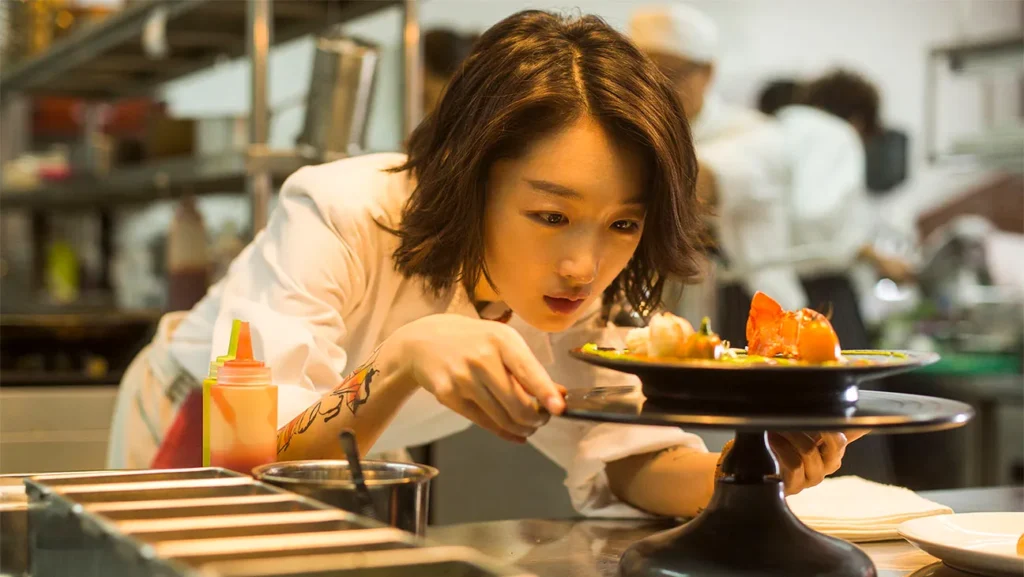

We meet twenty-something Gu Sheng Nan (Zhou Dongyu) in a parking garage as she is helping out a friend by scratching up the car of the friend’s cheating boyfriend. Gu is sitting on the hood of the car talking to her wronged pal on the phone when she discovers that she’s on the wrong floor of the parking garage, and she has mistakenly vandalized the wrong vehicle. The car is pretty well damaged by the time she’s confronted by the owner of the car, Lu Jin (Takeshi Kaneshiro), who is understandably confused by the whole situation. As meet cutes go, it’s a good one.
Lu Jin is a hotel executive in charge of buying out hotels to add to his successful stable. A buttoned-up, all business type of guy, he holds the culinary arts in such high regard that he judges each hotel he tours based solely on the quality of the food that comes out of their kitchen. At the latest property he is considering buying, he is unsatisfied with all of the dishes he samples, until the final plate knocks his socks off. Lu Jin decides to keep the hotel open for the immediate future, if only so this chef can continue to surprise him with their expertise. We, the audience, know something that Lu Jin does not: the chef preparing this incredible food is none other than Gu Sheng Nan.
Gu is very much a manic pixie dream chef, the polar opposite of the uptight Lu Jin. She lives in a ramshackle apartment with a Bull Terrier named Boss. She clearly loves expressing herself through cooking and takes on the challenge of cooking for the mysterious and powerful hotel executive with gusto, speaking to him through the ingredients and preparation styles. Like any good romantic comedy, there are a series of wacky misunderstandings. Here they include characters arguing, getting drunk, winding up in jail, and someone even winds up stuffed into a suitcase and being thrown out of a hotel room. But in a humorous way. It’s a credit to Zhou Dongyu and Takeshi Kaneshiro that they are each charming enough to make this silliness work.
Being a rom-com, the stakes aren’t very high. But the steaks look delicious. It’s easy to give in to your epicurean desires while watching This is Not What I Expected, a pleasant romantic comedy from director Derek Hui. The pace is brisk throughout, with some cool kinetic camera movements here and there. I especially enjoyed the hallucination sequence after our couple eat pufferfish, during which they see the fish floating in a kaleidoscope sky admonishing them as “stupid humans.” The film begins, ends, and is interspersed with close up shots of food being prepared, sometimes in slow motion sequences, designed to make your mouth water. If you’re a foodie, you’re an easy mark for this movie.
Police Story
Directed by Jackie Chan / Cantonese / 1985
by Taylor Blake


My first admission: I’ve got a ways to go in my viewing of Mandarin and Cantonese films.
My second admission: I’ve got a ways to go in catching up with Jackie Chan’s career.
Since 1962, the martial arts master has appeared in more than 150 narrative films, but this is my first venture into his work before he started working with Hollywood—and the first time I learned he directs, too. (I told you I have a ways to go!) And like I often feel in these Film Admissions pieces, my only regret is waiting so long to check this out.
An action-packed adventure starring a rogue cop who’s facing off with a crime lord over drugs and causing tons of collateral damage along the way? Police Story fits right in with the Gibson/Glover, Murphy/Nolte, Schwarzenegger, Stallone, and Willis 1980s police stories that Westerners are more familiar with. The film opens with an arrest attempt in a hillside shantytown that goes wrong when car after car rips through the homes. (How did they film this in the pre-CGI era?) From there, Chan dangles from a double decker bus, knife fights with an attacker, saves his girlfriend from a runaway car, and in the grand finale, destroys several floors of the local mall.
But between the action set pieces, Chan gets cake smashed in his face, steps in cow droppings, and ticks off his girlfriend (Maggie Cheung) with one misunderstanding after the next. This is comedy as much as it is an action movie. If the shantytown raid is the action highlight, the comedy pièce de résistance—even rivaling the opener as the most memorable scene—is Chan attempting to answer four phone calls at once while on desk duty. As he attempts to placate Cheung and Hong Kong residents in need of help at the same time, he bounces landlines from one limb to the next in a rolling chair—this is physical comedy on the level of Buster Keaton and Charlie Chaplin but in a way only Chan could do. But I guess if Jackie Chan is directing Jackie Chan, who would know better what stunts he’s capable of pulling off?
Goodbye, Dragon Inn
Directed by Tsai Ming-Liang / Mandarin, Minnan, Japanese / 2003
by Justin Mory
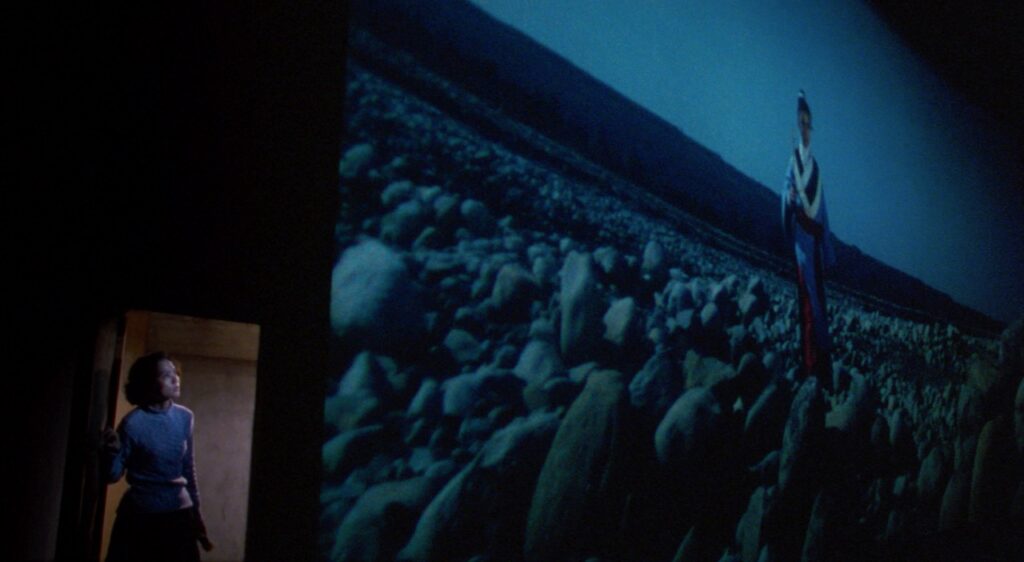
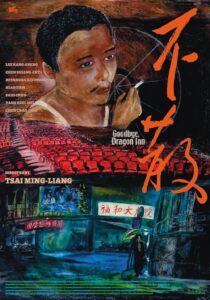
Tsai Ming-liang’s 2003 elegy for cinema straddles eras, countries, cultures, and even forms of storytelling in unifying viewers’ emotions across otherwise insuperable barriers of time and place to an almost palpable sense of irreparable loss. Set on the final day of business for a grand old theater on the outskirts of Taipei City, the mass-scale movie on gorgeous exhibition in this thousand-seat venue, playing to a scattered, milling crowd of maybe ten or twenty, is King Hu’s monumental wuxia epic Dragon Inn (1967); a film we see projected to a full house roughly contemporary to the theater’s opening some thirty years before. But now the theater is mainly empty, the walls in the lobby are peeling, and the structure itself is crumbling and leaking in the harsh climate. The remaining clientele are predominantly lonely men more interested in each other than with whatever’s on the screen.
Tsai’s gentle, formal, almost Tatiesque comedy is highly observational, remote and respectful yet involved and interested in the dwindling spectators to this last picture show. These include a Japanese tourist ineptly cruising for sex among mutually disinterested male patrons, an elegant woman noisily crunching baked watermelons seeds (she loses her shoe dangled over the seat in front at one point), and a disabled cashier, the theater’s sole remaining employee, who trudges up and down the many levelled stairs of the theater, lobby, and bathrooms in futile, lovelorn search of the absent projectionist. This is all told visually, the film’s soundtrack amply filled with the sharp dialogue, sound effects, and music cues from the film-within-the-film. A precisely mid-film exchange between the distracted Japanese man and another even more vague patron about the theater being “haunted” (but by who? possibly the remaining viewers themselves, or maybe us watching them?), adds to the overall mystery. And finally, almost surrealistically, a conversation occurs in the lobby between two stars from Dragon Inn itself, the actors Shih Chun and Miao Tien, who have individually been drawn to the theater long after they and the movies they made have been forgotten. The latter, elderly actor, however, has brought along his little grandson, who significantly appeared to be the most attentive viewer in the whole theater.
Tsai, well-known and perhaps infamous for his “slow movie” strategies of long takes, few cuts, and little-to-no camera movements, brings that style along with his familiar cast of collaborators, including Chen Shiang-Chyi as the heroine-like cashier, Yang Kuei-Mei as the noisy eater, Chen Chao-jung as a ghostly hall wanderer, and Tsai’s inescapable muse Lee Kang-Sheng (who finally turns up at the end as the elusive projectionist), fully to bear on this screen lament for and celebration of moviegoing. Of Chinese descent, brought up in Malaysia by his elderly grandparents, and educated and working in Taiwan his entire adult life, the director drew on memories of once-a-day screenings throughout his childhood with his grandfather across multiply vanished theaters in his native Kuching, Malaysia to reflect and evoke the theatergoing experience for multiple generations all over South and Southeast Asia. Drawing the universal from the local and particular, a 4K restoration of Goodbye, Dragon Inn from 2020 played past the festival, repertory, and brief theatrical showings to its ready availability on boutique Blu-ray labels and variously ephemeral streaming platforms. More reassuring, perhaps, its original Mandarin title Bú sàn apparently translates as “No Leaving”, part of an untranslatable idiom that reads something like “See You Later”. And while few now have or will have had the experience of watching Dragon Inn or its Goodbye in a filled-to-capacity, thousand-seat theater, the memory or its ghost possibly remains even while watching in the relative comforts of one’s living room.
Dragon Inn
Directed by King Hu / Mandarin / 1967
by Jim Tudor

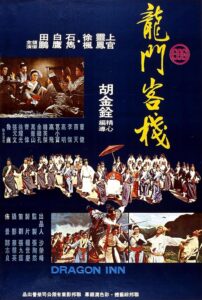
Near the end of spending as much of May as I’ve been able to viewing noteworthy martial arts output of Hong Kong’s venerable Shaw Bros. studios as well as some very similar early film’s of Shaw’s derived direct competition, Golden Harvest, watching King Hu’s 1967 hit Dragon Inn felt downright destabilizing. Or maybe… it’s actually stabilizing? What I mean by that is, after watching fifteen or so films that were churned out factory-style and generally shot on the same redressed period sets, this auteur-driven and sure-handed wuxia (martial arts adventure set in ancient China involving characters with acute senses and impossible abilities) actioner felt like more of a breath of fresh air than I was anticipating, and one that I didn’t know I was in need of.
Prior to this viewing, I’d only seen a few other King Hu films. So, on some level, I knew what to expect, yet I’m realizing that lately I’ve been lulled into a sense of Shaw Bros.-induced malaise. Dragon Inn, unlike so much of the massive output of Shaw, demonstrates nuance, texture, subtlety, and relatable tactility throughout. It’s having been largely shot on locations vast and dusty definitely helps these aspects in their thriving. In 1967, when Dragon Inn broke out as a major hit in multiple parts of the world, Hu had only recently left working for Shaw Bros. (where he made his well-received 1966 film, Come Drink with Me, and was quite dissatisfied with the studio’s internal methods) and went to Taiwan to make films on more of his own terms.
Dragon Inn, set in the Ming Dynasty (as most such wuxia films are), tells the tale of an assembled group of martial arts masters that take on the dominant forces of rebellious royal eunuchs to protect a family under threat. If one partakes of the excellent video essay by martial arts film expert Grady Hendrix located on the Criterion disc release of this film, you’ll there’s far more to the film’s appeal and relevance than that simple story. I’m exceptionally grateful to Criterion and Hendrix for providing such contextualization. From here, Hu would only get more bold and grandiose in his fantastical tales of sword-fighting springboarding valiant warriors of yore. I find I prefer the more grounded and shorter (under 2 hours) Dragon Inn to Hu’s later 3+-hour unrelenting epic, Touch of Zen. But do try both.