


A Perfectly Fine Galactic Nothing-Burger
DIRECTOR: JON FAVREAU/2026

A long time ago in a galaxy far, far away a bounty hunter teamed up with the cutest little guy you ever did see.
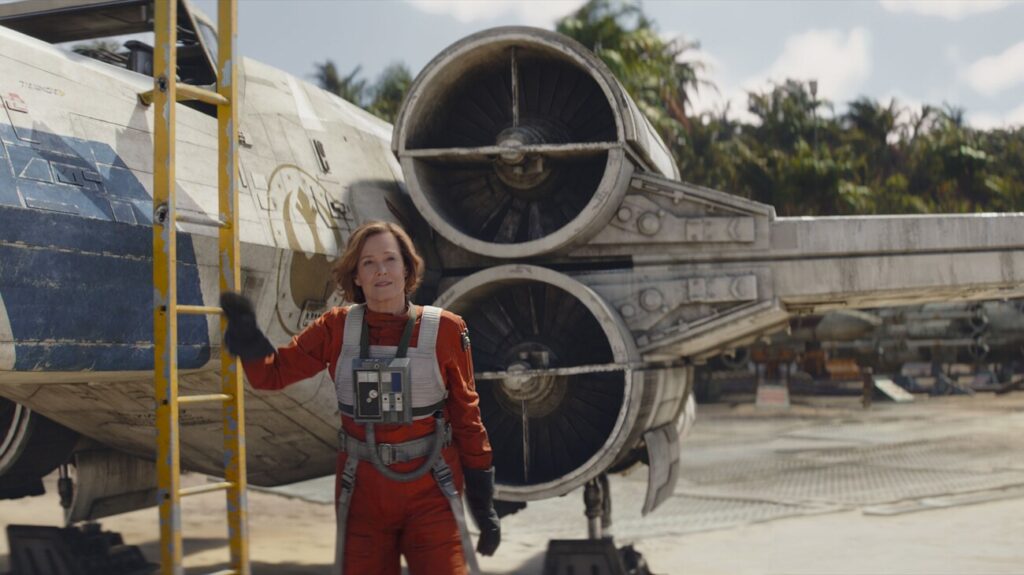
This bounty hunter, known as the Mandalorian (Pedro Pascal), is shooting first and asking questions later for the New Republic after the events of Return of the Jedi. Though the Emperor was vanquished, those who benefited from his Empire remain to cause problems for the New Republic. Colonel Ward (Sigourney Weaver) keeps the Mandalorian busy capturing (and if necessary, assassinating) Imperial loyalists who threaten peace in the galaxy. His latest mission: rescuing Rotta the Hutt (Jeremy Allen White) from kidnappers. But he won’t get far without Grogu, his Force-sensitive sidekick/adopted son.
JIM TUDOR: For three seasons on Disney+, we’ve watched Din Djarin (aka the titular Mandalorian) go from ruthless bounty hunting loner to fawning adoptive father to little Grogu (still a baby at 50+ years old and a survivor of the Jedi Temple purge of Emperor Palpatine’s Order 66) to liberator of his crushed home world. When the dust settled at the end of the epic events of the last episode aired, the duo retired to a homestead on Nevarro for some much-needed rest & relaxation. It’s been a few years since we’ve been able to check in with Star Wars’ biggest cultural sensation of its Disney-owned era. So what’s next?
The unfortunate answer is, not enough. Certainly, at least, not enough to justify a theatrical release touted as the franchise’s return to the big screen after seven years. Though generally enjoyable in and of itself, The Mandalorian and Grogu lands as a glorified “mission of the week” episode, and nothing more. As stated by the hosts of the Children of the Watch podcast, not only does this film not move the needle for Star Wars, it doesn’t even move it for The Mandalorian. Considering that all creative parties involved are well aware of the “cultural event” status that Star Wars movies have always had, the decisions that resulted in this one being what it is—a time-passing nothing-burger of sorts—are thoroughly confounding.
TAYLOR BLAKE: If anything, The Mandalorian and Grogu is a testament to the expectations game. I entered with the lowest expectations I’ve ever had for a Star Wars movie, partly because of the increasingly sour taste Rise of Skywalker left and partly because I was bored by The Mandalorian series after two episodes. The good news is that there’s no need to have watched the series to keep up with the plot here, though this would be an odd entry point to Star Wars as a whole. This is a slice-of-life story in just one slice of the galaxy, with none of the operatic tragedy or Joseph Campbell mythology the Skywalkers are known for. I suspect the slight emotional arc may be more satisfying for those who met these characters on Disney+—um, you called him Din Djarin?—but it curves just enough to prevent this from becoming a pure action genre play.
The biggest criticism is Mandalorian and Grogu plays just about everything safe, but mere competence is welcome after the messy productions that became the messy films Solo: A Star Wars Story and Star Wars: Episode IX – Rise of Skywalker. With a narrower cast, there’s less breadth than a typical Star Wars film, and with the focused bounty hunter plot, there are fewer philosophical ideas. And while there may be no high here on par with a scene like Duel of the Fates (an all-time sequence in what many consider the worst Star Wars episode, The Phantom Menace), we’re also never subjected to dialogue as bad as Anakin wooing Padmé with his complaints about sand. (In fact, there’s so little dialogue that some sequences evoke the silent film era.) If we turn the expectations game into a game of speculation, would this movie have blown our expectations away if it were released in the spot of 2018’s Solo? At least this premise isn’t as ill-conceived. We neither needed Han Solo’s back story nor wanted a replacement for Harrison Ford; we do have questions about galactic bounty hunters and the events between Return of the Jedi and The Force Awakens.
JIM TUDOR: Despite having grown up on Star Wars (the original movie onward) and it being the most formative element of my lifelong cinematic obsession, I’m one who feels that the franchise is best, or at least most interesting, when it deviates and takes chances rather than when it relies on nostalgia and familiarity. The Mandalorian and Grogu can be read either way. As I stated above, it is a big deviation from what we’ve come to expect in a Star Wars film. The problem, perhaps, is that it largely fails to compensate with anything thought-provoking or mysterious. I do believe that Star Wars ought to always leave us with something bigger to consider, be it the nature of The Force, the real-life parallels of the Rebellion against the Empire (and all of its permutations), or what means what to whom on a personal level. Star Wars movies shouldn’t be like other blockbusters adventure tentpoles where you walk out, shrug, say, “That was fun,” and then mostly forget about it—which is the case here.
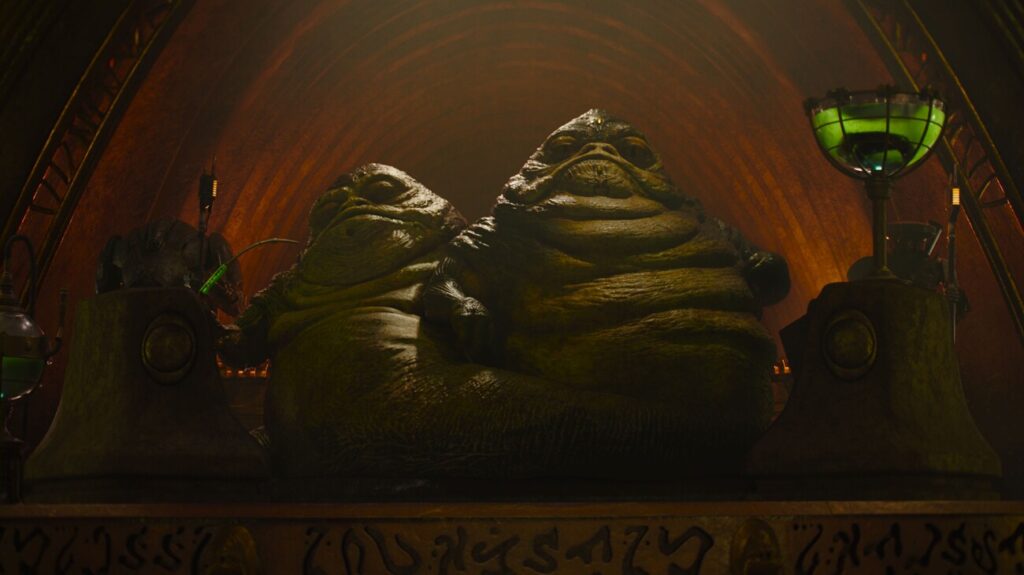
All that said, for all of my issues with it, I did enjoy The Mandalorian and Grogu. It will always be on the low end of my Star Wars list, but as I tell anyone who asks, I’m an easy mark for Star Wars. I will most always find something to like. Here, I appreciate the return of Jabba the Hutt’s son, Rotta, who was first introduced in the lamentable Clone Wars movie in 2008, when, as a baby Huttlet dubbed “Stinky,” he had to be rescued by Anakin and his new apprentice, Ahsoka Tano. Stinky’s come a long way in life, even as his presence here necessitates another Rotta the Hutt kidnapping storyline. Though Rotta prevails as the true heart of The Mandalorian and Grogu, his CGI visage can’t compensate for the lack of authentic human faces in this film.
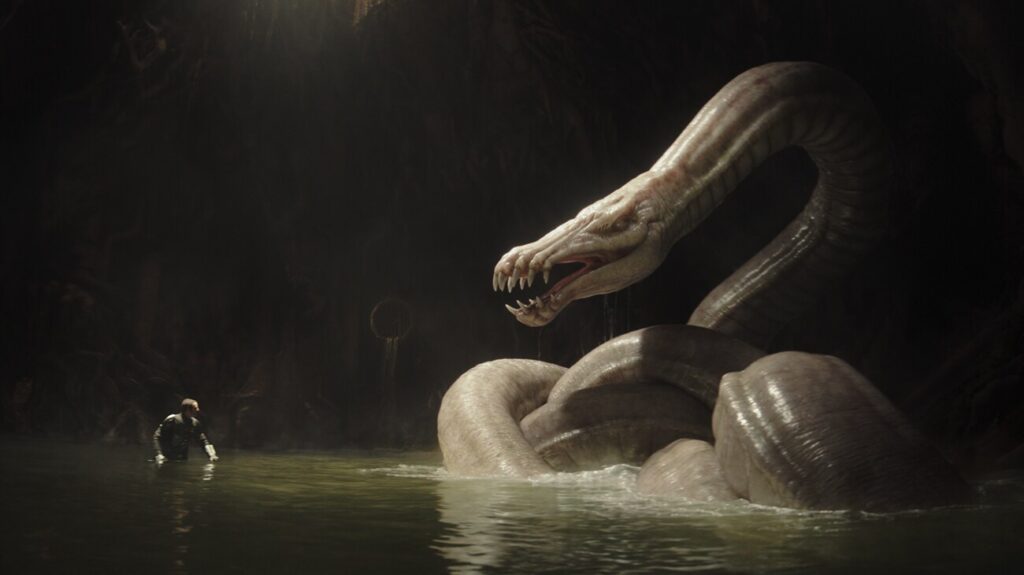
Din being a fully masked character and Grogu being a non-speaking puppet are major limitations that the series addressed by pairing them with human characters played by Gina Carano, Katee Sackhoff, or Carl Weathers. Methinks director Jon Favreau’s years of immersion in CGI development (evidenced in his films The Jungle Book [2016], The Lion King [2019], and the truly groundbreaking adoption of the StageCraft rear-screen virtual reality technology brought to the cultural foreground with The Mandalorian series) may’ve blinded him to the simple grounding importance of an emotive flesh and blood face. So while this doesn’t rank highly on Favreau’s mostly-impressive directorial filmography, his unique knack for cultivating tactility in his visual effects remains on display here. It’s especially nice to see a sequence of actual old-school stop-motion courtesy of Star Wars effects legend Phil Tippett. This sort of thing does my heart good.
But I will say this: When I teach Star Wars, I usually say, “We, as a culture, get the Star Wars we deserve.” In this abysmal 2026, what we get is a Star Wars film where the bigger stakes of the galaxy are ignored, and our hero is a libertarian cult member who insists on hiding in a helmet and armor, all in accord with his undeniable violent streak. He’s learning a better way from his son, whom he truly loves. Like everyone, there is good in him. But questions of what effect his own loyalty to an extremist sect of Mandalorian society (all of which is based on warfare) is having on the impressionable young Grogu remain frustratingly unaddressed.

TAYLOR BLAKE: You mention that this movie doesn’t move the needle for Star Wars and that the franchise is best when it takes chances. This is why all of these non-Skywalker efforts in the last 10 years send me back to the question, “Except for money, why?” Even Rogue One, one of the best-regarded of the decade, is just the D-plot of A New Hope. As we walked out of the theater, I remember asking my brother, “So did we learn anything new from this movie?” All he could come up with was, “Uh, we learned that it was way harder to get the plans to the Death Star than we thought.” Before the fallout of the The Last Jedi, Big Star Wars was hesitant to take chances. Post-Last Jedi, I’m waiting to see anything on the big screen with half the ambition of Rian Johnson’s (thought-provoking, mysterious, wonderful) episode. Alas, the chances of seeing The Hunt for Ben Solo seem to diminish by the day.
But as you said, this is a perfectly pleasant watch—perhaps even cozy? Grogu really is just that cute, channeling the energy of a newborn and the family dog into one of the most delightful beings in the galaxy. More than not, anything he did (sneezed, snacked, tapped the Mandalorian’s helmet) inspired giggles and coos in of my audience. The film’s other biggest asset: Ludwig Göransson’s electro-industrial score. The pulsing, percussive work sounds nothing like John Williams but still like Star Wars, which is something I wouldn’t have said was possible a week ago. This keeps the energy and tension up even as the Mandalorian faces off with forgettable creatures in dark settings not as dazzling as you’d hope from a Star Wars movie. Still, none of the film’s flaws are as egregious as those of Rise of Skywalker, which is now a toss-up when I do a full series rewatch: Will I yell at the screen when Oscar Isaac says, “Somehow Palpatine returned,” or will I just skip the movie altogether? Like Solo, The Mandalorian and Grogu is rewatchable even if it’s in nobody’s top Star Wars tier.