


Tommy Shelby Returns for a Bleak Final Soliloquy in Peaky Blinders: The Immortal Man
DIRECTED BY TOM HARPER/2026
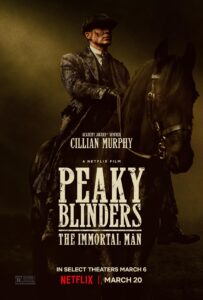
The last time we saw Birmingham’s most notorious gangster, he was riding horseback into the proverbial sunset to greet a hopeful new chapter of his life. This was a satisfying enough conclusion for this giant of a man and a beautiful closing chapter to the phenomenal legacy of Steven Knight’s melodramatic period crime series. Drenched in mud, blood, and smoke, Steven Knight’s Peaky Blinders was a sensational hit with audiences from its violent early days. This was in part due to the powerful presence of Cillian Murphy, who delivered the role of a lifetime for nearly a decade as the titular Tommy Shelby. Six seasons and four years later, this beloved drama has finally come due for the standalone feature film treatment. This time around, the Romani-gang leader has abandoned the heart-pounding life of crime for a self-induced solitary confinement. His days of bloodshed and gunfire are long behind him, left to rot in the tumultuous city he once called home. Tommy Shelby may be done with Birmingham, but Birmingham is certainly not finished with him. Drawn back by the oppressive weight of familial obligation and his own pride, this new edition of the beloved character must confront his tarnished past within a changing world. Now, the iconic question of the series carries an additional existential weight: just who the f*** is Tommy Shelby?
Picking up almost a decade after his dramatic exit from outside world, the cultural landscape has undergone a drastic shift. The turn of the decade has seen the start of World War II, and the early days of the Birmingham Blitz have only just begun. Nazi Germany has infiltrated the city with the intent to crash the British economy by introducing an abundance of counterfeit currency. This mission is captained in part by Nazi agent John Beckett (Tim Roth), who makes a deal with the modern Peaky Blinders to distribute millions of this counterfeit money throughout their network. His contact is the gang’s new leader and Tommy’s illegitimate son, Duke Shelby (Barry Keoghan), who’s reckless attitude and hostile tendencies are the markings of a burgeoning reputation. His dangerous antics are rebuffed by his aunt Ada Shelby (Sophie Rundle), who has replaced her elder brother as Birmingham South’s MP. It is her concern for the destructive actions of Duke and the Peaky Blinders that sends her all the way to Tommy’s doorstep.
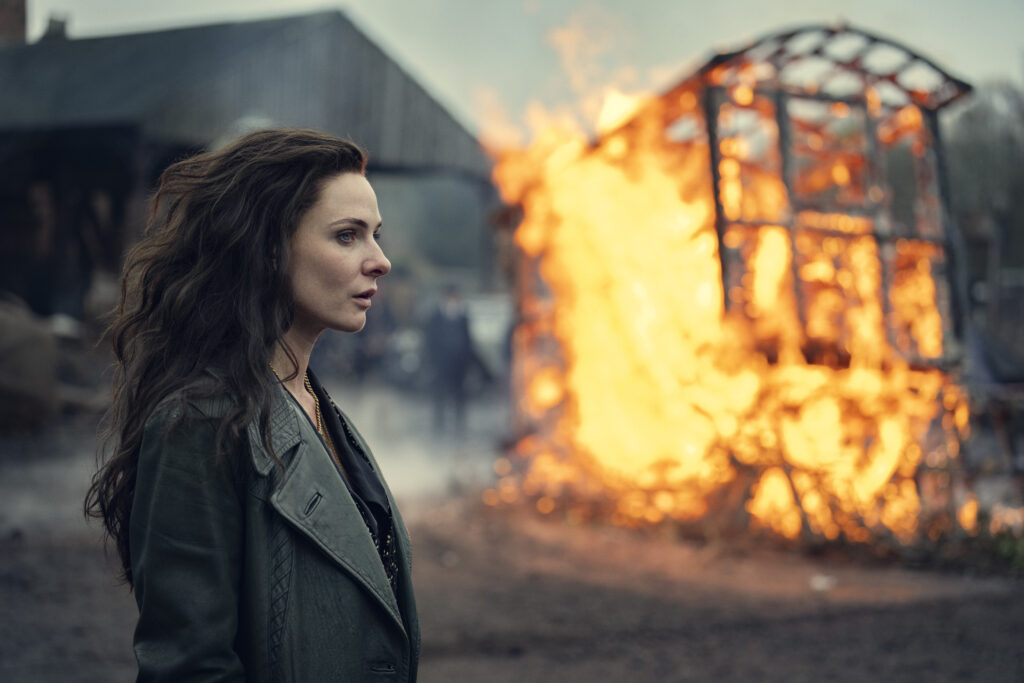
While his remaining family has been busy in Birmingham, Tommy appears to be quite content with his life of seclusion. Haunted by an overflowing graveyard of ghosts, this version of the man is a hollowed-out replica of the once revered political gangster. Now his days are spent wearily working away at his glum autobiography as a way to process a lifetime of trauma, accompanied only by the steadfastly loyal Johnny Doggs (Packy Lee). His monotonous routine is broken when Kaulo Chiriklo (a severely underutilized Rebecca Ferguson) – twin sister of Duke’s late mother – comes knocking. A Romany seer with alleged psychic abilities, she has similarly come in search of help for her wayward nephew. Somehow, this mysterious woman succeeds where Ada failed. Encouraged by his encounter with Kaulo and burdened by the weighty obligation to his surviving kin, Tommy Shelby makes his long-awaited return to the streets of Birmingham.
Following the typical Peaky Blinders algorithm, this film has no shortage of the brutality and melodrama so synonymous with the source material. In one memorable scene, Tommy enters his old establishment to be greeted by an entirely new generation of hungry, ambitious heathens. One unfortunate soul has the audacity to challenge the veteran’s credibility. Naturally, Tommy responds in a reasonable manner by shoving a grenade down the young man’s shirt and blowing him to smithereens. It is a clear statement as any: Tommy Shelby is back, and he is a man out for blood. It is this shift into casual violence and action sequences that finally makes the film feel comfortably reminiscent of the good old television days. Like his predecessors, director Tom Harper portrays his main characters as deeply flawed and morally ambiguous. The Shelby clan are no saints by any means, but when pitted against actual Nazis their image improves drastically. In the face of such monstrosity, we the audience are easily able to forgive and even encourage every cold-blooded action Tommy takes. Rest assured, this aforementioned stunt is only the beginning for him.
Reprising what may very well be his most iconic role to date, Murphy slips back into the skin of Tommy Shelby with a hauntingly familiar ease. Donning the iconic flat cap and familiar confident swagger, it is as if no time has passed at all. Perhaps it would seem that way entirely if not for how painfully palpable Tommy’s exhaustion is. His is the kind of bone-deep tiredness that trickles down into one’s own soul. To be fair, the sheer scope of misfortune that befalls this single man borders would border on ludicrous if majority of the audience had not been previously exposed to years’ worth of tragedy. Murphy’s talent is on full display as he quietly conveys the man’s internal spiral into the pit of regret as he looks back on his life’s deeds. His name may be spoken with the same reverence as the heroes of folklore, but Tommy Shelby has never been as mortal as he is here.

With the limited structure, the audience spends significantly less time with the cast of welcome familiar faces. To his credit, Steven Knight manages to package a typical season’s worth of character development quite neatly into The Immortal Man. In particular, the father-son narrative paints our protagonist in an unfamiliar light. The addition of Keoghan as Tommy’s rebellious heir is another stroke of genius from a franchise known for their top shelf casting. Keoghan fits into this world with such natural ease that it is a frustrating shame knowing that this is all the time we will get with him. He is entirely convincing as a rash young man struggling not to drown in the shadow of a titan. Each effort to live up to the Shelby name is edged with self-doubt, and it is not long before we see the vulnerable side of Duke as he reckons with an impossible decision. A regular chip off the old block, both Tommy and Duke must grapple with the crushing weight of legacy as the clock ticks down. While the runtime does not allow for much lingering over such complex intellectual queries, it is nevertheless beyond entertaining to watch two of Ireland’s most impressive talents share the screen.
Despite it’s flaws and limitations, The Immortal Man lands enough beats to capture the essence of the beloved series. The grimy aesthetics, gangster violence, dramatic monologues, and expertly placed needle-drops are all present and accounted for. We are even treated to a special rendition of the show’s iconic theme song, Nick Cave’s “Red Right Hand”. Diehard fans are sure to be satisfied, and the story is loose enough to allow newcomers to watch without too much of a headache. However, if you are in search of a fairy tale ending for our beloved characters, please look elsewhere. It is far from an optimistic conclusion, but then again would that truly fit for such a tortured soul? Regardless, after thirteen years and thirty-six episodes, Cillian Murphy goes for one hell of a final ride.