


Kathryn Bigelow Updates Fail Safe for the 21st Century
DIRECTOR: KATHRYN BIGELOW/2025
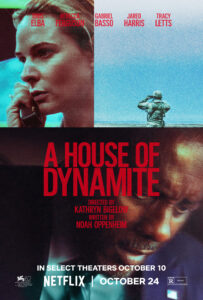
Until seeing A House of Dynamite, every 1950s science fiction film seemed silly to me. Giant ants, stiff aliens, and fire-breathing lizards? They’re the stuff of dated special effects and stilted animation. How many ways did audiences need to see something fall out of the sky or rise up from the earth to terrorize a small town? Then I couldn’t stop fidgeting through Kathryn Bigelow’s newest thriller, and all the Atomic Age metaphors clicked into place.
Unlike the monster and creature features of the 1950s, A House of Dynamite explicitly explores an impending nuclear disaster in real time. The major players across the government are scrambling for information from Situation Rooms, cars, helicopters, military bases, and anywhere else a device can patch into the conversation about a missile blasting toward American air space. No one knows who launched it, and no one knows its final destination.
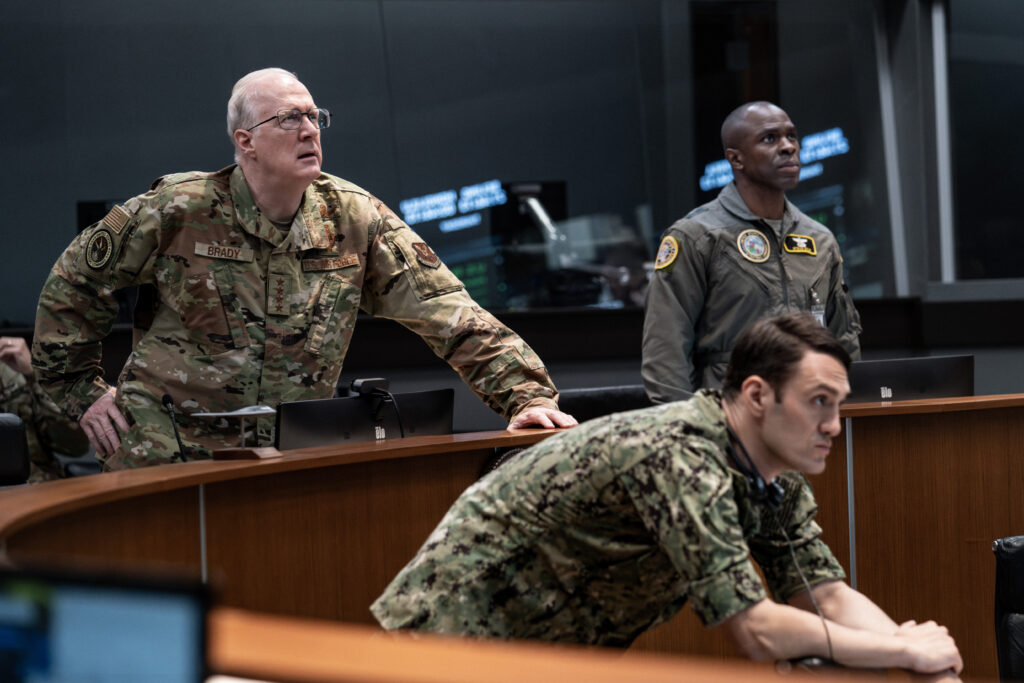
Leave it to a Best Director winner to figure out how to make a one giant video conference cinematic. A House of Dynamite drew a physical reaction out of me I almost never experience. Twitching my fingers, tapping my toes, bouncing in my seat—once the missile was identified, the agita never let up. The script combines the real-time plotting of 24 (without the one-man army named Jack Bauer) and the political problem-solving of The West Wing (minus its romanticism), losing none of the tension or acumen those Emmy-winning series were known for. I’m officially submitting another plea to Netflix to support longer theatrical runs for films that deserve it. This one should not be paused or watched with a phone in hand, and its sound should surround you.
More than those ‘00s TV dramas, A House of Dynamite takes inspiration from a pair of 1964 big screen dramas. You’re likely familiar with Stanley Kubrick’s farce Dr. Strangelove or: How I Learned to Stop Worrying and Love the Bomb. Its large ensemble (including multiple Peter Sellers) attempts to halt a nuclear explosion from across time zones, though they face incompetence and conniving at every turn. Dynamite owes more to Sidney Lumet’s sincerer take on impending doom, Fail Safe, which assumes its characters are at least qualified, if not sacrificially noble. Both run 112 minutes, jump between many of the same locations, and their characters spend a majority of their screen time on desperate phone calls. But Dynamite doesn’t retread all of the same territory Henry Fonda and Walter Matthau covered. Technology has changed so much in the last 60 years that Cold War leaders had longer to debate their course of action. Measures and countermeasures can be executed within seconds or minutes now, and we must consider more aggressors than just the Soviet Union.

This is where my newfound respect for the shrinking, snatching, and blobby creatures of the 1950s kicks in. Nuclear anxiety has depreciated in a post-USSR world, so when Turner Classic Movies hosts told this Millennial The Day the Earth Stood Still, It Came From Outer Space, and War of the Worlds were metaphors for atomic fears, Red Scares, and McCarthyism, I found myself wondering how much more they were motivated by studios looking to make a quick buck off of visual spectacles. Hollywood has never been accused of too much originality or risk-taking, and I’m used to modern audiences only wanting to visit the theater for spectacle. Then I spent the runtime of A House of Dynamite thinking about anything but nuclear weapons.
Bigelow’s work is made for audiences in the age of misinformation, Internet conspiracy theories, and artificial intelligence-powered bots. Negotiations aren’t as simple as a call between Washington and Moscow anymore because we can’t our identify our attackers or if they’re even human. Every member of the call—all experts in their field—debate the possible sources of this missile, and they all come with different perspectives on the best response. A general (Tracy Letts) pushes for preemptive strikes to prevent future attacks, while the Deputy Security Adviser (Gabriel Basso) advocates diplomacy to prevent starting wars with innocent countries. Even a literal playbook revealed at one point doesn’t provide a definitive solution. What everyone wants is more time to investigate, but that’s the one luxury no one has in this fast-moving world.

Dynamite does ask the same question many of those ’50s and ’60s movies did: Are we the architects of our own destruction? In the original Godzilla, a scientist accepts his own death as necessary to save the world from a dangerous discovery he’s made. In Them!, the oversized, carnivorous ants are the result of nuclear testing. In The Thing From Another World, the greatest liability at the Arctic base is a scientist who would rather study The Thing instead of kill it. Dr. Strangelove and Fail Safe blame our hubris. Is it a coincidence in the last two years Godzilla Minus One unexpectedly rocked the box office and Oppenheimer won Best Picture? Don’t forget Wes Anderson riffed on a twee alien invasion with Asteroid City, Mission: Impossible – The Final Reckoning raced to avert an AI-rooted nuclear winter, Leave the World Behind became 10 most-watched films on Netflix, and Civil War broke new ground for A24’s earning opportunities. Auteurs and audiences are both open to the possibility of disaster, and after 10 years in a row dominated by dumpster fire news, who can blame them?
There’s something poetic about mid-century moviegoers processing their global fears through invasions into their domestic lives while today’s viewers use large-scale adventures as allegory for domestic anxieties. Just as the ensemble in Dynamite can’t agree on the problem at hand, our culture can’t decide the reasons and/or appropriate action on school shootings, crime rates, pandemics, Big Tech, free speech, mental health, voting access, immigration, or budget cuts. Unlike many of us in 2025, though, these characters remain civil for most of their discussion. (President Idris Elba’s introduction on a basketball court evokes memories of Barack Obama, and First Lady Renée Elise Goldberry is styled similarly to Michelle Obama and on African safari just like the First Lady in 2011. Perhaps this means this film takes place outside of our moment.)

Like last year’s Civil War, Dynamite seems less interested in the indecision and conflict itself than how we handle it. (It’s no coincidence Greta Lee dials in from a Civil War reenactment.) This movie is a perfect example for the upcoming new Academy Award for Best Casting because no individual performer carries the weight of the film but any weak link could break underneath it. All represent reactions to a difficult situation: Jason Clarke’s natural leadership, Rebecca Ferguson’s hopeful calm, Letts’s need for control, Jared Harris’s dwindling patience, Moses Ingram’s guilt, Anthony Ramos’s despair. They keep this film from turning into a soulless plot machine, and even when underprepared, they are not the bumbling, weak collective of Dr. Strangelove, which is the kakistocracy many Americans expect from their government now. (Could casting a Hamilton reunion and the guy best known for playing J.D. Vance be commentary? That might be coincidence.)
In 70 years, this review may seem overwrought—in fact, I hope it does. Those 1950s genre flicks seemed silly to the granddaughter of a generation that never saw their darkest fears play out, and exploring worst case scenarios through fiction can prevent them from becoming real. The chilling Invasion of the Body Snatchers and sillier flicks like The Blob endure because they can be enjoyed as pure entertainment, even when trying to convince you 28-year-old Steve McQueen is in high school. A House of Dynamite can be enjoyed as a top-notch thriller, a feat of editing set to a restless score by Volker Bertelmann with a MacGuffin Mission: Impossible has proven never wears thin. But it’s one of the best movies of the year because that would be selling it short.