


Christopher Nolan Takes on His Most Epic Journey Yet
DIRECTOR: CHRISTOPHER NOLAN/2026

Note: This review contains mild spoilers for The Odyssey. Given Homer’s epic has been around something like 2700 years, we think it’s fair game!
Odysseus just wants to get home.
After a decade of war on the shores of Troy, he (Matt Damon) and his men have finally been released from the service of King Agamemnon (Benny Safdie), who waged war on behalf of his brother Menelaus (Jon Bernthal) when his wife Helen (Lupita Nyong’o) left with the Prince of Troy. But Odysseus and his men (including Himesh Patel and Andrew Howard) still face trials ahead. As their voyage is delayed by the gods and mythological creatures, his wife Penelope (Anne Hathaway) and son Telemachus (Tom Holland) learn to manage their island of Ithaca without him. Though she holds out for his return, with every passing year, her suitors press harder for her hand and Odysseus’s throne. He may never be able to return to the home he knew even if he survives the journey across the sea.
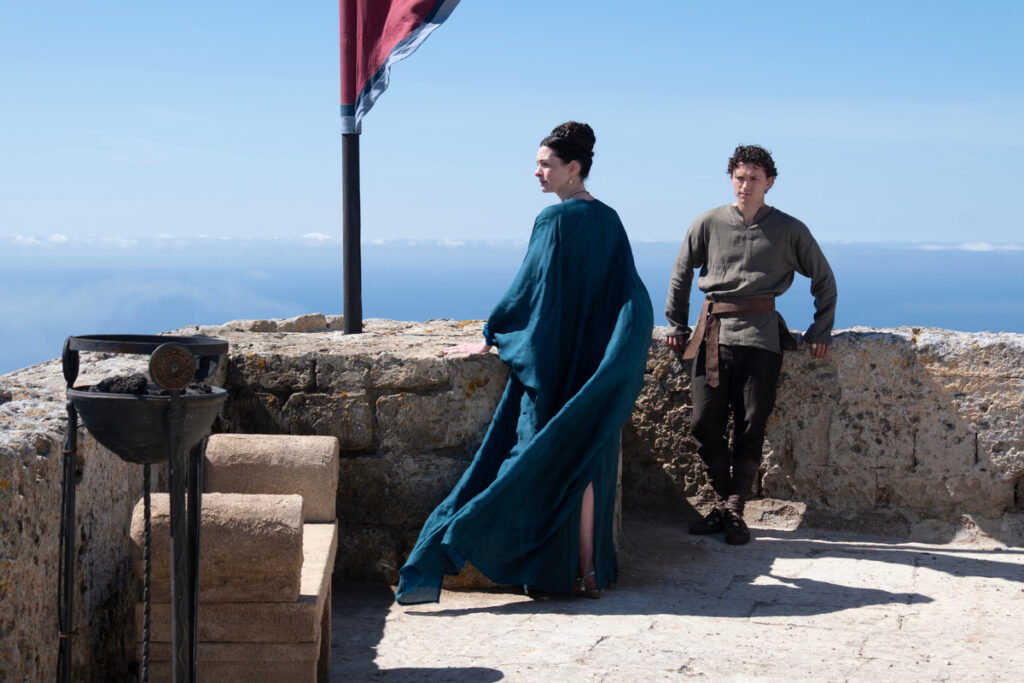
CLAIRE MEISCH: It is no exaggeration to say Greek mythology has bled deep into the heart of literature and art in Western culture. The sprawling tales and intricate history offers a fountain of material to inspire even the most casual creative soul. From Percy Jackson to Jason and the Argonauts to Troy to O Brother, Where Art Thou? (an equally fantastical adaptation of the same classic), there is an evident fascination held by the masses for the ancient mythos. So, it is no strange wonder that one of the goliaths of cinema would choose to tackle the enormous task of transferring one of the world’s oldest texts onto an IMAX screen. In typical Nolan fashion, Homer’s grandiose epic is spun into a story of vengeful gods, a crumbling civilization, violent wars, an endless sea, and one man’s journey to reach his final destination: home.
Coming in just under the three hour mark, The Odyssey still manages to sacrifice sections of the source material. To his credit, Nolan does an admirable job condensing this expansive work into something digestible to the average audience member. Perhaps the greatest feat accomplished by this film is the depictions of the perils Odysseus and his crew face on their voyage. The decision to utilize an oversized animatronic puppet to depict the Cyclops Polyphemus makes the giant appear even more otherworldly. The sheer volume of the creature is equally—if not more—alarming. The carnivorous whirlpool Charybdis and the multi-headed maneater Scylla are faceless horrors prowling just out of sight. A chilling scene involving the witch Circe (a scene-stealing Samantha Morton) practicing her magic on a collection of Odysseus’s soldiers offers strong evidence that Nolan should follow through with writing that horror movie of his.
In this land of magic and monsters, The Odyssey simultaneously functions on a more human-sized scale. Our fabled protagonist here bears an eerie similarity to Nolan’s last leading man. Both Oppenheimer and Odysseus are men molded by their experience with war and are therefore haunted by a looming legacy of death and destruction that they claim personal responsibility for. These mortals—Oppenheimer more so—have their name spoken in the same reverent breath as their culture’s respective gods. In Odysseus’s case, this perceived illusion of a grand, veteran war hero is systematically dissected as his journey progresses. Years of loss and desperation strip away the legend to reveal a lost soul struggling to reconcile his sense of honor with the bloody atrocities he has committed. As Odysseus begins his great trek back to Ithaca, one of Nolan’s odd trademarks rears its head. As a director and writer, he has carved out a clear niche for himself that can be traced back to his early Memento days. A centralized theme threaded neatly throughout his filmography is the oppressive weight of time. Whether it be the threat of endless years trapped in a malleable dreamscape in Inception or the tragic sacrifice of an entire lifetime for the sake of mankind in Interstellar, Nolan tends to assign precious value to the passage of time. Likewise, this ticking clock is often intrinsically connected to a desperate attempt to reach home. At this point in his career, Nolan is an expert at depicting the incurable psychological impact of the unstoppable slippage of time. It is the great threat looming over us all, and is the bittersweet pulsing heart of The Odyssey as the audience views the indomitable power of a nameless antagonist.

TAYLOR BLAKE: I won’t bury the lede: This is why we go to the movies! Christopher Nolan is on the short list of directors that inspire no anxiety when he announces a project—of course it will be good. The Odyssey is as ambitious as anything he’s put his mind to, and you’ve pinpointed how thematically in sync this is with the rest of his canon. With a host of familiar faces from his acting troupe, the highest level of craftsmanship in every department, and a time-hopping narrative structure, this is wholly Nolan.
However, I’d counter this and Oppenheimer are least like the rest of his filmography, and not just because of their historical scale and scope. He has explored themes of responsibility (Interstellar), legacy (Oppenheimer), maturing into manhood (Dunkirk), and the desire for home (Inception) before, but I don’t remember Bruce Wayne lecturing anyone on the value of hospitality. Every main character desires to be a hero (at least in their own mind), but Odysseus benchmarks his success with how guests are treated. As he crosses thresholds on Mediterranean islands and Penelope’s suitors abuse hers in his absence, conversation returns to Zeus’s Law: Treat guests as if they could be gods in disguise. In a mythological poem, this ancient Greek version of the Golden Rule (or perhaps, the Hebrews 13:2 rule) should be taken literally. But because of rumors of violent “Sea People” landing in neighboring communities, people are more suspicious than ever. The Odyssey isn’t just about hospitality—it’s about the collapse of the Social Contract. Fear leads to dehumanization and the dissolution of good faith in each other, and after too many chips at people’s trust, the Social Contract crumbles to ruins like the ones in Athens today. The Dark Knight films examined how terrorism inspires societal chaos, but here the stakes are more personal. Then it was the Joker vs. collective—now it is one neighbor against another.
Also new territory: an interest in the stories of women. Hathaway, Marion Cotillard, and Emily Blunt have delivered memorable performances for Nolan before, but his oeuvre is known for its dead wife energy. Not only are the wives living in this story, but between Circe’s bitter sorcery, Helen and Clytemnestra’s abuse from their husbands, and Penelope’s frustration with patriarchal rule, their plights are specific to their womanhood. Another larger theme of The Odyssey is that the winners write the history, and Circe’s loneliness, Helen’s scars, Clytemnestra’s heartbreak, and Penelope’s house arrest are the consequences of losing the narrative.

CLAIRE MEISCH: That is an excellent point about the dissolution of the domestic space. In this rapidly changing civilization, home and hearth are no longer synonymous with safety. Odysseus is not only a witness but a grand perpetrator of this crime against these sacred societal constructs. After all, it is his mind that conjures the conniving plot to lure the Trojans into welcoming their hidden swords behind the city walls that is the catalyst for this uncertainty. A city burns and civilians fall in the name of a victory won only by deception. As Odysseus stands among the wreckage, there is a looming sense that one man’s actions have altered the course of history. This distrust continues to seep into the narrative. When Telemachus visits Sparta and crosses the threshold of her great hall, we half expect Menelaus (Jon Bernthal) to slaughter the young prince at the dinner table. The imposing Agamemnon returns from Troy as a monumental war hero only to be slaughtered in his own bed by a vengeful wife, Clytemnestra (Nyong’o, playing twins). Odysseus and his soldiers maim the carnivorous Polyphemus as he slumbers by the warmth of his own fire. The palace of Ithaca deserted by her lost king is a rotting corpse being gradually feasted upon by invasive, predatory suitors. Neighbors turn into nightmares that lurk through the halls of the palace with hate in their hearts and a ravenous hunger for power in their eyes. “Fear thy neighbor” is rapidly becoming the newly established norm—as you stated—and violence substitutes for hospitality in these once civil lands.
You are also absolutely correct in acknowledging that The Odyssey is one of Nolan’s more formidable projects, and such a demanding film requires talent prepared for the challenge. Fresh from another well-deserved Oscar win, Ludwig Göransson resumes his partnership with Nolan to craft a score that drives the perilous journey along the lengthy run-time. Tasked by his director to forego the typical orchestra, Göransson leaned into the use of such historical Greek instruments as the bronze gong, flutes, and the lyre. The final result is a swelling, beautifully haunting soundtrack near certain to earn the composer further accolades. Key plot pieces are uniquely enhanced by the powerful music, most notably the alluring call of the siren song. Equally as transfixing is Odysseus’s descent into the underworld. The score swiftly turns bone-chillingly harmonic as shrouded spirits rise from the grave to burden the living with their grievances. It is a sequence that feels distinctly Macbethian, and one that solidifies the king of Ithaca’s grief and self-loathing as his fallen comrades prophesy of tragedies to come. The dead confront Odysseus with his weaknesses: He may no longer desire to return to the kingdom his men so long for.

TAYLOR BLAKE: Funnily enough, Macbeth came to my mind as well when Odysseus received prophecies about his future. (And the vision of Hades isn’t too far from the aesthetic of Joel Coen’s underrated Tragedy of Macbeth.) I’ll also echo your appreciation for the score. It’s not as relistenable as Oppenheimer’s, but it did hit a dopamine center in my brain when I realized the sound of Odysseus’s bow is worked into the soundtrack.
Speaking of craft, it’s worth mentioning the performances from both new and old members from Nolan’s troupe. (And weirdly, a recurring 2026 troupe co-starring in The Drama, Spider-Man: Brand New Day, and/or Dune: Part Three.) Among the new faces, Bernthal, Morton (aging up her Minority Report character), and Nyong’o prove Nolan and longtime casting director John Papsidera have a knack for finding actors who can make meals out of supporting parts until they find a leading part right for them. And it isn’t nice to discover Tom Holland is capable of literally something else besides Peter Parker? Among the returning troupe members, let’s not underrate the value of consistency. Damon’s march from Ithaca to and through Awards Season will be both a discussion of a guilt-ridden performance here and of a worthy lifetime achievement award. (He has an Oscar for writing Good Will Hunting, but his three Oscar nominations don’t cover his performances in The Talented Mr. Ripley, The Departed, Interstellar, The Last Duel, or Air. See what I mean about consistency?) As for supporting performances, the standout is Robert Pattinson’s suitor with the most punchable face, Antinuous. His combination of callousness and cowardice makes for a delightful villain, one whose sniveling reminds me of Alan Rickman’s Sheriff of Nottingham. Had he a mustache, it would be twirling every time it’s onscreen.
Perhaps the greatest compliment to pay this film is that it doesn’t feel it’s near-three hour runtime. This may be Odysseus’s terraqueous purgatory, but it is a thrill ride for us thanks to epic action presented with a finesse usually reserved for Ridley Scott. (My one nitpick is the IMAX cameras seem struggle with quick focus changes within a shot.) And even with so much emphasis on character, the personal connection is never lost in the large scale.