


Ridley Scott Returns With a Post-Apocalyptic Western
DIRECTOR: RIDLEY SCOTT/2026

Hig is all alone at the end of the world.
Well, technically, he isn’t living by himself. Hig (Jacob Elordi) maintains what’s left of a small airport with Bangley (Josh Brolin) as more of a fortress than a home. A pilot and mechanic before a pandemic wiped out a majority of the planet’s population, he flies into the ruins Denver for supplies as needed, while Bangley, a soldier, manages security. In their limited experience, other survivors tend to be violent, pillaging what they want by any means necessary. Hig’s only real companion is his dog Jasper, but he often wonders if he could find others like him if he’d just be willing to risk flying further into the mountains.
Though it’s based on Peter Heller’s novel from 2012, The Dog Stars feels tailored to our still-reeling-from-the-chaos-of-a-global-pandemic moment. Director Ridley Scott expands upon the book with the action-adventure he’s known for, but it’s restrained for the man whose last two features were Gladiator II and Napoleon. Some audiences may be disappointed that the action moments are fewer and shorter than the trailer would suggest. I argued in my Gladiator II review Scott is our greatest living director of battle sequences, but he’s working with a smaller scale here, its $80 million budget closer to the star-powered melodrama House of Gucci ($75 million) than epics like Napoleon ($200 million) or Gladiator II (at least $250 million). As you’d expect, the handful of action sequences are solid, and they culminate into a terrifying set piece that pays off the dread pulsing under the surface from the beginning.
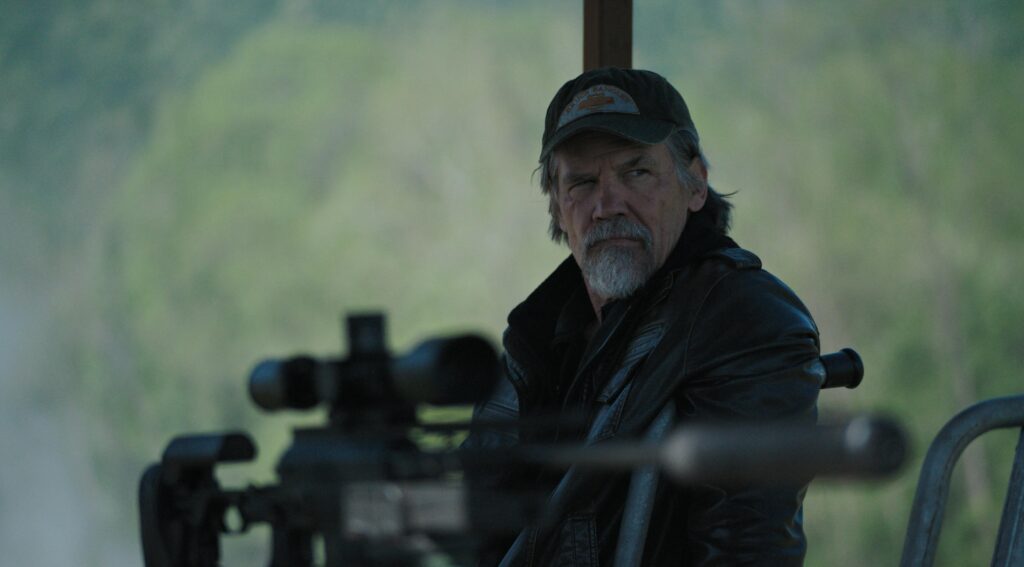
This post-apocalyptic leads with character, focusing on people afraid to trust again after tragedy. The script is graciously sparse in explaining what drained Denver of its Mile High glory and why many survivors (whom Bangley nicknames “Roaches”) cover themselves in cryptic tattoos. This isn’t a story like The Hunger Games, which sustains itself with complex dystopian scaffolding—this is a Western, where shootouts are a brief interruption from the scenic vistas and innovative homesteading. Bangley’s paranoia feels descended from John Wayne’s in The Searchers, while Hig’s hope for the future is a muted version of the optimism that fueled movies like How the West Was Won. Like every Western on some level, it’s contemplating how to build a society out of lawless dust.
That muted optimism does lead to an uncomfortable question: Are we sure Jacob Elordi has the juice? I haven’t watched a minute of Euphoria and couldn’t stand more than half of one Kissing Booth movie, so perhaps HBO and Netflix have provided him better showcases, but on a giant screen, he’s an energy vacuum: handsome, smoldering, and…just there. Sofia Coppola used this to great effect in Priscilla, his Elvis a beautiful but vacuous icon dulled by fame and addictions. Elsewhere, it comes off listless. Surrounded with romance clichés and other storytelling issues, his drifter in On Swift Horses came off dull, and his Heathcliff felt like he wandered in from another movie set. I’m half-convinced he earn his Oscar nomination for Frankenstein because of his willingness to sit 10 hours at a time in the makeup chair. About halfway through The Dog Stars, I started imagining other actors in his part—wouldn’t Austin Butler, Aaron Pierre, Glen Powell, Anthony Ramos, or Miles Teller have brought triple the charisma?

Then I was reminded of another actor: Ryan O’Neal. After his breakout as a heartthrob in 1970’s Love Story, he spent the decade a hot commodity better known for his handsomeness than his range. His good looks may have opened doors, but he kept them ajar with his good taste. He worked with Richard Attenborough, Blake Edwards, and Stanley Kubrick, and he became a muse for Peter Bogdanovich. Elordi seems to be using his heartthrob capital similarly, working with masters like Coppola, Scott, and Guillermo del Toro as well as divisive-but-skilled filmmakers like Emerald Fennell and Paul Schrader. We could do a lot worse than a buzzy young actor using his attention to get auteurs’ projects made, and there’s no reason to believe he couldn’t find more roles like Priscilla better suited to his subdued persona.
Unlike Hig, Elordi isn’t all alone. He’s surrounded by veterans with greater presence like Brolin and Guy Pearce, who can make meals (and warmth) out of their cantankerous supporting roles. Margaret Qualley and Benedict Wong also brighten any scene they’re in, though he most memorable scene stealer is Allison Janney, whose extended cameo ups the thrills and deepens the film’s ideas about community when her one-of-a-kind echo chamber is revealed. And in the hands of Scott, all of them come together into satisfying adventure, even if it’s a minor work in the career of the man who made Alien, Blade Runner, and Gladiator. (Oh, and Thelma & Louise and The Martian and…)