


Moving New Documentary Examines the Endangered Filmgoing Experience
DIRECTED BY RUSTIN THOMPSON/2026
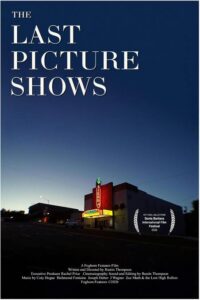
I have spent an embarrassing amount of time on Cinema Treasures. If you’re unfamiliar with the website, it’s essentially an enormous archive of movie theaters, both the ones that still exist and the ones that have disappeared. You can look up some theater you vaguely remember seeing a movie at 35 years ago and suddenly find yourself an hour later looking at photographs of a single-screen theater in a town you’ve never visited. So almost immediately, Rustin Thompson’s The Last Picture Shows felt like someone had made the movie version of Cinema Treasures. Then Cinema Treasures co-founder Ross Melnick actually showed up in the documentary and the website itself became part of the film, and I thought, OK, this movie has me.
And it did. In fact, The Last Picture Shows had me in tears for a surprising amount of its running time. Some of that is probably generational. I think people over 40 have a collective nostalgia for movie theaters that is difficult to explain to someone who has grown up with every movie ever made theoretically available without getting off the couch. Movies weren’t just something you watched. Going to the movies was something you did, and the place where you watched them was an essential part of the experience.
There is something even more beautiful to me about the small-town movie theater. Imagine living in
some isolated little town in America decades ago. There might not be an art museum. There might not
be a concert hall. You certainly didn’t have the entire history of recorded culture sitting inside your phone.
But you had a movie theater. You could walk down the street, through those doors and suddenly be
anywhere. Another country, another century, another planet. The movie theater was this strange little
haven in the middle of Americana that connected you to the rest of the world.
Those are the places Thompson is interested in, and some of the most powerful moments in The Last
Picture Shows consist of little more than watching them evaporate in front of us. Thompson traveled
more than 10,000 miles through ten states and visited 123 theaters while making the film. Some are still
operating. Some are abandoned. Some have become churches or businesses. Others have completely
disappeared. At times Thompson shows us a photograph of the theater that once stood in a particular
location and then lets it slowly disappear until we’re staring at the empty piece of land that replaced it.
Those moments destroyed me, and not entirely because they’re sad, although obviously they are. There
was something else happening to me while watching them. It was that strange mixture of memory and
grief you feel when you realize something that seemed permanent for most of your life wasn’t permanent
at all. We’re watching a part of American life that existed for more than a century quietly disappear, and
Thompson is smart enough not to overwhelm those images with explanations. Sometimes he just lets us
look.
Thankfully, The Last Picture Shows isn’t simply a feature-length exercise in mourning old movie theaters.
That probably would have worked on me anyway, but Thompson is after something much more
interesting. He wants to understand why this is happening, and that means moving beyond nostalgia and
getting into the economics and politics of modern theatrical exhibition.
Some of the answers are obvious. Streaming is part of it. COVID accelerated it. People’s habits have
changed. Attention spans have changed. Movies themselves are no longer as central to American
popular culture as they once were. We’re living in an attention economy where a movie isn’t simply
competing against another movie. It’s competing against Netflix, YouTube, TikTok, Instagram and the
phone vibrating in your pocket every 30 seconds.
But the documentary gets into something I found much more interesting, which is the uncomfortable role
the movie studios themselves play in all of this. If you follow the trades or spend enough time reading
about the film industry, you’ve probably encountered the increasingly simplistic narrative that there are
good companies that believe in theatrical exhibition and bad companies that want everything dumped
onto streaming. The Last Picture Shows makes that distinction much harder to accept.
One of the film’s most fascinating sections explains what happens when a small theater books one of the
giant studio movies it desperately needs. Say it’s the newest superhero movie. Everybody wants to see it
opening weekend, which is great for the theater. The problem is that the studio might require them to
keep playing it for three or four weeks. Three or four weeks is an eternity in the modern theatrical
landscape. By week three, almost everyone in town who wanted to see the movie may have already
seen it. By week four, the theater could be playing it to almost nobody.
A multiplex can survive that arrangement because it has ten or fifteen screens. It can shove the
month-old superhero movie into its smallest auditorium and put the newest release on the giant screen.
A single-screen theater doesn’t have that option. It has one screen, and if that screen is contractually
occupied by a movie nobody is showing up to see anymore, there isn’t another auditorium where it can
put something new.
This is where the whole “saving theatrical” conversation gets considerably messier. Even some of the
studios that publicly champion the theatrical experience are participating in a system that can make it
harder for actual theaters to survive. Of course the studio wants another week if there’s another dollar to
be made. They’re corporations, and maximizing the return on their product is what corporations do. But
maximizing the revenue of an individual movie and preserving the culture and infrastructure of
moviegoing are not necessarily the same thing. The people who get crushed between those two goals
are often the independent theater owners who can least afford it.
Those theater owners are the real heroes of The Last Picture Shows. Almost nobody Thompson meets
seems to be keeping one of these places alive because they’ve discovered an ingenious way to get rich
running a small-town movie theater in 2026. They’re doing it because they love movies. They love the
buildings. They love their communities. More than anything, they seem to believe that their town should
still have a movie theater, and they understand that once one of these places disappears, bringing it
back isn’t as easy as deciding five years later that maybe we made a mistake.
This is also what keeps Thompson’s film from becoming an obituary. For every theater that has become
a church, a restaurant or an empty lot, there is another one where somebody is still turning on the
marquee and opening the doors. After spending so much of the movie looking at the places we’ve
already lost, those surviving theaters start to feel almost miraculous.
Maybe I’m naive, but I don’t think it’s impossible that we eventually find our way back to them. I don’t
mean that moviegoing is suddenly going to become what it was in 1940. It won’t, and pretending that we can simply reverse history isn’t particularly useful. But I do wonder if there is eventually going to be a breaking point. Maybe we finally get sick of having 900 streaming services and somehow still having nothing to watch. Maybe we get tired of algorithms feeding us endless content. Maybe we get tired of social media destroying our attention spans. Maybe at some point we collectively remember that leaving the house and experiencing art with other people is actually pretty great.
There are already encouraging signs. Repertory screenings sell out. Younger audiences show up for old
movies. People get excited about seeing something projected on film. Independent theaters are finding
ways to make movies feel like events again instead of another rectangle you half-watch while scrolling
through another rectangle. Even Pope Leo XIV has recently talked about the importance of movie
theaters. When the Pope is telling us we need to save the movies, maybe we’ve reached the point where
we should listen.
So I came away from The Last Picture Shows incredibly sad, but not hopeless. The hope the film gave
me isn’t exactly optimism. It’s closer to a prayer that before enough of these places disappear, we
collectively hit reset and remember what was so great about them in the first place.
Because you can’t stream a movie theater. You can’t recreate the experience of walking underneath a
glowing marquee by adding another title to your watchlist. And you can’t replace the strange magic of
sitting in the dark with a room full of strangers, watching the same images flicker across a giant screen
and experiencing something together.
For more than a century, people in little towns across America could walk into a building on Main Street
and, for a couple of hours, be transported to the rest of the world. Some of those buildings are still there.
Somebody is still unlocking the doors, turning on the projector and fighting to keep the lights on. The Last
Picture Shows is ultimately about those people, and they’re holding those doors open for the rest of us.
I hope to God we come through for them, and I hope we come through for the movies.