


Hollywood’s Bygone 1930s Blonde Bombshell Boldly Lives on

Welcome to one of my favorite parts of writing for ZekeFilm: Film Admissions! My colleagues are always expanding my film horizons, but there’s something special about digging into a pocket of film history together. Thanks to this project, I discovered how much I love the work of Steven Soderbergh. Our Bill Murray Film Admissions led me to Lost in Translation, which led to Sofia Coppola becoming one of my all-time favorite filmmakers. Our Musicals feature introduced me to the magic of A Star Is Born, the features of George Cukor made me want to see every Katharine Hepburn feature, and did digging into Revisionist Westerns make me fall in love with Paul Newman? (Actually, I’m not sure Film Admissions can take credit for that last one—I’m pretty sure I’d be crushing on Paul Newman no matter what.) The biggest revelation came when we dug into the filmography of Howard Hawks. Since watching Bringing Up Baby for the first time, I can’t stop watching 1930s screwball comedies! Zany, class-conscious, and often romantic, Hollywood’s early comedies endure because they set the template for Hollywood’s future. And one of this genre’s biggest stars? Jean Harlow.
Harlow wasn’t the first blonde movie star. Marion Davies and Marlene Dietrich came before her, and her co-star in The Public Enemy Joan Blondell broke out about the same time. But Turner Classic Movies host Robert Osborne captured her moment in the zeitgeist best: “Harlow did have first-time bragging rights on one thing: she was the first in what became a long line of platinum blonde bombshells who have added sizzle, sensuality and sassiness to the film medium ever since…Before Harlow, vamps and seductresses always tended to be sloe-eyed, exotic, slinky and, 99 percent of the time, dark-haired. Not Harlow. She was numero uno to become a major star by being bold, brassy and determinedly blonde.” All due respect to Osborne (and the point he’s trying to make), but “vamp” and “seductress” are too reductive of her talents. Though she was best known for her comedies, she appeared in war, crime, musical, adventure, and romance movies. She also transitioned just fine into the Hays Code era, which didn’t work for every actress who dallied with vamp/seductress archetype (see: fellow blonde Mae West).

Though her career took off like a supernova in the 1930s, her star doesn’t shine as brightly a century later. Her most-logged movie on Letterboxd (1932’s Scarface, in which she plays a very supporting part) has only been logged 85,000 times. I flipped through a few film reference books I have on hand, and she’s only mentioned in passing. Is it possible her last moment of cultural caché was her namecheck in Madonna’s “Vogue” in 1990? In 2026, the term “blonde bombshell” is more likely to make you think of a different movie star: Marilyn Monroe. As every media outlet, TCM, and the Academy Museum celebrate what would’ve been Monroe’s 100th birthday this year, I find myself wondering why Harlow isn’t as celebrated. They both appeared in just over 30 films, the most memorable of which were romantic comedies. Their young, unexpected deaths both led to conspiracy theories. Could the 25 years between their deaths be the only thing relegating Harlow to her less potent immortality? We’ve lost almost everyone who would remember her fame firsthand. But we wouldn’t have the legend of Marilyn without the lore of Jean—this month’s Film Admissions is here to introduce you to just the beginning of it.
– Taylor Blake
Red-Headed Woman
Directed by Jack Conway /1932
by Justin Mory


“So gentlemen prefer blondes, do they? Yes, they do.”
“Like Hell!” gets closer to Jean Harlow as Lil “Red” Andrews’ sarcastic self-rejoinder to her own opening rhetorical, which many might recognize as an obvious in-joke for famed screenwriter Anita Loos, who wrote the 1925 comic novel Gentleman Prefer Blondes and its 1927 sequel But Gentleman Marry Brunettes, here covering yet another hair-color in adapting Katharine Brush’s scandalous 1931 novel. The role that really established Harlow’s brash movie persona over the next five years of scintillating yet strangely sympathetic screen-vamping, Harlow trades her established Platinum Blonde (1931) for the eventual Bombshell (1933) she would quickly become, the title dye-job bringing the ultimate scarlet lady to the screen, who nevertheless remains unusually admirable despite or perhaps because of her title-character’s forthright sexuality and lack of conventional morality. Making Red-Headed Woman even more successful as counter-narrative in 2026 than it ever played in 1932, possibly.
Ambitious working girl “Red” (Harlow) is shown arming for battle past the opening credit-lyrics of her own tinny-crooned song, with her dyed hair steam-pressed, see-through gown form-melded, and cameo-photo of Renwood, Ohio’s young heir to its coal-mining wealth garter thigh-strapped. Yes, William “Bill” Legendre Jr. (Chester Morris) may be happily married, but an attractive blonde with excellent manners and good breeding (Leila Hyams) is hardly a match for Red’s more shall we say direct appeal to the unacknowledged preferences of red-blooded male sportsmen. Cutting a romantic swath through the upper crust and leaving a sexually-vanquished trail of victims in her red-curling wake, which comes to include Bill’s father’s “upright” business partner (Henry Stephenson) and several chauffeurs (including Charles Boyer in a pre-stardom role), the high society forces for local morality and the public good ultimately do succeed in repelling rapacious Red from their midst, but a two years-later coda at the horse-races in Paris suggests the Red-Headed Woman may have ultimately succeeded in reducing the male population to sugar daddies and obliging chauffeurs on a more international scale.
“Pre-code” to the nth degree, this 1932 MGM film certainly revels in screen naughtiness even as the Damocles Sword of the Hays Code hovers ominously above, whose strict enforcement a mere year or two later further cut a very fast-paced film that was already only 80 minutes to begin with. Rarely exhibited in its complete form after its original run, Red-Headed Woman resurfaced three decades or so after its star’s untimely death to shock and delight once more, bringing among much else composer Richard A. Whiting and lyricist Raymond B. Egan’s jazzy title-song, with immortal lines like “the doctors say that her only sin/was just too many vitamins”, to fuller appreciation and vivid evocation of Jean Harlow’s undiminished talents. Blonde, brunette, or red, she remains an irresistible headed-woman in any hair color.
The Public Enemy
Directed by William A. Wellman / 1931
by Erik Yates
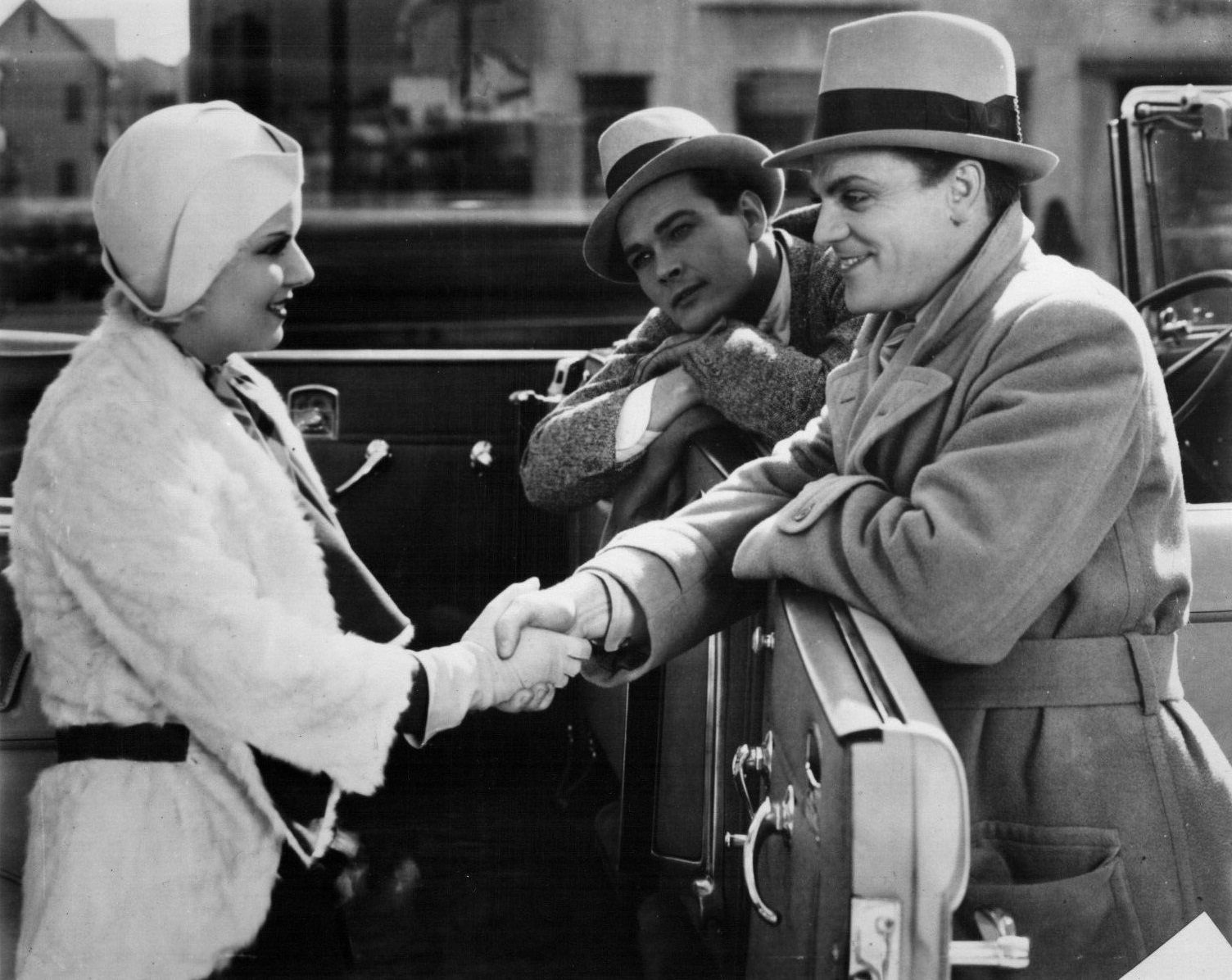

The Public Enemy is a Jean Harlow picture that I must admit I had yet to see until this Film Admission piece. Not only does she appear in the film, but this is also a classic gangster film that you can easily see the foundations of all future gangster pictures to come. James Cagney’s approach to criminal Tom Powers was seen all over the cinematic landscape of wise guys everywhere…even just those trying to act tough. From Nick, the bartender in Jimmy Stewart’s It’s a Wonderful LIfe, who models this type of persona when he offers to “slip you my left for a convincer…” in George Bailey’s alternate reality, to Bugs Bunny who adopted Cagney’s (and Edward G. Robinson) delivery in several cartoon episodes, even losing an Academy Award to Cagney in “What’s Cookin’ Doc?” (1944). This is even funnier knowing that Warner Bros. Animation was doing this to poke fun at Warner Brother’s biggest live-action star at the time.
While Jean Harlow only appears for less than ten minutes in The Public Enemy and doesn’t make her first appearance until nearly 40 minutes into the film, she still received 2nd billing for her effort. Warner Brothers had to pay a premium to Howard Hughes, who had her under contract, to get her into the film to take advantage of her exploding popularity due to her role in Hughes’ Hell’s Angels (1930). Cagney was an unknown commodity at the time and Warner Bros.’ desire to sell tickets meant that Harlow had to be in the picture to take advantage of her Hughes’ coined “platinum blonde“ bombshell status.
While she developed her iconic, snappy timing after moving to MGM a couple of years later, this performance was largely panned. In The Public Enemy, Harlow plays Gwen Allen, a wealthy, high-society woman who is willing to slum it to run around with the bad-boy gangster Cagney is playing. Despite this criticism at the time, I found her to be a magnetic personality that stole the few scenes she appeared in. I can see why Warner Brothers was so eager to have her appear in this picture, even if only for a few minutes of screen time. Her performance is also famous for her lounging around in the scenes with Cagney wearing bra-less silk pajamas which would help eventually push Hollywood to adopt strict censorship rules later.
While The Public Enemy was an example of her early star power that helped push a film to box office success, it’s crazy to read that she only had 6 more years left in her life, dying in 1937 at age 26. While The Public Enemy is a groundbreaking and foundational gangster film, Harlow’s brief appearance is clearly foundational for other actresses who lit up the screen and faded away just as quickly…namely Marilyn Monroe. While her star burned out too quickly, Jean Harlow burned brightly while she was there.
Saratoga
Directed by Jack Conway / 1937
by Max Foizey

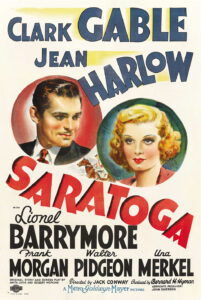
Carol (Jean Harlow) is the orphaned daughter of the owner of Brookvale, a horse farm now run by her Grandpa (Lionel Barrymore). This farm has produced many champion racehorses over the years. The horses all have great names, such as Blue Bolt, Dawn Boy, and Miracle Lad. Carol has just come back to the United States after some time in England, bringing with her a fiance named Hartley (Walter Pidgeon). Hartley is quite well off, and he loves to gamble. This is music to the ears of the local bookmaker, Duke (Clark Gable).
Duke is friendly with everyone he meets, a jovial man who has a habit of teasingly telling people he loves them. “Grandpa, I Love you.” “Carol, I love you.” and, notably for the era, “Rosetta, I love you,” directed at a character played by the trailblazing Hattie McDaniel. The film becomes a battle of betting wits between Duke and Hartley, with Harlow stuck in the middle. It gets a little convoluted as far as who is betting on what and for how much, but it’s an interesting story in that there are no real villains here, just friendly rivals looking to make a fast buck. The horseracing scenes are well done, with impressive cinematography by Ray June.
Much of the humor in Anita Loos and Robert Hopkins’ breezy screenplay is solidly era-specific.There are two song and dance numbers that are excruciating and would never make the cut these days. Keep an eye out for Margaret Hamilton, the Wicked Witch of the West herself, in a memorable cameo. Nearly everyone in this film is a fast talker on the take, none more so than Duke. Gable is perfect for the role, not breaking a sweat as he rattles off lines like “I’m not going to have the frost put on me by a filly who romped out of Saratoga with clover on her heels and finished up with a bad case of swell-head.”
The stoic Walter Pidgeon makes for a nice contrast to Gable’s smug demeanor, and Jean Harlow is the perfect foil for both. To this day, nobody in movies looks like Harlow and few have equaled her screen presence. Tragically, Harlow died while making Saratoga. The film was completed using a stand-in and an overdubbed voice. The stand-in scenes are easy to spot, and add an air of melancholy to an otherwise upbeat film. As far as last pictures go, it’s not a very memorable swan song for Harlow, but her performance is confident and engaging and it does make one sad that she passed away at such a young age when there were undoubtedly greater artistic achievements yet to come her way.
Dinner at Eight
Directed by George Cukor / 1933
by Robert Hornak
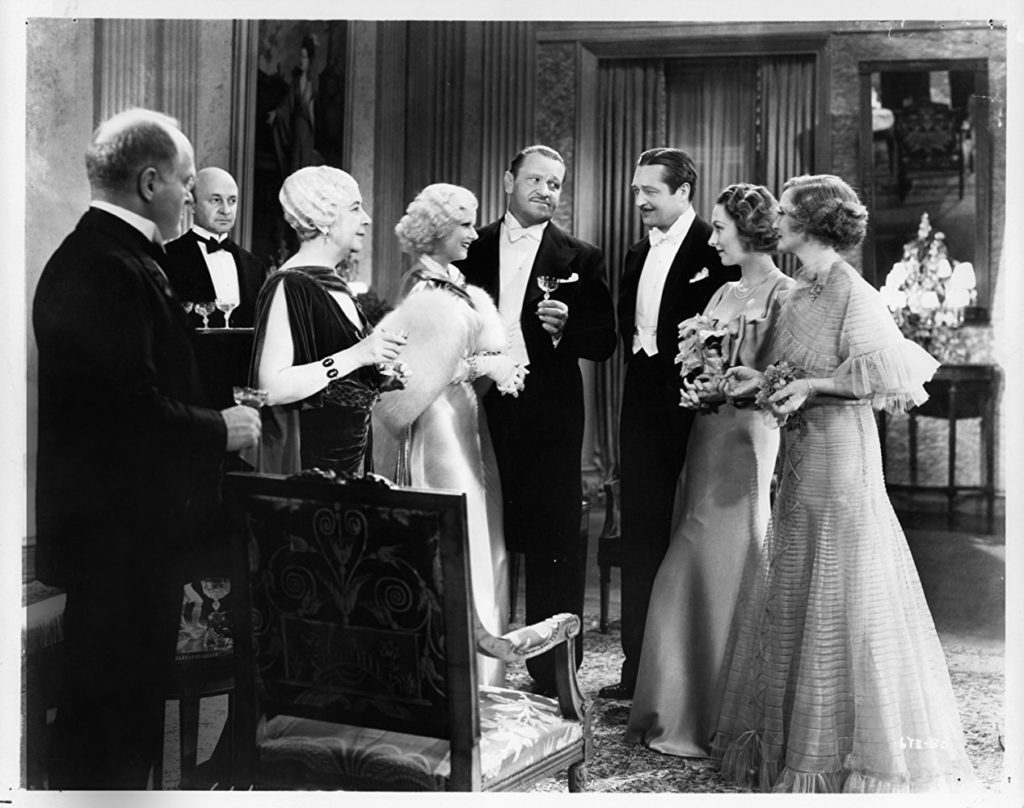
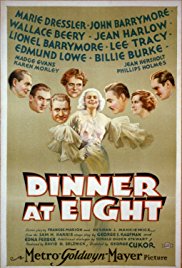
Another one I put off for some reason, despite its constant sashaying toward the top of comedy lists from the era – only to learn it’s a heckuva stretch to call it a comedy at all. The felt cultural memory of this movie, to me anyway, has it freewheeling satirically toward a comic blow-out at a gala, all-star dinner where, in my lifelong imagination, dessert gets thrown cross-table alongside Groucho-esque bon mots. But we never get to the dinner. Instead it’s a slowly intertwining set of rather dark relationships from broad to tragic, plodding roundabout toward a gathering we never really see, like Moses gate-kept just outside the Promised Land.
It’s 1933 and we’re in the first long blush of the Great Depression, where relics of the old, east coast way of life all gloat through their jowls over their former youths dappled in entitled success, spending their screen time vying for each other’s attention, cash, time, or any other commodity to soothe their abject fear of failure. The twin heads of fading art and belly-up commerce are initially repped by aging actress Carlotta Vance (Marie Dressler) and share-hemorrhaging shipping magnate Oliver Jordan (Lionel Barrymore), joined at the emotional hip in conversations that bely a deeper purpose to whatever is to come – is it to be graying nostalgia or a farcical satire of the vapid and deluded? We get a bit of both as we hear Carlotta periodically but intentionally drop down her rafter-smacking mid-Atlantic accent – the fake upper-crust lilt that’s the vocal mask of the insecure in the newish, steamrolling flicker-show reality of sound technology – as often as Jordan drops down into a chair with portentous heart palpitations, both creakily groping for any hint that their gravy train’s still on the track.
Meanwhile, another aging actor, Larry Renault (John Barrymore), a progressively drunk stage actor, paces his cage/hotel room awaiting news of his next big role and gets routinely sized down scene-to-scene by everyone from his not-so-longsuffering agent to his side-eyed bellboy of choice, he who sneaks in his hourly shipment of hooch. Renault is a drunk whose career is sunk, a brave role for Barrymore, never not fun to watch, but who could’ve ad-libbed this part from his own diary. For awhile it’s fascinating to think of the Barrymore brothers, who never share a scene in the movie, each playing characters lurching toward eventual death inside their self-imposed traps, an almost self-contained epitaph for the glorious silent era they both only recently epitomized.
If it’s not immediately obvious that the movie’s about class conflict, then the scales finally fall off about halfway through. Our lady of the highfalutin house, Millicent Jordan (chirpy Billie Burke), gripes ad nauseam about having to invite Dan and Kitty Packard (Wallace Beery and our lady of the month Jean Harlow): Dan’s a brutal lout making a play for buying up all the Jordan stock, with eyes on parlaying his wealth into a cabinet position with FDR – he’s a new breed of cut-throat businessman who behaves like a wrestler, as it were, toward the more elegant robber baron class – while Harlow’s Kitty is his pampered, scheming wife, who he found “behind the tracks in Passaic”, and clearly meant to be seen as his own household lesser to be boxed around the ring like an emotional scapegoat, a dynamic she’s more than willing to slash with a sharp “Nerts!” So we’re already three deep in the strata of the various “haves” – the Jordans (ensconced old money), Dan (wanna-be schemer from the lower ranks), and Kitty (scrappy tagalong from nowhere with no claim to wealth but what her husband steals). But then, as if we haven’t drawn the picture of perverse upward mobility from low enough vantages, Kitty is blackmailed over her affair with her doctor by her even lower-stationed maid for the price of a diamond bracelet.
Side note, but the maid, a small part, seemingly included just to make a point, is played by the generally unknown Hilda Vaughn, a regular MGM bit player, who for my money has the only believable, non-actorly presence in the movie – rolling up to her very few scenes with the weird vampiric danger of a Classical era Timothy Carey. Her menace is a thread the movie sadly drops almost immediately.
This is my first Harlow movie, so I can’t judge her against anything but what she does with what she’s given here. It’s not a disservice to her efforts to say that at least she doesn’t disappear in the swell of big names surrounding her. And if there’s any claim on this being a comedy, it rests on Harlow’s ability to channel wiseass street smarts through the deco-addled elegance of her white sequined robe, backless satin dress, and what can best be described as giant, feathery pompoms – and with her platinum blonde skull shimmering like a photo negative of Betty Boop, her angrier moments give every impression of a human electricity ball. Her deliberately poverty-bent accent throughout her long screaming matches with Dan brings the biggest humor of the movie when she later tries, seemingly without a nod from the rest, to affect the upper-crust mid-Atlantic lilt of her social superiors. Again, this aspect of the movie (Kitty’s awkward attempts to fit in) are not followed through to the end, so Harlow’s efforts are ultimately wasted.
This is an early one by eventual great George Cukor, who we can see probing his gift for comedy in scattered sections, but the mix of comic ingredients separates in the jar from the extremely stark stuff like heart attacks, infidelity, financial ruin, and suicide. What it does is remind us that the giftedness that later gave us the sparkling serio-comedy of The Philadelphia Story, Holiday, Born Yesterday, and a couple of Hepburn-Tracy joints had to chew its teeth on something. Dinner at Eight also points to the future refinement of a kind of sub-genre that mixes heavy personal pain with comedy that includes The Apartment, Terms of Endearment, Silver Linings Playbook, and anything else that tries to manage dark and light in a way that also deeply entertains by employing eternally charming actors, providing the dubious service of making heartbreak and loss seem almost appealing.
The Girl from Missouri
Directed by Jack Conway / 1934

by Jim Tudor

In all my years of living in the state, I’ve met an awful lot of girls from Missouri. But never once did I meet one like Eadie Chapman. As played by burning blonde 1930s superstar Jean Harlow, Ms. Chapman immediately plots a course out of the show-me state for good (and, good on her for that) and into marriage with… any man who’s “making something of himself.” (Not so good on her for that). Is our gal nothing but a (gasp!) gold digger? Well, not exactly. You see, this film goes out of its way to demonstrate that Eadie, though a sexy showgirl of the stage she is, is completely on the up-and-up in her laser-focus quest of netting a rich man.
For the sake of obvious contrast, the film pairs Eadie with best friend Kitty (Patsy Kelly), a single-minded man-happy brunette who’s entire existence revolves around gettin’ herself some you-know-what. But despite Eadie’s rigid virtue, she has a rough go of things. Her first wealthy prospect promptly offs himself right after proposing to her, but not before gifting her his fancy cufflinks. If you think that this sounds like a recipe for major homicide investigation troubles, you’d be correct- but not until much later in this fair-to-middling movie. Can this midwestern girl beat the false murder rap and land the man of her dreams prospects?
Harlow is a fascinating presence here insofar as her character oscillates between frigidly sexless and grossly opportunistic in her quest to “marry up”. Director Jack Conway infuses as much energy as possible into this with swish pans and lively camera work, and Franchot Tone puts his thousand-megawatt smile to work as scheming Lionel Barrymore’s son who’s understandably hot and cold towards Eadie, depending on what plot she’s currently hatching. But compared to so many better Harlow star vehicles, this one struggles to go much of anywhere.
Bombshell
Directed by Victor Fleming / 1933
by Taylor Blake
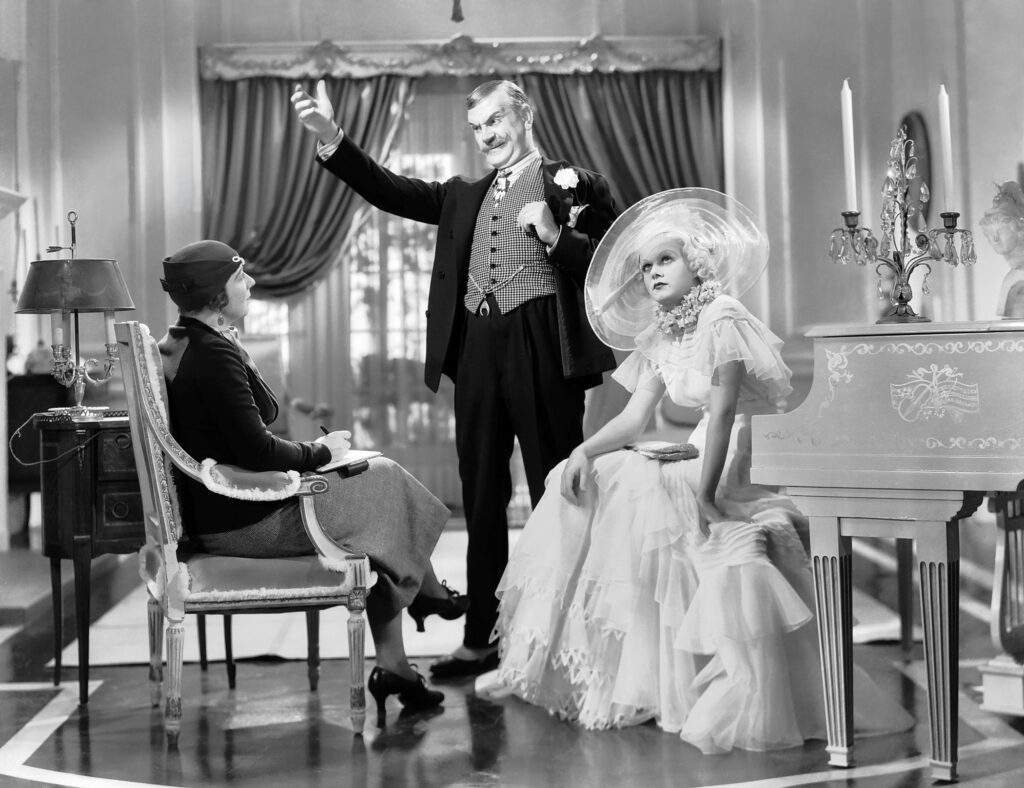

The life of a movie star may be hell for Lola Burns, but it’s a pleasure for us.
The satire Bombshell sends up not just Jean Harlow’s career, but every movie star’s at the dawn of Hollywood. Lola (Harlow) is surrounded by an entourage of fluffy dogs, a cavalcade of rumors, and a menagerie of staff, family, and press who can find a way to hang on to her gilded cage. She must reshoot a film to fit the new Hays Code (also titled Red Dust like the 1932 drama Harlow co-starred in with Clark Gable), negotiate between feuding paramours, and go through an acute beauty regimen to look fabulous through it all. Champagne problems? Sure—too bad this is the time of Prohibition.
Bombshell feels like reading a 1930s tabloid filled with petty scandal, and in the hands of Harlow, a group of solid character actors, and director Victor Fleming, it’s the juiciest and most hilarious gossip. If you feel any sympathy for Lola, give it just a minute—she’ll undermine it with one of her flights of fancy. She’s as gullible as she is pliable, and her diva tendencies make her dependent on the handlers who take advantage of her. Since no injury lasts longer than it would in a Looney Tunes short, you’ll only laugh at her misfortunes, but it also makes it satisfying when she finally gets wise and tells off her suite of self-serving managers.
Harlow can’t take credit for originating “dumb blonde” stereotypes, but this ditzy performance certainly continued it. Bombshell isn’t the first movie to make fun of its own industry, but it models a forever template still in play as recently as last year’s Jay Kelly. Though Harlow’s self-parody Lola is the epitome of 1930s glamour, this take on the lives of the rich and famous is still timeless.