


Watch us Move Through our Animated Movie Selections

Some say, and not without confidence, that all movies are animation when it comes right down to it. Scientifically speaking, when persistence of vision and the phi phenomenon meet and fall in love, something special can be the result. Something… moving. One frame with an image on it, another frame with the same image but slightly progressed image on it. Then a third, the same but slightly progressed yet again. This, twenty-four times. Per second. Whether we’re talking about digitally captured images or conventional celluloid film stock, twenty-four frames per second is the agreed-upon rate at which consecutively played-back images take on lifelike fluidity. Said images can be photographed, drawn, rendered in 3-D virtual space, or realized however you like. It is, in fact, all animation. Take several such corresponding image sequences and cut them together in an intuitive fashion, and then you’re really going places. That’s filmmaking. It only expands from there.

Thankfully, none of our participating contributors for this month’s ZekeFilm Film Admissions theme of “Animation April” opted be a weisenheimer and try to get a live-action entry into this mix by this rationale. Half of their write-up would have to be the above ramblings. No, what we’ve got are our particular group of articulate film lovers articulating something about a movie that is animated, per the conventional understanding of the word. For many, it’s a first-time watch. For me, it’s a musing over a film I’ve had a significant journey with. Whatever the case, we’ve all found something to get a bit animated about. For all, it’s something significant. Below are our individual takeaways from our selected animated films- films from all over the world and of differing sensibilities. Because, in the hallowed words of Guillermo del Toro, animation is a medium, not a genre.
– Jim Tudor
The Hunchback of Notre Dame
DIRECTED BY GARY TROUSDALE AND KIRK WISE / 1996
by Claire Meisch


To say that I grew up with limited exposure to the classics of Disney filmography is being quite generous. Majority of my childhood was spent rewatching Tarzan, The Little Mermaid, and The Lion King on a dull monotonous loop. It goes without saying that I have had an abundance of ground to cover in my adulthood – typically encouraged along by close friends astonished that I could possibly be so uncultured in this area. The Hunchback of Notre Dame has sat perched at the top of this list for far too long now, which makes this the perfect opportunity to dive into this peculiar addition to the proverbial mouse’s extensive library.
It seems ludicrous now that Disney once had the creative pluckiness to adapt an 18th century French novel about the complexities of faith into an animated feature for children. A heavily censored, watered-down version of Victor Hugo’s sprawling work, Hunchback of Notre Dame is not particularly faithful as adaptations go. Loosely using the structure and subjects within Hugo’s classic work, director duo Gary Trousdale and Kirk Wise work their magic to turn a dark tale of obsession and oppression into a family friendly affair. In their interpretation, the deformed Quasimodo (Tom Hulce) is a gentle soul who has spent the entirety of his isolated life with the bell towers of Notre Dame. His only human contact is by his pseudo-father figure Judge Claude Frollo (Tony Jay), who is quick with his abuse and treats his ward as a slave. Encouraged by the lively preparations for the Festival of Fools, Quasimodo emerges from his seclusion. His decision places him in the path of the Romani woman, Esmerelda (Demi Moore), and this chance encounter shapes their fate permanently.
Even after delicately replacing the original gruesome murder with singing gargoyles, there is still plenty of reason to understand why Hunchback of Notre Dame is widely considered one of Disney’s more adult projects. The themes addressed are assuredly more mature than your average Sleeping Beauty princess flick: genocide, sin, social injustice, lust, and prejudice to name only a few. A majority of the questionable material here revolves around the character of Frollo, who is an especially heinous villain by Disney standards. His internal struggle over his lustful feelings towards Esmeralda defines the relationship between the two characters. Their scenes are more sexually charged than should be acceptable in any material marketed towards children, which could make for an understandably uncomfortable watch for most parents.
The charming soundtrack does an admirable job to assist the film’s G rating. With the phenomenal professional coupling of composer Alan Menken and lyricist Stephen Schwartz, there is a delightful array of impressive tunes. We have the enthusiastic opening ensemble number (“The Bells of Notre Dame”), a rousing ballad for our kind-hearted hero (“Out There”), an absurdly spine-chillingly villainous solo (“Hellfire”), and a quick rendition to neatly tie it all together (“The Bells of Notre Dame (Reprise)”). It is all quite formulaic, but why change the recipe when the final product is so routinely delightful? Like all Disney films of this era and before, there is a unique Broadway-level quality to the music that seems to be lacking in the modern age.
The late 90s animation itself is undoubtedly dated, but the material has a timeless relevance. The themes of social isolation and positive portrayal of the outcasts of society are typical of films in this vein. Nonetheless, there is an immortal sort of importance to Quasimodo’s quest to find acceptance without entirely changing his own person. The Gothic imagery and repetitive use of religious iconography does make The Hunchback of Notre Dame stand apart in the substantial catalogue of animated Disney features. Of course, this only adds to the argument that this is one of the studio’s more adult projects. Throw in a bit of commentary on the unquantifiable personal and cultural effects of Catholicism, and you have yourself the recipe for child’s film that stretches the parental guidelines nearly past breaking.
A Town Called Panic
DIRECTED BY STÉPHANE AUBIER AND VINCENT PATAR / 2009
by Sharon Autenrieth


I love A Town Called Panic (2009) and yet I find it hard that love hard to articulate. The heart has its reasons and all that, but I’ll really try to explain why I am so thoroughly captivated by this absolute wackjob of a movie.
Let’s start with the is-ness of A Town Called Panic. It is a Belgian feature length adaptation of a stop motion TV series about plastic toys. If you immediately think of Toy Story, you’re not all wrong, particularly if you remember the plastic army men in that movie. Most of the main characters in A Town Called Panic (Cowboy, Indian, Postman, Policeman) hop/shuffle through life on molded plastic stands. But these stop motion figures lack the fluidity of computer animated toys. And yet! That’s a major source of this movie’s charm. Directors Stéphane Aubier and Vincent Patar used limited animation, usually associated with low budget, rapidly produced projects, to create the jerky, frenetic look of A Town Called Panic. It’s planned chaos, and the visual effect matches the film’s plot, which is mayhem. It starts simply enough: Horse is enjoying a peaceful birthday – a shower, reading the newspaper, receiving a birthday card from a friend. But that card reminds Cowboy and Indian that they haven’t gotten Horse a birthday gifts and sends them into a panic (there is a lot of panic in this movie, hence the title). They impetuously decide to build Horse a barbecue spit as a gift. The mishaps begin with an order of 50 bricks for the spit that turns into 50 million. You’d think that would be enough of a crisis, but trust me – it’s only the beginning.
A Town Called Panic is both witty and absurd. The characters, whose faces are fixed and whose movements are limited, are still delightfully distinct. Horse is essentially the parent figure to Indian and Cowboy, and while he gets exasperated with their bickering and troublemaking and occasionally kicks them hard enough to launch them through walls, he never stays upset with them for long. My favorite supporting character is Steven, the farmer who lives next door and is always, I mean always, shouting. Steven lives with his wife Janine and a farm full of animals who attend music classes, taught by another horse who is, perhaps surprisingly, not named Horse. She is, instead, Madame Longrey, and she has a flowing mane of red hair. Horse finds her irresistible and tries to impress her by playing the piano. It is, Madame Longrey tells him directly, a disaster. The solution is for Horse to take piano lessons from Madame Longrey, but the cascading crises in the movie require Horse to beg off class over the phone, in increasingly absurd circumstances.
The rules of physics don’t mean much in A Town Called Panic. Flattened furniture can be reinflated as easily as a beach ball. Proportion doesn’t matter much, either. Indian is significantly taller than Cowboy, and Janine is a larger scale toy than Steven – but Steven eats a breakfast of human sized toast and jam, and drinks coffee in a way that may explain why he is always shouting.
I have to mention that I think hearing these characters in French makes the movie funnier, not because French is a funny language, but because it is a beautiful language being used in a very silly way. For years after my family saw this movie, yelling “Cheval!” (that’s Horse in French, fellow rubes) was an inside joke among us.
A Town Called Panic has mystery, monsters, mad scientists, and a giant robot penguin. It takes Cowboy, Indian and Horse to an undersea world, the arctic, and back to the homey village they share with their friends. The narrative doesn’t really hold together, and it leaves me with a lot of questions – or would, if I wasn’t content to just let it happen. But A Town Called Panic is such a funny, unpredictable, unique trip – who wouldn’t want to go along for the ride?
Ghost in the Shell
Directed by Mamoru Oshii / Japanese / 1995
by Max Foizey

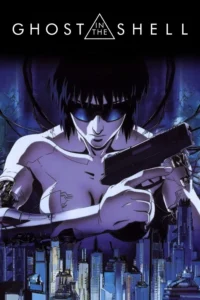
Kazunori Itō’s screenplay, based on Masamune Shirow’s 1989 manga of the same name, tells a story about identity, conciousness, and purpose, set in the year 2029 in the fictional New Port City. Most everyone in this future is augmented with technology. Some have robotic legs or enhanced eyes. Others have had their brains placed into entirely new mechanical bodies, a shell more steel than flesh.
Major Motoko Kusanagi (Atsuko Tanaka) is one such cyborg, working for an elite counter-terrorism force. Alongside grizzled veteran Batou (Akio Otsuka) and young buck Togusa (Koichi Yamadera), The Major is tasked with hunting down a mysterious hacker known as The Puppet Master (Iemasa Kayumi), who is suspected of being able to “ghost hack” into someone else’s mind.
The hacker is revealed to be an artificial intelligence requesting asylum before it is shut down, leading to questions of what it means to exist (“I Think, Therefore I’m Programmed?”). Though inhabiting a female body, The Puppet Master speaks in a masculine voice and is referred to with male pronouns by other characters. This, along with the film’s frequent use of nudity (of shells) makes for an interesting jumping off point for an exploration of sexuality and gender identity.
The rather complicated story is interspersed with memorable and quite violent action scenes. Kenji Kawai’s elegiac score draws in the viewer with haunting vocals over classical music, perfectly matching the ambitious, sytlized animation. At times the characters use their cybernetic abilities to communicate with one another without speaking out loud. These scenes of computerized telepathy can take some getting used to, but later in the film there is a cool battle against a giant spider tank, so it all evens out.
I watched the film with Japanese audio and English subtitles, so I cannot speak to how the American voice cast sounds. In 2008 the film was re-released as Ghost in the Shell 2.0 with a new score, some different voice actors, and new digitally created animated sequences. None of these changes made for an improvement, so I do not recommend watching that version. Stick with the original 1995 version, which now has a nifty 4K remaster available.
A dazzling mix of traditional hand-drawn and digitally created animation, Mamoru Oshii’s Ghost in the Shell is an engrossing cinematic experience that proved to be hugely influential across a wide range of visual mediums since its release. It’s easy to see its DNA in everything from The Matrix to Ex Machina, and the film has spawned a popular franchise of its own that includes a sequel, television spin-offs, and a decent live-action remake starring Scarlett Johannsson.
Fantastic Planet
Directed by René Laloux / French / 1973
by Justin Mory


Based on Stefan Wul’s 1957 science fiction novel Oms en Série, director and co-adapter René Laloux with illustrator, designer, and co-scenarist Roland Topor revitalized the flagging French animation film industry with their highly original fantasy-parable about life on a far distant planet in the long distant future. France with Jean Image’s Johnny the Giant-killer (1950) had been somewhat late to feature animated films, and the mainly Disney-influenced cartoons produced in the interim, many based on familiar French-Belgian comics like Tintin and Asterix, had not reached much of an international audience, but La Planète Sauvage, or Fantastic Planet, proved both strange and exceptional enough to capture the imagination of its audiences domestically and abroad. Laloux had come to animation in a highly unconventional way, originally collaborating with mental patients to create short frame-animated cutout films as an innovative form of treatment, and a subsequent collaboration with renowned post-surrealist writer and illustrator Roland Topor utilized Laloux’s distinctive animation approach to motion-replicate the uncanny graphic experience of Topor’s equal parts hilarious and horrifying drawing style, brought previously to highly-detailed and compellingly disturbing animated life in Les temps morts (1964) and in the both unforgettable and indescribable Les Escargots (1966).
Laloux in a 2001 TV interview described his approach in terms opposing the American or Disney style, where graphics remain secondary to realistic motion, and which he most fully realized in Fantastic Planet, wherein the highly-wrought detail of the imagery far precedes the free movement of the image. And in Wul’s source material, Laloux and Topor found an ideal subject for their collaboration, in which giant telepathic blue hominids called Draags from a planet called Ygam have rescued and enslaved a tiny race of creatures they call Ohms (humans) from a dying planet they know as Terra (Earth). The apparently inferior creatures become prized pets or amusing, disposable playthings for their children as the Draags continue their telepathic journey to Ygam’s unnamed lunar satellite, known as La Planéte Sauvage, or Wild Planet (Fantastic Planet), even as hardy bands of undomesticated or wild Ohms survive and resist their giant captors’ genocidal “de-Ohm” campaigns and monstrously murderous machines.
As mentioned, France had few resources at this time to produce a fully animated feature, so Laloux ended up co-financing and outsourcing all the technical aspects of animation production behind the Iron Curtain in what was then Czechoslovakia, specifically at the famed Jirí Trnka Studio in Prague. Noting the irony in that same TV interview of using colonial methods to produce a film with a strong anti-colonial message, the excellence of the results, however, speak for themselves, and the strangeness in particular resulting from the unorthodox interplay of image and movement – Alain Gourager’s rock-jazz-folk fusion-electronica score, at a time when classically-sourced music dominated the dance of planets and stars circa-2001 (1968), certainly adds another element – arrives at a tone, mood, and atmosphere that in form and effect quite literalizes the term otherworldly. Indeed, why should logic, cause-and-effect, sense, reason, and “world-building” dominate our conception of life and reality on another planet? With Fantastic Planet, in the tradition of while also reacting against the French movement of Surrealism, Laloux and Topor found artistic, dreamlike, and richly organic means to motion-visualize the far reaches of our imagination; a place as easy to reach as projecting our minds to the other side of the moon, or in sitting down to watch a movie.
Spirited Away
Directed by Hayao Miyazaki / Japanese / 2001
by Erik Yates


The first film I thought about watching for April Animation is 2001’s Japanese classic, Spirited Away. By the time the credits rolled, I fully understood why this film is universally praised and revered. It is a film that is meticulously perfect in its hand-drawn animation. Each frame feels personal, and lived-in as a result in contrast to a computer rendered studio tentpole. I was impressed with how the film centers on one specific location, a bathhouse centered in an abandoned theme park that comes alive with the spirit world (kami) and other creatures. In spite of this singular location for most of the film, there is an elaborate amount of world building that goes on throughout the film. Most impressive is the character development for every character in the film.
There are no small parts, and no character is regulated to simple descriptions such as “hero”, or “villain”. Each character is complex and takes a narrative journey throughout the runtime of the film which results in personal growth from the protagonist Chihiro, to the witch who runs the bathhouse, Yubaba, and Kaonashi, the no-face. Each character also represents “types” of personalities that we will all recognize in our lives, as well as being characters that are borne from Japanese folklore, Shintoism, and the environment. The music adds to the magic as well. In short, every single aspect of this film works well together and helps to bring the audience into the story organically. While I watched it with English audio, it is available to stream in Japanese, its original language, with subtitles in English. I plan on watching it this way as well. This is a film that you will want to go back to again and again due to its immense layering and universal themes. There is simply no way to absorb everything this film contains with one viewing, but that is a great problem to have. It means you will have to (get to) watch it all again! Perfect in every way!
The Iron Giant
DIRECTED BY BRAD BIRD / 1999
by Taylor Blake
My first admission: I’d never seen The Iron Giant till now.
My second admission: I’m convinced stealing is good. Steal from the classics or steal from the bad stuff—it doesn’t matter. As long as a movie can follow through on its own vision, no one will complain that they’ve seen something similar before.
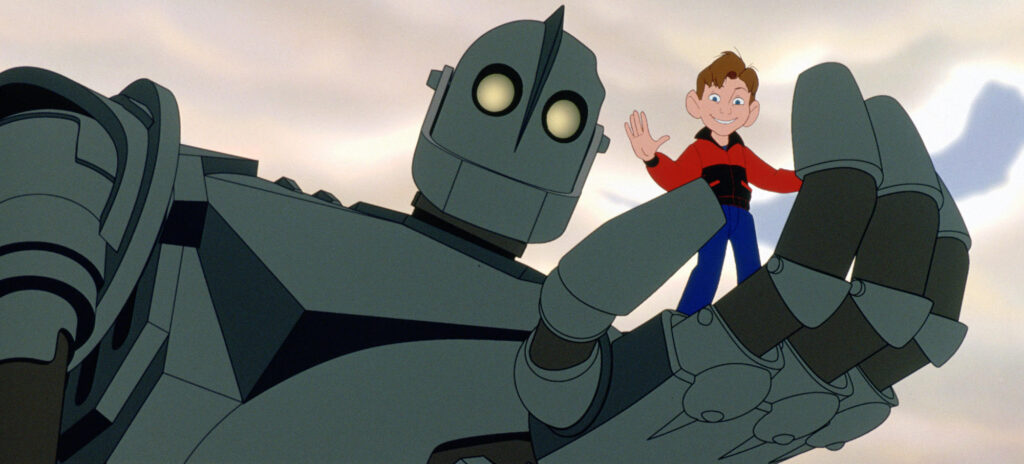
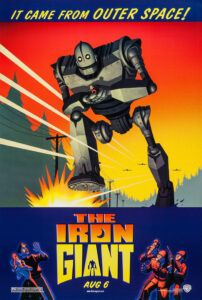
Is The Iron Giant just E.T. with a metal-based alien instead of an organic life form? Yep—that doesn’t mean it isn’t charming, inventive, and true to its own creative perspective. This 1999 animated feature from Brad Bird follows another young boy who befriends a creature from space. This time, the boy is Hogarth Hughes (Eli Marienthal), and the creature is an enormous robot (Vin Diesel). When Hogarth befriends the Iron Giant, he attempts to keep it a secret from his struggling single mom (Jennifer Aniston) and from a singleminded agent of the U.S. government (Christopher McDonald), but it becomes more challenging every day more metal—the Giant’s snack of choice—goes missing in their small Maine town.
Yes, stealing can be lazy—see the recent Super Mario Galaxy Movie for an example of taking from Star Wars for the sake of having no other ideas to lean on. However, the history of animation is littered with excellent literary adaptations, and even many so-called original stories steal with great success. The Lion King pulls from Hamlet, Spirited Away borrows from Alice in Wonderland, A Bug’s Life riffs on Seven Samurai/The Magnificent Seven, and Lilo & Stitch follows the E.T. framework, too. In 2005, Brad Bird would make The Incredibles, which is still the best version of the Fantastic Four yet.
The Iron Giant is successful because it knows plot points are just the blueprint. Where E.T. leaned into the loneliness and abandonment children feel after divorce, Giant explores heroism and Cold War paranoia. Giant also works because it makes good use of its 1950s setting, creates imagery that could only be done with animation, finds plenty of opportunities for jokes, and lets its voice cast create lived-in characters. And 27 years after its release, I hope filmmakers look to it for more to steal today.
American Pop
DIRECTED BY RALPH BAKSHI / 1981
by Jim Tudor


Last week, I logged this film for the eighth (should be ninth) time after showing it to my History of Animation class, perhaps for the last time. I say that because I was not asked to teach History of Animation in the upcoming fall semester. (Cutbacks!) So who knows if I’ll ever get to run this strangely venerable Ralph Bakshi classic in good ol, Webster University Sverdrup room 123 ever again. The very first time I watched American Pop had to have been around 27 years ago. It was via a rented VHS tape, in my parents basement. I did not care for it. Flash forward to early 2019, when I first started teaching History of Animation. My student assistant, Ethan Halker- already a major Bakshi expert- suggested that I take another look at the movie. A few semesters later, I finally did.
Though the film itself is uneven and wildly imperfect in numerous ways, it nevertheless hit me that it might just be the perfect thing to show in class near the end of semester. After all, the multi-generational story of American Pop happens to begin around 1900- the same time as cinema itself was being introduced to the world. And by extension, animation as we know it. Bakshi’s film proceeds to squirrel its way through Vaudeville, World War I, prohibition, World War II, the 1950s, and into the hippie era out west. All the while, popular music of the time periods is the constant thread. From foreign prayer chants to Tin Pan Alley to big band & jazz, Greenwich Village folk music, and into rock n’ roll, the soundtrack is just as unpredictable as it is ever present. Even the first time I saw the film, I was astonished how well Lynyrd Skynyrd’s “Freebird” functions as an overarching, sweeping anthem.
To say American Pop has grown on me over the past however-many years would be an understatement. This rough, weirdly rotoscoped story of generational trauma has also resonated deeply with many of my students who were hit with the movie unawares. I’ve had past students approach me and thank me for introducing them to this movie. Somehow, I’ve become a most unlikely champion for this rather obscure animated feature. (Even in Bakshi’s filmography, it’s often glossed over). If I were Mr. Bakshi, I’d think that I’m deserving of one of the choice American Pop animation cels he has for sale on his eBay story. But that’s neither here nor there…
The lesson of it all? Rock stardom awaits if you just stick with it long enough. Eeeeeh, maybe. More likely, though: share your gifts. Do what you gotta do to survive. But don’t ever lose the beat… as time goes by.