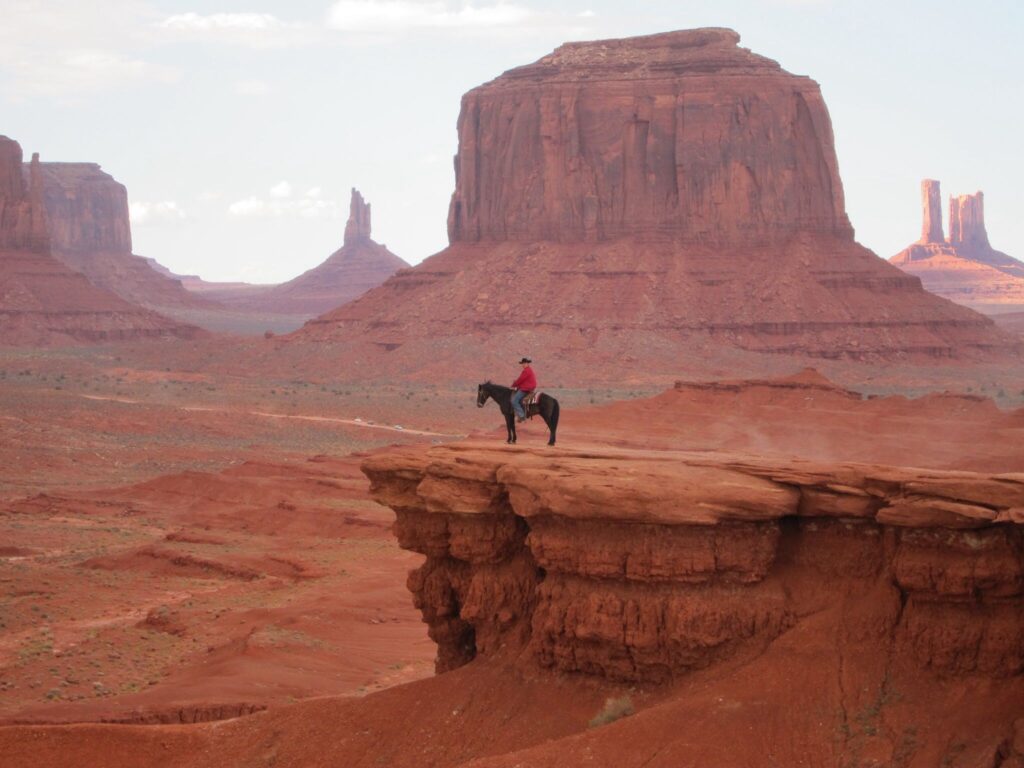


Beyond the Horizon… “My Name’s John Ford, I Make Westerns.“
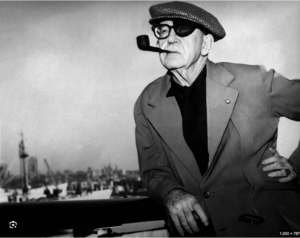
If John Ford doesn’t embody American film, he at least embodies our relationship to it. He chronicled the country’s history in movies like Drums Across the Mohawk, Young Mr. Lincoln, and The Iron Horse as well as its current events of the time like The Great Depression (The Grapes of Wrath), World War Two (They Were Expendable), and politics at the beginning of the TV age (the underrated The Last Hurrah). He gave us several templates for one of the most American film genres, the western. Even the characters in the movies set in his native Ireland feel like we are watching them or their ancestors before they migrated here.
It is an immigrant’s emotions we view Ford’s America through. The art direction of his stories is authentic, though the facts often lack accuracy. He wasn’t interested in the historical moment itself, as much as what it represented. This romanticism warred with a cynicism that crept into his work after the war years. His gunfight in Tombstone lacks adherence to the actual shoot out; it tells a tale of family tragedy, not heroic daring. In two of his films, Fort Apache and The Man Who Shot Liberty Valance, he questions his romantic portrayals of the past.
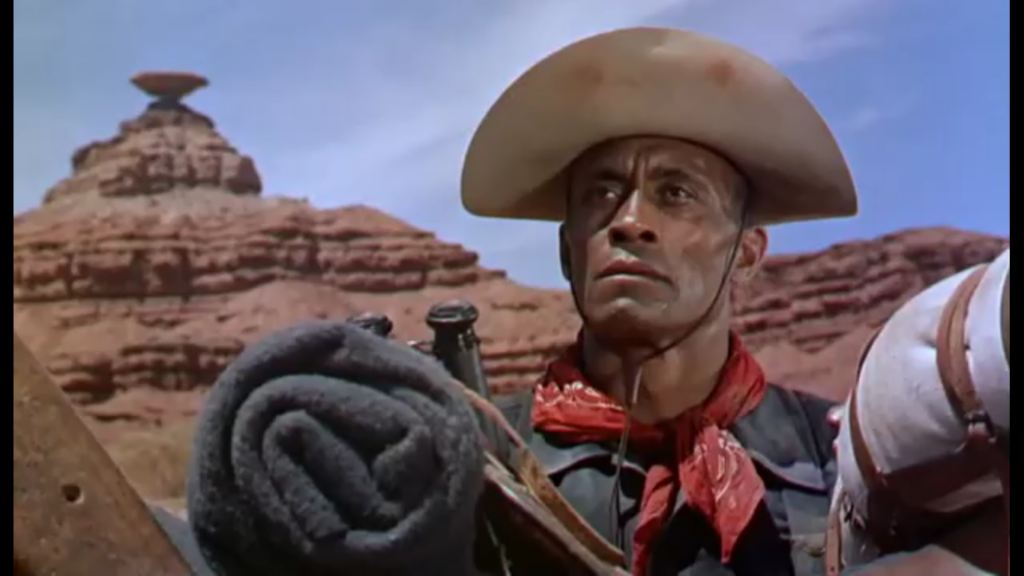
Contradictions also were a part of his politics. A Roosevelt Democrat, he helped form The Screen Directors Union and fought Cecil B. DeMille, who wanted members to take a loyalty oath during The McCarthy Era. He advanced the career of African America actor Woody Strode, giving him the rare lead in a picture, Sergeant Rutledge. As someone who served in World War Two, filming the Battle of Midway, he had a kneejerk to Vietnam War protestors, leading him to declare “God Bless Richard Nixon” at his AFI ceremony, one of the final acts in his life that narrowly defined him. It says something that the two actors who he is most known to have collaborated with were Henry Fonda and John Wayne who respectfully embodied the left and right of classic Hollywood.
Most of us Gen X Cinephiles came to Ford through the movie brats who he inspired. His influence is in shots George Lucas stole directly from The Searchers, a film often cited by Scorsese and Paul Schrader as well. It’s telling that when that generations most successful commercial director depicted a meeting with Ford in his autobiographical The Fabelmans, he cast David Lynch, one of the most avant-garde filmmakers, as the director.
Ford shaped American movies, American masculinity (with the help of Wayne), and how we view its history. Every American filmmaker either consciously or unconsciously is in artistic conversation with him, whether it be support, rebuttal, or understanding. It’s difficult to be involved with film and not have a Ford admission.
– Scott Montgomery

Editor’s Note: As with almost all ZekeFilm Film Admissions group pieces, this roundup of Ford films runs the gamut of voices experienced with the filmmaker. All, however, are cinema buffs, and all are welcome to this Fordian communal gathering.
The Man Who Shot Liberty Valance
Directed by John Ford/1962
by Max Foizey


We’re listening to a story told to a local reporter for the Shinbone Star by Senator Ransom Stoddard (James Steward), who has come back into Shinbone for the funeral of a local man. The reporter is understandably curious as to why a Senator would bother traveling all the way to their small town for this funeral. Stoddard’s tale goes back twenty-five years, detailing his run-ins with an outlaw named Liberty Valance (Lee Marvin), and a cowboy named Tom Doniphon (John Wayne). What follows is a compelling story of unchecked violence, lost love, courage, honor, and surprisingly, the importance of local elections!
The Academy Awards have recently added a category for Achievement in Casting, but if that award had been around in the early 1960s, this film would certainly have been a contender. Lee Marvin eats up every scene he’s in, James Stewart is just the right mix of naive and gutsy, and John Wayne’s distinctive drawl embodies the spirit of the American West itself, pilgrim. I was most impressed with Vera Miles’s memorable performance as Hailee, a headstrong woman who proves to be the glue that holds the story together. Miles is a powerhouse, every bit matching (and sometimes exceeding) the performances of Marvin, Stewart, and Wayne.
The Black and White cinematography by William H. Clothier is beautiful, Edith Head’s costumes are perfect, and director John Ford’s expert blocking and framing of scenes is on full display, especially in the film’s final showdown. Westerns were the dominant box office champions for roughly twenty years from the late 1940s to the early 1960s, and a lot of that success was due the work of John Ford. Though he worked across many genres in his long career, Ford became a celebrated filmmaker mostly through his westerns, of which he directed more than thirty. Ford’s westerns didn’t just include scenes packed with spurs, horses, and shotguns. They had characters experiencing pathos, longing, and regret.
It makes perfect sense that The Man Who Shot Liberty Valance is held in such high regard among western fans, John Ford fans, or just film fans in general. It presents a perfect distillation of the power of the modern myth to inspire and create lasting change. It’s also a peek behind the curtain into the lives of those living with the uneasy knowledge of a reality that others are unaware of. The Old West never really existed quite in the way that it was depicted in classic Hollywood films. With The Man Who Shot Liberty Valance, Ford makes the case that it was important for America to remember a past it hadn’t really experienced, in order for the country to grow into a nation worthy of that myth.
Steamboat Round the Bend
Directed by John Ford/1935
by Jim Tudor

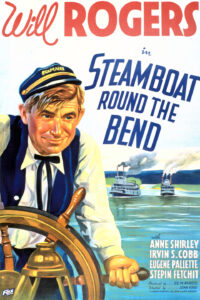
Imagine being voluntarily held captive to all manner of crackpot religious skewering and targeted hard-sells of questionable health products. Back in the ‘90s of John Ford’s 1935 outing Steamboat Round the Bend (the second most recent ‘90s, to be clear), people boarded a riverboat for recreation only to be subjected to these very things. Today, we simply go on the internet for such hokum. But on the positive side of this analogy that no one asked for, one can meet likeminded friends if one only knows where to look, be it on a steamboat 135 years ago or online today. This being a John Ford film, the makeshift community that emerges on main character Pearly’s (Will Rogers) steamboat is an amusingly rowdy band of flawed but all-too-human eccentrics. I for one wouldn’t have it any other way. (They fall just short of the most sustained raucous bunch in a Ford film that I’ve come across, 1941’s sublimely clattering Tobacco Road– as would most any ensemble).
Here we have a flimflam seller of dubious tonic (the starting point for Rogers’ Pearly in the story), a hopelessly drunken goof (played by Ford’s older brother, Francis), a blustering roving preacher of gospel gibberish known as New Moses (Berton Churchill), and an incoherent bumbler played by Ford favorite, the controversial Stepin Fetchit. This motley bunch join together in the film’s final act to collectively race against the clock by waterway, aboard Pearly’s puttering steamboat that’s been converted from a wax museum-like attraction of historical Europeans to a post-Civil War American South-favoring version of the same thing. It’s unintentionally cringy when a lightbulb goes off in Pearly’s head to turn the Ulysses S. Grant mannequin into Robert E. Lee. But later, when the gang is burning everything they can to get the ship to go as fast as possible, General Lee goes into the flames without a second thought. Such are the ideological dualities so often found in Ford films. What’s their big hurry down the river, you ask? A good man, Duke (John McGuire), is going to be hanged for killing a man in defense of his fiancée, competent swamp girl Fleety Belle (a feisty Anne Shirley). Pearly was initially no fan of Duke “settling” for an uneducated poor girl of the land such as Fleety, but he warms up to her soon enough in a benign, mentoring way. Before long, he’s got her wearing pretty dresses the likes of which she’d never dreamt of and piloting the steamboat.
Steamboat Round the Bend marks Ford’s third and final collaboration with Will Rogers, fully on account of the humorist’s untimely death by plane crash that same year. Sadly, Rogers did not live to see the debut of this film. He never considered himself an actor, but Ford so loved his demeanor that Rogers was given unprecedented freedom to alter scripted dialogue to suit his populist wordsmithing. That proved true even for this screenplay (which was in turn based on a novel by Ben Lucien Burman) bearing the respected name of Dudley Nichols. This punchily entertaining Southern romp arrives at a time when Ford had long since moved on from making Westerns (though he’d get back to them with 1939’s seminal Stagecoach, the first of several such films he’d shoot in the majestic Navajo land of Monument Valley), concentrating instead on stories of vibrant individuals in varied tonal fare. Ford would win his first of four Oscars for the shadowy heavy dramaThe Informant, released a mere four months ahead of the more basically lit Steamboat Round the Bend. Though neither film is recalled today on most short lists of Ford’s greatest work, both The Informant and Steamboat are exemplary of the two prominent faces of Ford, as pointed respectively out by his biographer, Scott Eyman: Ford the serious artist and Ford the lightweight entertainer. The thematic bond is always community. Messy, loud, awkward, community. Again, I wouldn’t have it any other way.
The Last Hurrah
Directed by John Ford/1958
by Taylor Blake

My first admission: I had never seen The Last Hurrah.
My second admission: I’d pick a John Ford drama over a John Ford Western almost any day.
Go ahead: Give me a plot summary of Fort Apache, My Darling Clementine, She Wore a Yellow Ribbon, or Two Rode Together, and I’d guess you were describing any one of them. (I’ve seen all four—my memories are indistinguishable.) But The Grapes of Wrath? Henry Fonda broke my heart in that. The Quiet Man? John Wayne and Maureen O’Hara are magic. How Green Was My Valley? It’s a character drama worth celebrating, even if it shouldn’t have won Best Picture over Citizen Kane.
1958’s The Last Hurrah might be my favorite Ford drama yet. Spencer Tracy‘s mayor of an unspecified New England town, Frank Skeffington, is making his fifth and last bid for mayor. Some, like his carefree son (Arthur Walsh), take his success for granted. But this far into hicareer, it’s not unusual for people to encourage him to hang up his hat. His greatest opponent isn’t the younger candidate running against him (though his bland, TV-friendly persona feels prescient of Kennedy’s victory in just a few years), but the irrelevance of his generation.
Sure, this isn’t as scenic as Monument Valley, and on paper, not a lot happens in The Last Hurrah. Ford’s direction isn’t flashy, but small character moments are still a meal in the hands of actors like Tracy and a dozen veteran character actors. As Skeffington attempts to balance campaigning with governing, we see much of his day is focused on negotiating between the egos who control the town’s money and influence. His career is an example of the tension in politics between its intended purpose (taking care of the constituents) and everything periphery to this job description that requires most of his time. This feels like a precursor to The West Wing and every modern political procedural, and it still feels as fresh.
Wee Willie Winkie
Directed by John Ford/1937
by Justin Mory
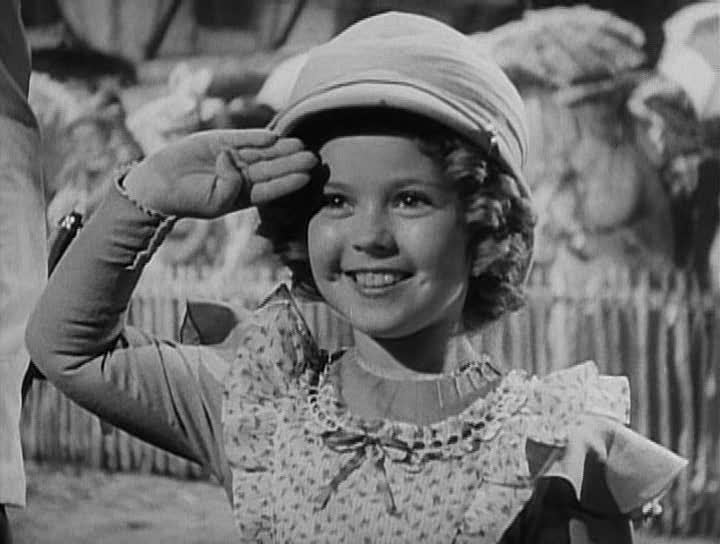
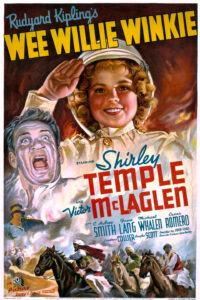
John Ford directs a 9-year-old Shirley Temple in 20th Century-Fox’s large-scale filming of Rudyard Kipling’s 1888 story Wee Willie Winkie. Which, as you take in all that, manages to remain a fairly rousing colonial adventure tale, while also successfully incorporating its child star’s money-making persona into the satisfactory resolution of its plot. A bit of a departure for both Ford, who didn’t like directing kids, and the kid herself Shirley Temple, who usually relied on elaborate musical numbers as a chance to throw at least one buck-and-wing opposite, say, dancing legend Bill “Bojangles” Robinson, the crusty director and cheery child actor found artistic compromise of a sort in the casting of gruff character actor Victor McLaglen. Who as the glowering Sergeant MacDuff probably does not have much tap-dancing ability per se, but is able to whip raw recruits and willing children alike into the precision choreography of rank-and-file drill-and-procession. Everyone’s heart melted by the end in addition to a rebellion soundly squashed, a complex geopolitical situation is settled in 99 minutes of cute comic theatrics tempered by solid/stolid storytelling.
Set on the northern border of India in 1897, Priscilla Williams (Temple) and her widowed mother (June Lang) travel to a remote frontier outpost commanded by their grandfather and father-in-law Colonel Williams (C. Aubrey Smith), who doesn’t have much use for women or little girls, but does have enough solicitude to issue the child a pith helmet so she doesn’t perish of sunstroke. Priscilla quickly befriends the colonel’s subaltern Sergeant MacDuff (McLaglen), who dubs the eager kid “Wee Willie Winkie” after a Scottish nursery rhyme; “Private Winkie” just as quickly becoming a rallying mascot for the entire regiment. So when imprisoned rebel leader Koda Khan (Cesar Romero) stages an invasion of and jailbreak from the compound, leading to tragedy and noble self-sacrifice for MacDuff, Winkie is subsequently kidnapped by one of Koda’s spies. Impressing the rebel leader with her bravery and fortitude, however, her bright and forthright example inspires both the rebels and her stiff-necked grandfather, whose eventual cooperation brokers peace and justice in the Raj.
Not only predicting or foreshadowing Temple as an able goodwill ambassador for UNICEF and eventual U.S. diplomat, Wee Willie Winkie also serves as a clear template for John Ford’s decade-later U.S. Cavalry pictures. The first of which actually features Temple, as Henry Fonda’s romantically eligible daughter opposite her then-husband John Agar, in the director’s Custer’s Last Stand redraft, Fort Apache (1948). Two years before the director officially returned to the American West with Stagecoach (1939), it’s quite tempting to view the dusty setting, conflict between natives and an occupying military force, and even the seriocomic nature of its military drilling and macho fisticuffs – like two of the three cavalry pictures, which also include She Wore a Yellow Ribbon (1949) and Rio Grande (1950), there’s even a mid-film dance – as a coded Eastern-Western, the colonial battles similarly echoing the confusion of “Indians” as oppressed natives or savage invaders. Ford displays no less fascinating ambivalence on that subject in the latter half of this movie; whose real sympathies, in a continuum of movie depictions culminating in Cheyenne Autumn (1964), may have first been softened behind the rough facade by the wide-eyed view of a child actor in a kid’s movie.
Two Rode Together
Directed by John Ford/1961
by Erik Yates
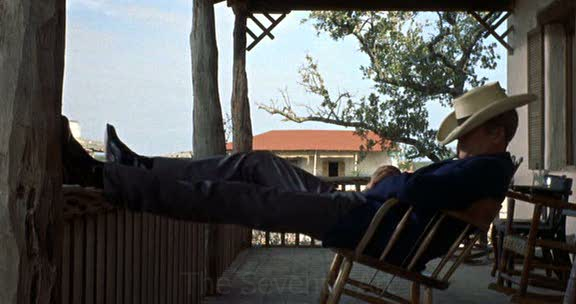
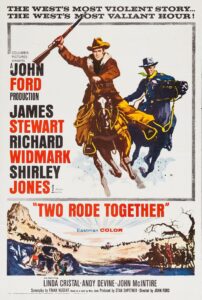
For John Ford June Film Admissions I dove into the Jimmy Stewart-starring Two Rode Together. Always a fan of Mr. Stewart, this was a more obscure film given his oeuvre despite both he and John Ford being heavy hitters, especially in the Western genre. Often compared to Ford’s film The Searchers from 1956, Two Rode Together shares some basic similarities, but its worldview on the same subject arrives at vastly different conclusions. Like The Searchers, Two Rode Together features two men riding into Comanche territory to rescue white captives. Where John Wayne’s Ethan Edwards is personally seeking to find his niece, here James Stewart’s character of Guthrie McCabe, a mercenary-styled sheriff, only agrees to the quest for finding these captives to line his own pockets. Richard Widmark (played by Jim Gary) is a boy scout of an Army officer who accompanies McCabe, partly out of duty of being ordered by his commanding officer, and also to ensure that the right thing is done. He doesn’t trust McCabe who has more of a Han Solo vibe as a scoundrel who seems to be in it for the money- but might have a heart after all.
While both cited films of Ford explore the concept of assimilation, Two Rode Together has a much darker interpretation of it. The captives are often assimilated into the Comanche culture or killed. Some of the adult captives do not want to return, either to protect their loved ones, or because they’ve accepted their new reality and can’t envision what a return would look like. They want to be remembered by their loved ones they way they were, not seen as a victim. The children who were taken often have no memory of their “white” upbringing and are now fully Comanche. While The Searchers spends most of the film on the search, Two Rode Togethermakes the search a brief portion of the narrative, choosing to focus more on the way society welcomes back the captives. Here, Ford is quite cynical towards the “white” town who see a young boy who is returned as a “savage”, the same racists view that the townsfolk held towards the Comanches. Before this particular boy’s return, the townsfolk who lost sons are competing and arguing for whose missing son he might be, with one opportunistic and wealthy individual paying McCabe a side bonus if he says the boy is this man’s new wife’s child, who was taken years before he wed her. Once the boy is seen by the townspeople upon his return and he is unable to speak English and is showing aggression towards his former town members (whom he doesn’t have any memory of), no one wants him. That is, except the distraught mother of a different child who has hysterically chosen to believe that THIS is her child. After a tragedy and resulting death of this distraught woman ensues, the town demonstrates that they are the true savages in Ford’s film when they have a sham trial and lynch the child they paid McCabe to go and retrieve.
The other captive that is recovered is a Mexican woman named Elena de la Madriaga (played by Linda Cristal). In the film she was forced to become the wife of the Comanche warrior, Stone Calf. Once freed from him, she finds herself being ostracized by the white society she is returned to for not choosing suicide in her situation and instead choosing to continue to live. Elena earns the respect of McCabe due to her strength, and she is the catalyst towards turning McCabe from scoundrel to hero. While the dialogue between McCabe and Officer Gary is light and humorous at times, and an attempt at a happy ending for McCabe and Officer Gary is a given, the film is actually much heavier in its tone and leaves viewers with a taste in their mouths that we are often the savages we accuse of others of being. Two Rode Together is a very good film that isn’t often talked about in Ford’s filmography given the other gigantic films he has directed, but it is one that should be seen and experienced.
My Darling Clementine
Directed by John Ford/1946
by Claire Meisch
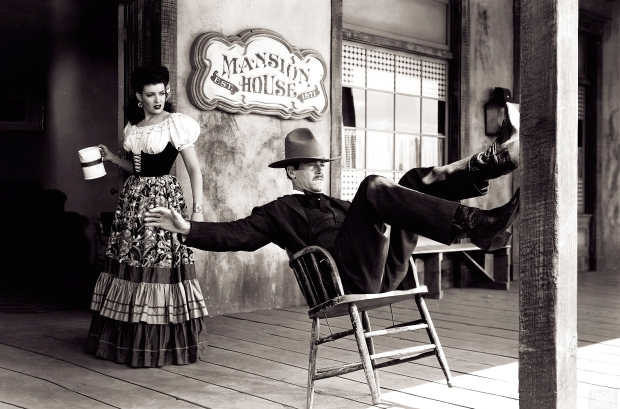
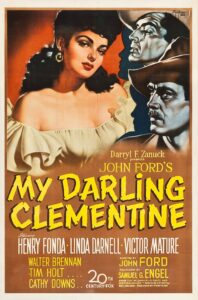
I have an admission to make: I am not the craziest fan of Westerns. That is not to say I have not had any exposure to the genre. Majority of my knowledge stems from late nights watching television with my father while he lists the name of every actor synonymous with 1950s Western filmography. My lack of knowledge in this realm directly translates into my inexperience with John Ford’s work as a director. Though Ford was not strictly chained down to a specific genre, his work in this particular field is universally lauded and adored.
While my personal experience with Western filmography may be limited, that does not mean a few have not caught my attention over the years. In particular, 1993’s Tombstone remains a cornerstone piece of my childhood. This very real Southern town is a renowned landmark synonymous with the culture, along with the bloodied, gunslinger history that surrounds it. The historical figures that populated this town have produced inspired interpretations. Wyatt Earp and Doc Holliday are names that summon a mental picture of wild saloons, tumbleweeds, and intense gunfights. Any location with this kind of checkered past and larger-than-life inhabitants is bound to experience the film treatment. Considering my love for the Cosmatos adaptation, it felt only natural to experience Ford’s take on the iconic friendship between the gambler and the lawman: My Darling Clementine.
The Earp brothers roll into the lawless land that is Tombstone initially with an honest curiosity, but their intentions sour when their youngest is murdered while on watch outside of town. Filled with a righteous vengeance, Wyatt (Henry Fonda) accepts the vacant position of town marshal in an effort to establish a sense of order in the community. It is not long before Earp encounters the hot-tempered Doc Holliday (Victor Mature). Their initial interaction between Wyatt and Doc is the equivalent of two men flexing their muscles in testosterone-fueled display of male dominance. Their tense conversation breeds a relationship built upon grudging respect, and the two form a tenuous bond. When Doc’s ex-lover and the subject of the film’s title, Clementine (Cathy Downs), comes calling in search of her former flame, her presence disturbs the shaky balance previously established. Enraptured by Clementine, Wyatt awkwardly attempts to court her. Doc, on the other hand, spooks and takes flight to escape the remnants of his past. The result is full of bloodshed and drama, and this town will be permanently stained.
Though I may not be a front-line champion for these types of films, it is not hard to acknowledge Ford’s expertise here. What is truly captivating about My Darling Clementine is the overall stillness. There is a distinct lack of any flashy action or dramatic violence. This version of Marshal Earp is a more subdued man with an edge of gentleness uncommon in the same era as the hypermasculine John Wayne. The wide shots of the desolate desert and the growing boom town are as simple as they are beautiful. Ford keeps these subjects wrapped in decades of mythology and exaggeration strictly grounded in reality. These are flesh and blood humans coping with the tragedy dealt to them while discovering a way exist in their environment. In Ford’s hands, gods become men and the legend of the Wild West fades into the sands and mountains.
She Wore a Yellow Ribbon
Directed by John Ford/1949
by Scott Montgomery
I became a John Ford acolyte through a film that connected him to two other artists I revere. As with most young cinephiles, Martin Scorsese held the place of directing deity. He often mentioned the love he had for Ford. I also collected western art prints with my family. Frederic Remington, a New York-trained artist in the 1880s and ‘90s was a godfather of that genre. One night, I watched a documentary on Remington that spent a great deal of time demonstrating the influence he had on Ford, focusing on one movie in particular, She Wore a Yellow Ribbon. When I had a chance to rent this link between two artists- these two masters- I swiped it from the Blockbuster shelf. After watching it, I hit rewind and watched it again.
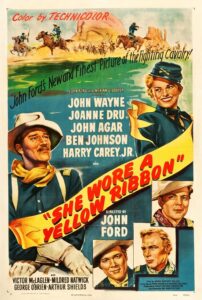
The synopsis reads like a standard western programmer. After the defeat of Custer, The Northern Cheyenne have joined up with southern tribes, led by the vengeful war chief Red Shirt. On his last patrol, retiring Captain Nathan Brittles (John Wayne), has to also escort the wife (Mildred Natwick) and niece (Joanne Drue) of the post’s commanding officer to a stage station. However, Ford uses that simple story to dive deeper than he ever did into Remington’s paintings and illustrations, both in technique and theme, that echo into Scorsese’s work.
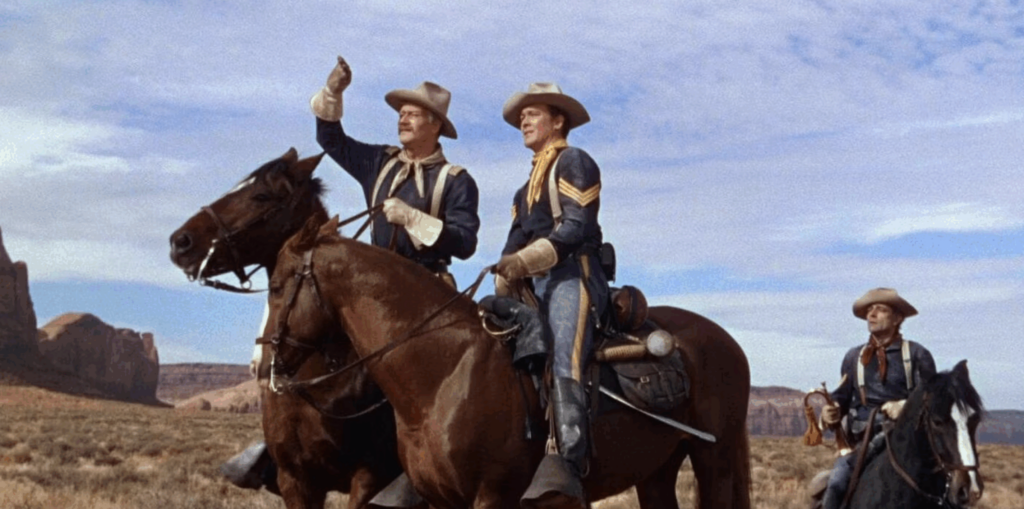
It represents some of the best applications of Ford’s color cinematography. The striking bright blue uniforms of the soldiers, accented with even brighter yellow piping, juxtaposes them from the earthiness of the frontier backdrop, something often seen in Remington’s paintings. I remember wishing he could have found a way to have blended the powdery blue smoke that the artist often had coming from chimneys and campfires on one of my VCR viewings, only to realize he did when I saw it at L.A.’s American Cinematheque in 35mm.

He uses the horizon line much like Remington did to display the drama. As Brittles mission becomes more fraught, the troopers are often depicted below the line, with the land dominating them. Much like the artist’s Indians in his paintings, Ford places Red Shirt and his warriors rising above the horizon as much a part of the Monument Valley environment as the grand rock formations. It’s notable in Spielberg’s autobiographical The Fabelmans, his young fictional stand-in gets a harsh tutoring about the horizon line from Ford through Remington paintings.
Some of the most compelling shots are done in a sequence during a lightning storm. Ford took advantage of the dramatic weather, arguing with his D.P. Winton C. Hoch, who didn’t want to risk shooting in bad weather, but relented, filing an official protest. Images like lightning flashing above the marching troop helped Hoch win the Oscar that year for Best Color Cinematography.

However, Ford goes deeper than the looks, even for what is his lightest movie to deal with the calvary. Most of the story deals with failure. Slowed down with the colonel’s women, Brittles is unable to back up a part of his troop who get massacred at the stage station. He is also unable to stop repeating rifles from getting in Red Shirts’ hands. The captain often cites apologizing being sign of weakness, yet Ford demonstrates through him how to carry oneself with dignity in defeat, instead of passing the buck to his colonel or his relations. Ford, as with Scorsese, wrestles often with how true honor is obtained in dishonorable circumstances.
Ford used all the script, look, and thematics to deliver a love letter to the military. Its rituals run through the script, starting with an inspection and ending with a formal dance. It pulls together an Irish sergeant, Swedish blacksmith, and even southerners who recently fought their brother soldiers in The Civil War. Even class lines get worn away as shown in the battle between two officers for the hand of the commander’s niece. Few are perfect, often caught drinking or brawling, however duty washes their sins.
She Wore a Yellow Ribbon catches the director and his stock company of actors meeting at the height of their talents. Wayne, after a decade of Republic B westerns and war programmers, as well as a brilliant turn in Howard Hawks’ Red River and two other Ford films, proved to be both the acting talent his mentor promised him to be in Stagecoach. He does a wonderful job playing older, hitting the challenging right notes of the director’s humor and sentimentality. Natwick plays her army wife with humor and dignity. As ex-confederate Sgt. Tyree, Ben Johnson gives one of his best riffs on his amiable good ol’ boy who is smarter than his superiors and Ford gives him some great moments to show off his riding skills. The collaboration allows for an entertaining story he uses to partly to examine an artist he admired. As one of his peers said, “You finally painted your Remington.”