


Recognizing the Truth in Aaron Sorkin’s Social Sequel
DIRECTED BY AARON SORKIN/2026

Operating in the shadow of 2010’s culturally seminal The Social Network is a disadvantage not lost on that film’s screenwriter, Aaron Sorkin, who’s nevertheless decided to give writing and directing a sequel a go. His making said sequel a journalism movie rather than a cost-of-success movie is a good move. Making it also the kind of heavy-handed message movie that Fincher’s film resisted ever being is not a good move.
Through Sorkin’s trademark sharp banter and rapid-fire factoids and statistics, he traces everything from sharply rising teen girl body dysmorphia to rampant cyber-bullying to dug-in pandemic-era jackassery to the horrendous onset of rightwing radicalization back to the irresistible tractor beam of social media. But it’s not just that. It’s the decisions that the leaders of said social media platforms make on the regular in favor of boosting dopamine hits (tailored to each individual user via their “likes”) with the intent to keep people glued to the platform as much as possible. What was once ostensibly about human connectivity has, largely by design, given way to a sea of bad bots, outrage-generating news, and conspiracy theory propagation.
Sorkin presents all of this as though he himself has uncovered the social corruption of the 21st century. He may not realize to what degree Facebook itself is considered a passé platform. Lip service is given to the fact that the kids instead use Zuckerberg’s acquired other major platform, Instagram. But still, the movie treats Facebook as though it’s retained its cultural cachet of 2010 times. You know, back when Sorkin won an Oscar for Best Adapted Screenplay for The Social Network. The Social Reckoning screenplay scratches that smartypants itch that Sorkin has built his impressive career upon, but his since-emergent directorial accession coincides with the withering of cinema as a top art form. I don’t like that latter fact about cinema itself any more than you do. But… is anyone going to tell him…?
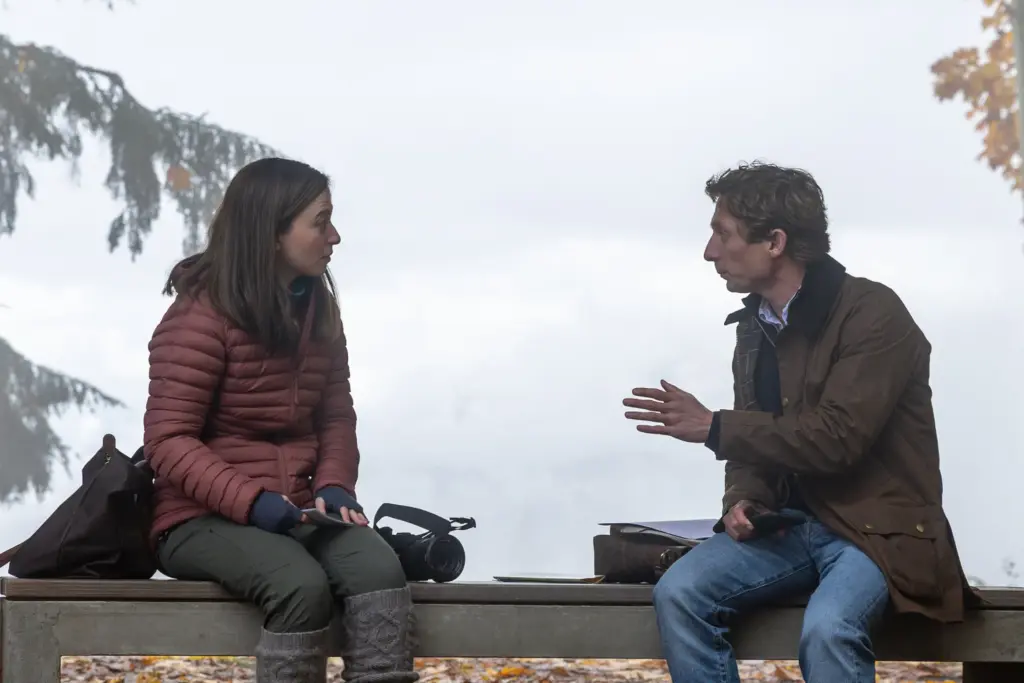
That said, I’ll also say this: Sorkin as a director gets a worse rap than deserved. The Social Reckoning landing as old-time “televisual”, i.e., shot in a very basic manner, would, for most, be neither here nor there amid this material were it not for Fincher’s realization of The Social Network. In that inevitable comparison, Reckoning crashes and burns. That will do no favors for the “Stay your lane!” mentality film buffs wield towards Sorkin ever since he’s taken to the director’s chair with regularity. It’s pretty undeniable that his directed movies (2017’s Molly’s Game, 2020’s The Trial of the Chicago 7, and 2021’s Being the Ricardos) are comparatively lesser in comparison to the results of his screenplays realized by other name directors (for example, Charlie Wilson’s War, directed by Mike Nichols; Moneyball directed by Bennett Miller; A Few Good Men and The American President, directed by Rob Reiner). Sorkin as a visualist lacks any magnetism, but gets his stories’ jobs done. Faint praise, hard won.
More detrimentally, Sorkin has taken to his Newsroom high horse to make The Social Reckoning with a stupefyingly heavy political agenda. While the early October release date logically mirrors The Social Network’s, one also suspects the 2026 midterm elections being only a month away likely factored into the filmmaker’s calculations. Here we have a circa-early 2020s journalism story wherein the valiant reporter’s crusade to unearth real dirt on Zuckerberg’s Facebook algorithm manipulations is interrupted by COVID and then the attempted January 6th insurrection. Without naming the Compulsive Liar-in-chief (who, in the wake of it, founds a social media platform for all of his lies named, with straightest of faces, “Truth”), all roads lead to Sorkin sharply pinning blame on Jeremy Strong’s stoney Bond-villain-esque Zuckerberg. Sorkin’s early-2020s Mark Zuckerberg is infused with more self-important arrogance and inerrant pomposity than this movie is- and that’s saying something.
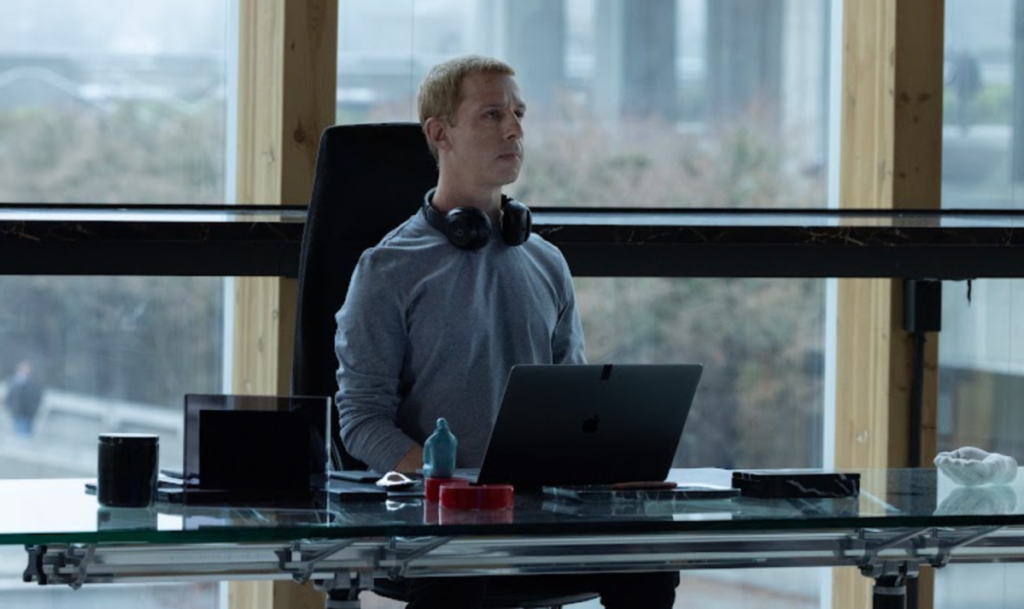
The timeline’s slides between 2019 and 2021 as Facebook data engineer Frances Haugen (a disappointingly utilitarian Mikey Madison) grapples with whether or not she should turn whistleblower on the company’s wayward practices. Actively trying to persuade her to tell all is Wall Street Journal newsman Jeff Horwitz (Jeremy Allen White, carrying this thing), frazzled and in it for the long haul. The business would soon be Meta’s dark chicanery nor the additional crap pulled along the way, however, have not amounted to any tangible real-world outrage, much less this level of dissection. Never mind it absolutely should have and still should. Sixty-five-year-old Sorkin, however, is not the man for the job. The man is and hopefully always will be a top screenwriter. But if anyone ever uses the term “visionary director Aaron Sorkin,” unfriend them.