


Behind the Scenes Tragedy Plagues Long-Gestating Action Film
DIRECTED BY AARON SCHOENKE & SEAN SCHOENKE (2026)
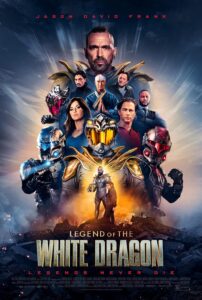
Legend of the White Dragon is not a complicated film. You could summarize the plot in under a minute and get by just fine. You could also write three thousand words and barely scratch the surface. The thinnest possible story stretches over a particularly fraught development and ultimately tragic bookending, and raises a number of uncomfortable questions.
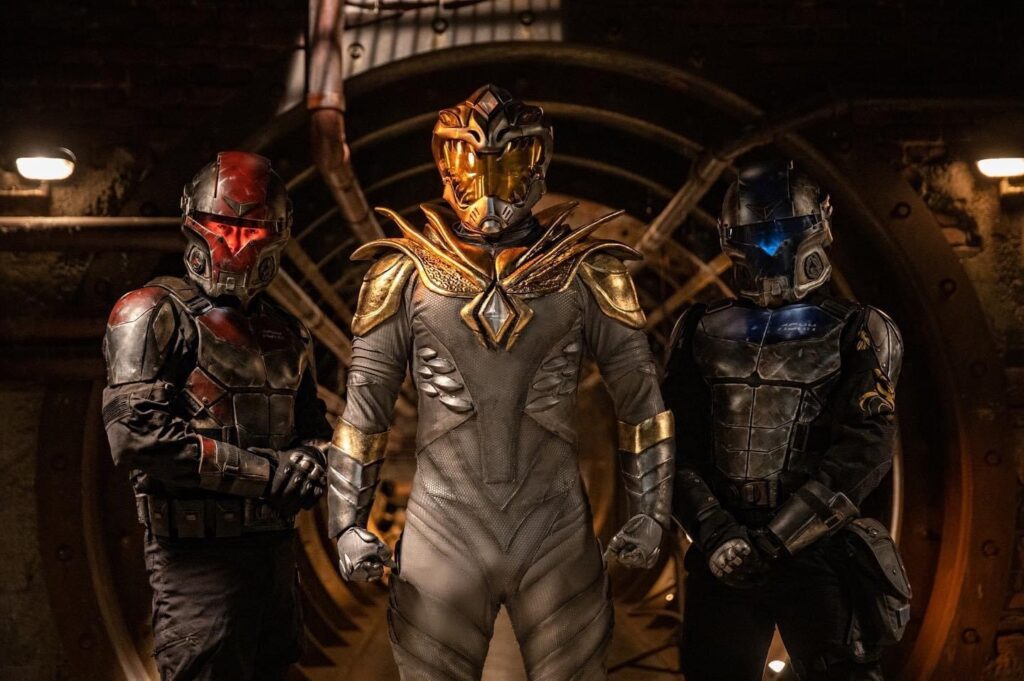
Let’s start with the simple, then. There are two warriors. One good is good and one is evil. Each possesses half of a magic crystal that allows the wielder to transform into a superhero. Each seeks to recover the missing half. The two fight. The good guy wins and lives to fight the next costumed villain. Yes – that’s it.
If this sounds like a Saturday morning cartoon or an episode of Power Rangers, it should. Legend of the White Dragon, which received an incredibly brief theatrical run over the final weekend of August, comes to us from Jason David Frank, a professional martial artist and actor best known as the iconic green antihero of the Mighty Morphin Power Rangers. He has worn many colors over the years, going from green to white to red to black and back again over many decades now. The storied tokusatsu and sentai genre has its roots in mid-sixties Japan. Frank has been a force in that world for nearly forty years. To western audiences, he’s not just a ranger. He’s the ranger.
Jason David Frank took his own life in 2023, before production had fully wrapped on Legend of the White Dragon. It was shocking. It was tragic. While plenty of baseless rumors spread, the actual details of the incident are sparse. The incident cast an enormous shadow over the film’s production and release. It should. The weight of that loss and the feelings of the family matter far more than Legend of the White Dragon. One is objectively more important than the other. That being said, the project was deeply important to Frank, who served as producer, director, and lead actor; his family worked hard alongside Bat In The Sun Productions to ensure it was released.

The project had already fought tooth and nail to survive. Frank’s death is the true tragedy, yes, but there were many obstacles prior. Two Kickstarter campaigns, the first of which failed, determined the scope and significantly limited the original vision for the project. It went from short film to trilogy to miniseries to standalone venture. Once it was finally time to begin principal photography and production, a horrific global pandemic arrived, which required significant reallocating of funds in an already limited budget to account for necessary health and safety protocols, per SAG-AFTRA. The loss of Frank came before all of his scenes had been shot, leaving co-directors Aaron Shoenke and Sean Shoenke with the unenviable task of scheduling reshoots, drafting new scenes for secondary characters, and working with editors to significantly recut the film. The end result is surprisingly cohesive, but comes at the cost further limiting the already incomplete screen time of the man at the center of the film
To compensate, the movie was forced to expand the roles of other characters. This most organically occurred for co-star Aaron Shoenke, who portrays Jai Katua, pharmaceutical exec and grieving widower turned dark dragon crystal counterpart. Many fans have voiced deep disappointment over the amount of screentime allotted to Shoenke, going so far as to accuse the Shoenkes of repurposing the film into a boon for Aaron’s career. The vitriol has been galling, though somewhat unsurprising in this era of toxic fan behavior. While the final cut of White Dragon doesn’t actually give Shoenke more screentime than Frank, the character of Jai Katua is undergoing a villainous transformation that by its very nature is a more dynamic on-screen arc than that of the eponymous hero. I must admit that I left my initial screening with similar suspicions, which prompted me to return for a second screening. Even after two screenings, it’s hard to shake the feeling that Frank gets short shrift.
These decisions in the editing bay were born out of necessity, but ultimately bring us to yet another complicating factor: the crowdfunding model. Formal preproduction began in early-to-mid 2019. Fans who contributed financially (‘backers’ in KickStarter parlance) to the development of White Dragon waited nearly a decade for what would ostensibly be a Jason David Frank vehicle. He was supposed to have top-billing, and everyone involved insists this is still the case. But the truth remains that Frank’s scenes weren’t finished. What was available had to be retooled as best as possible. The movie had always hoped to birth something larger – sequels, or a mini-series, or something. Those hopes seem squarely out of reach now.
Fan response to the film has been polarized. While some are just relieved to see Legend of the White Dragon have its moment in the sun, however brief, a large and predictably vocal contingent are unhappy. This raises the question: when a film is crowdfunded by fans, how entitled are they to proverbial returns on their investment? We live in an era of particularly visceral toxic fan responses. Frank’s passing has somewhat tempered the worst of the responses… but then, it really shouldn’t take an unthinkable tragedy to keep fans from being monsters. Still, the situation forces one to think about what happens when art becomes product. The distinction between movie and film is pretentious and tedious, but somehow finds legitimacy in this very particular context.
Legend of the White Dragon belongs in no small part to its audience and fans; as such, it cannot fully serve as tribute to Jason David Frank. It unknowingly sacrificed that option, removed the possibility, long before the tragic and surprising loss. How could anyone have known? The fight to bring this vision to life and the steps taken along the way were correct at the time. No one could have known these methods would complicate its ultimate arrival, or that the final product would be so different from its creators’ visions.
This movie wasn’t finished. What was promised simply could not be delivered as intended. But what were the options? The crowdfunding model takes the medium of film’s inherent problem of design by committee and magnifies it exponentially. The project is moved ever closer in the direction of product, not art. Art is not inherently required to provide a return on investment.
And yet these were the steps taken by Frank to bring this vision to life. He, alongside Bat In The Sun Productions and the Shoenke family, fought to make this happen. This brings us full circle, back to what actually matters: the loss of Jason David Frank. Publishing or producing an artist’s work after their death can be complicated. In the instance of suicide, it becomes even more complicated. Those simple statements feel laughably inadequate.

Legend of the White Dragon is straightforward. Everything that went into it, everything that surrounds it, and everything that came after, is anything but. Any one of the topics touched on above – art versus product, audience entitlement, the challenges of the crowdfunding model, sensitive reviews of posthumous releases, and family grief for a public figure – merits an essay unto itself. It’s taken an essay’s worth of words to merely identify these things.
The film’s end credits are accompanied by nearly fifteen minutes of B-Roll, behind the scenes footage, and candid photography. In it, we see Frank laughing, smiling, joking with crewmembers, and genuinely celebrating each and every co-star as they wrap their time on set. It is wonderful. It is heartbreaking. I would like to think this fifteen minutes is the true eulogy, somehow separate from the film before. Unfortunately, you cannot cleanly split a review of this film and the story of Frank’s suicide into two separate parts.
The privilege of a critic is that of insulation. It’s easy to turn tragedy into a series of academic and philosophical questions. “Who gets to turn grief into a thinkpiece? Who has the greatest claim to grief – the adoring audience who make up his thirty year legacy, or the immediate family who knew the man in full? How does one sensitively critique the final work of an artist when that work is… well, underwhelming?” Maybe these are worthwhile questions. If so, Legend of the White Dragon certainly succeeds in prompting them. But these same high-minded, abstracted thoughts are irrelevant to the friends and family that Frank left behind. They are questions that look good on the page, but seem to offer little beyond it.
Prior to the humanizing footage of the end credits, a CGI scene of White Dragon flying between skyscrapers like Iron Man is accompanied by voiceover that assures us legends never die. But artists and pop culture icons are not legends. They are more than their body of work and more than their legacies. We frequently lose sight of that. Their families never will.