


A Filmmaker By Any Means Necessary. Ya-Dig. Sho-Nuff.
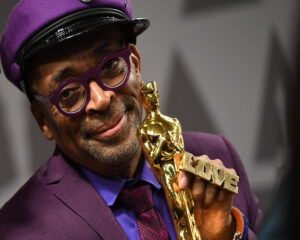
From his feature debut in 1983 though the present day, there has not been a voice as singular in cinema as Spike Lee. His films feature talented ensemble casts, electric soundtracks, kinetic editing, perfect costuming, and run the gamut from being deadly serious to downright hilarious, often in the same movie.
Lee’s films tackle important societal and racial issues without ever feeling like “message movies” or homework. It’s evident Lee loves movies as much as he loves making them, and his work with the camera, his way of involving the viewer, is always inventive from film to film.
He’s also an underrated screenwriter, writing all but a handful of the movies he’s directed and produced. Looking over the history of Zekefilm, contributors have offered their takes on Highest 2 Lowest, Blackkklansman, and Chi-Raq, and seven different ZekeFilm writers have chimed in about Lee’s masterpiece Do The Right Thing. If you are new to the Spike Lee canon, allow me to suggest some of my personal favorites for you to check out: Crooklyn, Girl 6, 25th Hour, and Da 5 Bloods. Maybe some or all of these will be covered by a ZekeFilm writer in this column! Let’s find out together.
– Max Foizey
Red Hook Summer
Directed by Spike Lee/2013 (U.S. Theatrical Release)
by Jim Tudor
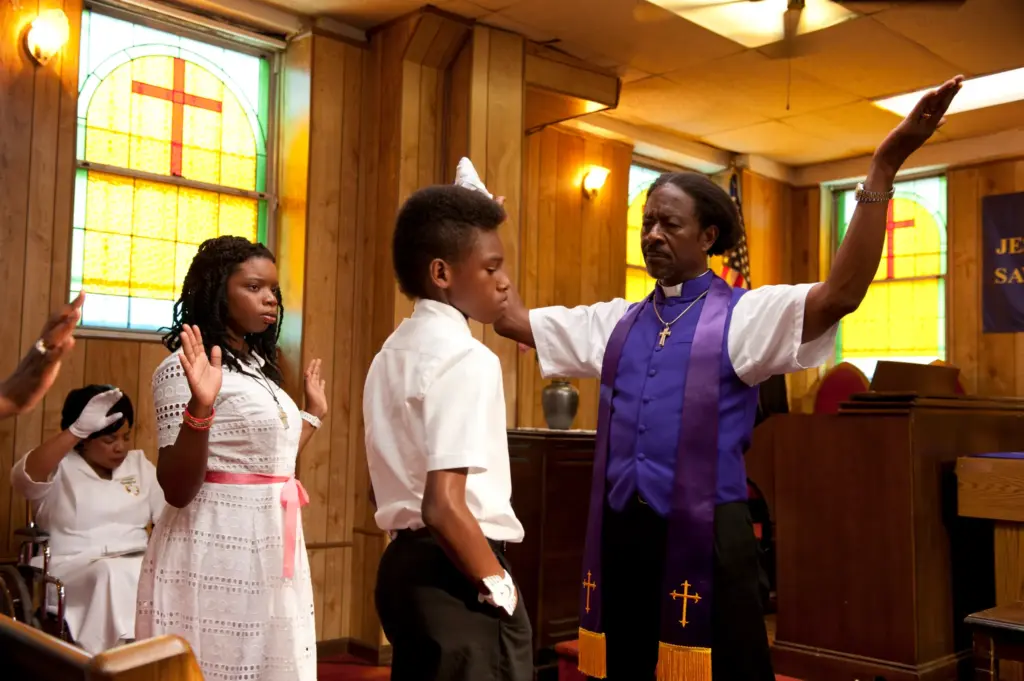
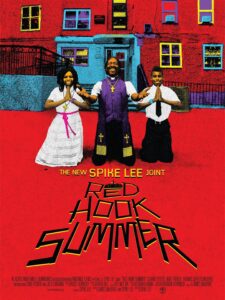
I seem to recall Red Hook Summer being touted upon its initial theatrical release (if in fact any theaters actually ran it during in its extremely limited 2013 run) as the sequel to Do the Right Thing. Big talk for a seemingly little movie, I thought. Finally having seen Red Hook Summer, I can confirm that it is indeed little in scope, though not in intent or heart. Spike Lee very very briefly reprises his role of Mookie (now credited as “Mr. Mookie”) to basically wander through one shot, still wearing the same jersey and still delivering pizzas, albeit in a different place. That’s the only way I can see how this is related to Do the Right Thing. In his audio commentary on the DVD, Lee says that he loves to let characters overlap between his movies, implying they’re all set in the same world. And why not?
Lee admits he’s avoided having kid characters in his films prior to this one, and I can kinda see why. Red Hook Summer prominently stars two kids as main characters, Toni Lysaith as Chazz Morningstar and Jules Brown as Flik Royale. Flik is a tween from Atlanta in Red Hook for the summer against his will. He’s made to stay with his grandfather, Da Good Bishop Enoch Rouse (Clarke Peters, who is exceptional in what turns out to be an extremely demanding role), he’d never met. Enoch leads a small Black church in the community, netting him a meager $150 a week. His dumpy apartment is decorated only with “white Jesus” pictures and crosses. Literally everything he says or does involves Biblical references and/or Christian platitudes. This is a complete other world for Flik, who is made to spend tons of time at his granddad’s church. This disrupts his budding interest in using his iPad 2 for filmmaking, but he does get to meet Chaz, a young girl his age whom he falls in with awkwardly but fully. When Bishop Enoch isn’t on screen, it’s all about these two kids. They’re not great actors, unfortunately. They don’t sink Red Hook Summer, but they might’ve contributed to its lack of theatrical exposure back in the day.
Spike Lee allows Bishop Enoch three different long-winded high-energy sermon-giving scenes, which the actor completely goes to town on. It’s in conjunction with these scenes that we get to see edge-of-stardom Jon Batiste as the dynamic church organist and
Colman Domingo as an unexpected interloper. It is, however, not until the last quarter of the two-hour film that anything of real note happens in the story. I did a double take when I saw that the film’s score was by
Bruce Hornsby of “Mandolin Rain” fame. It turns out that Lee has adored Hornsby ever since the two were introduced by Branford Marsalis. Singer Judith Hill contributes numerous songs to the soundtrack, and Hornsby sings one that cleverly namedrops Do the Right Thing.
Red Hook Summer was shot in only three weeks on a very low budget. Lee utilized some of his NYU film students to work in his small crew. It’s a meandering film by design, more interested in neighborhood vibe and character interaction than anything else. Unlike Do the Right Thing, 90 minutes of local color being colorful feels like a strain for Red Hook Summer. The film is not at all a takedown of the Black church, though criticisms are lodged over certain specifics. The revealed past sins of Bishop Enoch are infractions of him and him alone… mostly. What is truly extraordinary is that we don’t come away hating that character for what we learn he’s done. It’s an uncomfortably controversial road to go down for the film, but Spike Lee has never sidestepped controversy. This, though, still succeeds at being unexpectedly different than what one might expect. Much credit goes to the great Clarke Peters for pulling this off.
Did Red Hook Summer get its hooks in me? Not initially, but moreso on my second pass, with the commentary. It’s been a lingering curiosity for me that I’m very glad to have finally seen.
25th Hour
Directed by Spike Lee/2002
by Taylor Blake
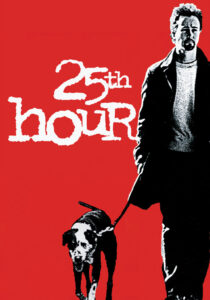
I do my best to avoid others’ opinions before I write about a film, but every once in awhile, I need them to develop my own.
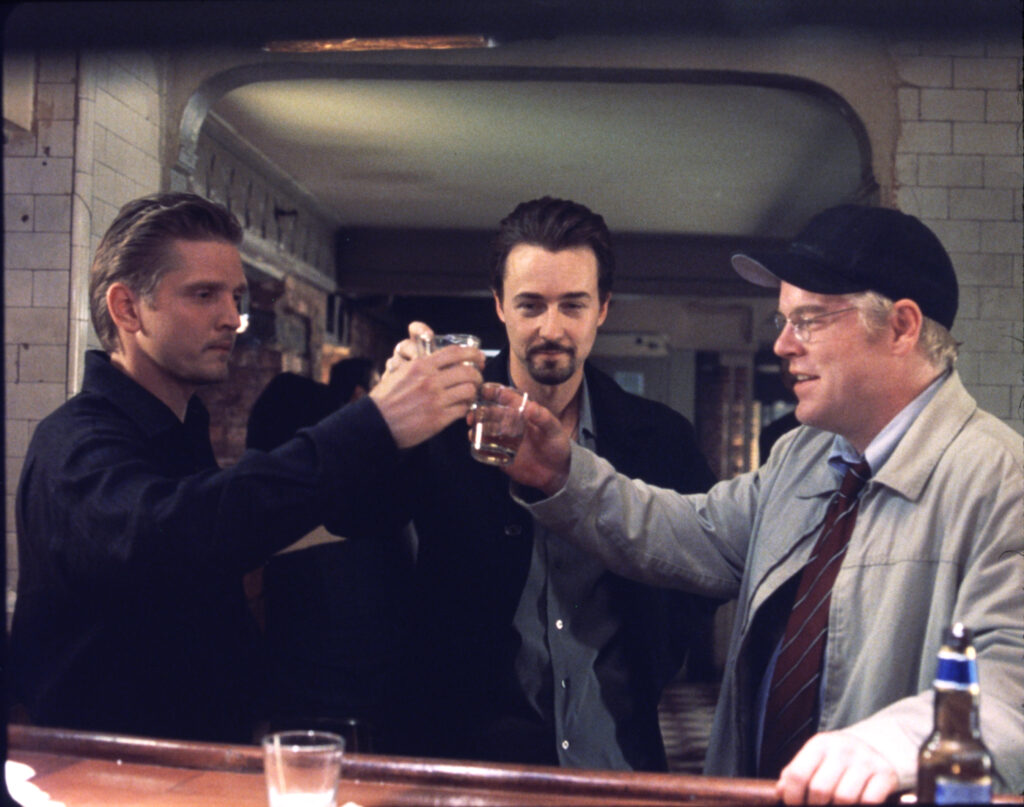
Spike Lee’s 25th Hour became the best kind of inscrutable for me. Something is clawing just beneath the simple premise of a man’s last day of freedom before prison, pulsing and raging and hard to define. Edward Norton’s convicted drug dealer, Barry Pepper’s bull-headed Wall Street trader, and Philip Seymour Hoffman’s pathetic English teacher are all struggling to get through these 24 hours, and not just because of the deadline looming over their last night out together. It’s not even because Norton fears his girlfriend (Rosario Dawson) may have been the one to turn him in to the Feds. His apoplectic monologue in the mirror fumes at anyone and everyone he can think of, including himself. His anger flows from no single source, and he has no idea how to shut it off.
This very New York story isn’t obtuse or avant garden, but it did leave me feeling at a disadvantage because of my age. Hanging in the air—almost literally—is 9/11. I was old enough to understand the facts on that day as I peered over the shoulders of teachers and parents glued to TVs. But I was too inexperienced—and fortunate to be several degrees removed—from the psychological weight. Thank goodness for critics like Roger Ebert, who could expand my childhood vantage point to understand what adults would be carrying into theaters in 2002. They also brought in their anger about the Enron scandal (a term I heard but didn’t understand in 2001), mistrust in the government, and a now-bleaker future than the new millennium promised. Upon its release, Ebert gave 25th Hour 3.5 stars; n 2009 he revised it to four (out of four).
A quarter of a century later, this vacillation between frustration and despair is just our heartbeat, an arrhythmia that (perhaps) kicked off on 9/11 and we’ve learned to live with. With Lee’s well-composed eye, this pain becomes propulsive thanks to montage editing. With on-location shooting that showcases the faces of New York, he expands what could have otherwise been a play in a claustrophobic, off-Broadway theater. And with simmering, on-the-precipice performances from our leads, there’s catharsis for our suspicion that it wasn’t supposed to be like this.
Of course, there’s also Doyle, the spotted stray Norton rehabilitates and who seems to be the only one with a future he concerned with besides his own. If his human friendships prove bad company corrupts good character—though it’s unclear if any of them ever showed good character—then his canine demonstrates there may be a chance for a fresh start no matter where you come from. There may be rage, but the last few hours on the outside also provide a new perspective.
Highest 2 Lowest
Directed by Spike Lee/2025
by Scott Montgomery
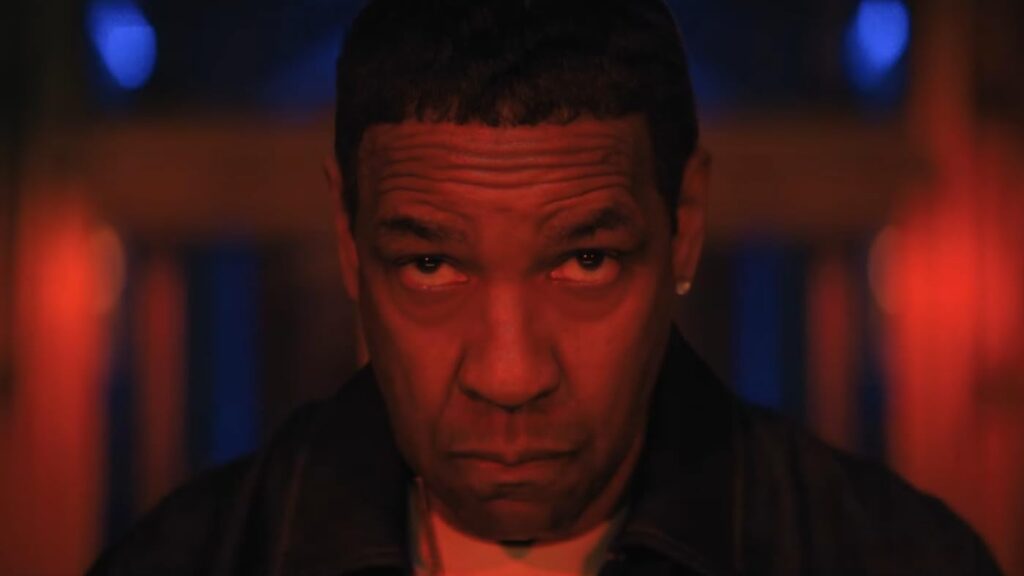

While I love Spike Lee’s “important pictures” like Do the Right Thing and Malcolm X, my admission is that I become more excited when he tackles genre. He wields his uncompromising views of our complex social community and his energetic baroque cinematic style, as he serves up a war or crime flick, deconstructing the form so he can construct his story by his own rules. A great example of this was his latest, Highest 2 Lowest. It becomes a fascinating study when you look at the source material and the first interpretation by another brilliant auteur.
The 1959 book King’s Ransom was an early entry to the 87th Precinct series Evan Hunter wrote under his Ed McBain pseudonym that set a template for the police procedural. It offers a great premise to examine morality and class. It begins with Douglas King, a self-made executive who oversees the factory of The National Shoe Company. Meeting at his home with the other vice-presidents who are plotting to take over the company from the founder. He tells them to go to hell and ushers them out. He confides to his righthand man that he has seen this coming and plans to buy up enough company shares he mortgaged his home to get for his own take-over.
Soon after the meeting, he gets a call his son has been kidnapped and will be safely returned for ransom. Even though the amount is close to what he has to close the deal, he understandably agrees to give it. That is until, he learns they’ve taken his chauffeur’s son by mistake but still want the money for that boy’s life.
The book then splits into three stories. The main one is a police procedural with the boys from the Eight-seventh, featuring the main regulars, Detectives Steve Carella and Meyer Meyer (yes, that is his name). The reader follows them and their fellow cops as they collect clues and work with Mr. King, who now refuses to give the money. The other thread also deals with King knee deep in intrigue and betrayal with his planned takeover as he also argues with his wife who begs him to come up with the ransom. The author also looks at the tension between the three kidnappers, including the ring leader and his reluctant girlfriend. All three come to a head in the “ransom” exchange for a tense conclusion.
The fall out is intriguing. Not all of the kidnappers are arrested due to the feelings one has for the other. King lands on his feet with both the corporate takeover and his family, much to the cops’ chagrin. A discussion between Carella and Meyer serves as an epilogue as it explains what happened and the story’s themes that argues that even some criminals have more scruples than businessmen.
The great director Akira Kurosawa took King’s Ransom and shifted several perspectives, structure, and ideas to examine his country of Japan in High and Low. It opens much like the book with the meeting with the businessman, going by the name of Kingo Gondo played by Kurosawa stalwart Toshiro Mifune, with the other executives of the shoe company who he throws out, followed by the confiding in his lieutenant of his plans and the financial risks he’s taken. The lieutenant behaves differently in the film, though. The news of the kidnapping and reveal of the wrong boy being taken also happens in the same order.
The changes in story begin when the police sneak into Gondo’s home and set up shop, telling Gondo to communicate with the kidnappers as they pick up what they can. We don’t see the kidnappers for the first hour, in fact we rarely leave Gondo’s home. Kurosawa’s understanding of camera and character blocking bring a tense and claustrophobic vibe as Gondo wrestles with the decision to give the money or not. Here, he does.
As soon the hand off takes place, the cops take over and the procedural crashes into the drama. We follow them as they try to catch the kidnappers in the handoff. Kurosawa switches to a more documentary style, associated with the genre The exchange shows how smart both the cops and kidnappers are. We then follow the squad as they painstakingly work to find the kidnapper and money as we are finally introduced to him as he struggles to lay low and deal with his junkie associates. The cops also switch their tactics to pin a murder charge on him since it holds a much stronger sentence than kidnapping. Kurosawa, like many Japanese at the time, was appalled at the rise in kidnapping and the minor punishment given. Many believed the film helped change the sentencing laws.
Kurosawa, who came from samurai ancestry, also expressed his feelings about what postwar society has become. Mifuni plays Gondo much like an shogun, living above the city in his castle like mansion on a hill. When offered of a figurehead position of the shoe company for them to save face due to the public attention given after the kidnapping, he declines. The cops come off as working class samurai, some even played warriors in Kurosawa’s period flicks. Their second in command is referred to as “Bossun” as a reference to the foreman position you find on the Yokohama docks. The film renders the chauffer as an annoying peasant, with pleading and groveling. Western capitalism challenges Kurosawa traditions in his rebuilt Japan. The kidnapper acts as much out of the jealousy for the riches he doesn’t immediately have. This all comes to head when Gondo meets with the criminal after his arrest. Both men can’t see who the other is due to their positions in society. The Japanese title is Heaven and Hell.
There have been attempts to do an American remake for decades. Even one from a David Mamet script was slated in the eighties. Screenwriter Alan Fox saw it as a template to explore the current state of the music. Spike Lee took his script and went even further and deeper for Highest to lowest.
David King, played by Lee’s own often used leading man Denzel Washington, plays David King, a music mogul who’s fragile business deal involves buying back controlling interest of his flailing recording company. Many believe he has lost his ear, but he knows it is because he lost control and the business became less personal. Washington brilliantly knows just the right wattage of his star power charisma to mix with gravitas age has given him.
Lee and Fox make two changes from McBain’s book and Kurosawa’s film right from the start. First, the sons involved in the kidnaping mix up are teenagers instead of very young boys. This gives King someone else to argue about giving the ransom with other than his wife (who is more on the fence in this version.) His son, Trey (Aubrey Joseph) is dealing with survivors guilt as well as attacks on a Twitter like platform. A powerful scene occurs between the two of them, with the son confronting him with his initial action of keeping the money as King struggles to maintain dominance as a father (or run to it as refuge).
Writer and director also give more weight to the chauffer, named Paul Chistopher here. Fox gives him more screen time and makes him a childhood friend of King’s and Lee casts the brilliant actor Jeffery Rush who can meet Washington toe to Toe. Paul often takes the role as King’s lieutenant, but a more streetwise, ex-con version. I can’t help but wonder if he covered for something he was involved with King. He can’t be dismissed. When he Paul asks King to give the ransom, he finds a dignity to it. There is no groveling. There is no way King can refuse in the end.
The police are also treated differently. While not inept, they don’t act as nimbly and are shackled to procedure and their world weariness and subtle prejudices. We first feel the class distinctions with the way they treat Paul when they learn it was his son taken, as opposed to how King was treated.
Lee infuses the movie with his amazing visual and aural flexes that stand out while still serving the story. It opens with an eagle’s eye view of New York to “Oh What a Beautiful Morning” from Oklahoma leading to King’s penthouse that is even more majestic than Gondo’s hilltop home. He opens up the apartment’s space with colorful African American art. His editing and camera work during the daring the hand off where the kidnappers skillfully utilize the city’s Puerto Rican Day celebration makes my point of Lee and genre,
It’s after the hand off, Highest 2 Lowest truly veers from McBain and Kurosawa. Instead of the cops going after the kidnapper, it’s King. That ear of his recognizes the rapper he passed on, Yung Felon (rapper A$ap Rocky in a strong performance), belonging to the voice he dealt with on the phone. The police think there are more important avenues to follow, so with Paul backing him up, the two hit the streets on their own, keeping King as the protagonist at all times.
As with most New York filmmakers, Spike Lee has a bold personality and he doesn’t hold back here. He always operates in the direct here and now he is shooting in and the characters have to not only deal with the crime story, but a media that makes everyone in the world a participant with unfocused sets of facts and jealous need for money and fame. A scene that pays homage to High and Low‘s finale has Young Felon , behind bars, giving King an offer to work as his producer. It’s hard not to think of the experienced director who raised money for his first film and fought in every way to get his vision of Malcolm X on the screen to look at a younger generation who equate popularity with talent and expect to get it quick and easy.
In interviews Spike Lee made a point to mention both McBain and Kurosawa. He takes these sources and treats them in the way a bebop jazz musician takes a standard and both expands it and goes inside it. Now, someone give the man a western.
Summer of Sam
Directed by Spike Lee/1999
by Max Foizey
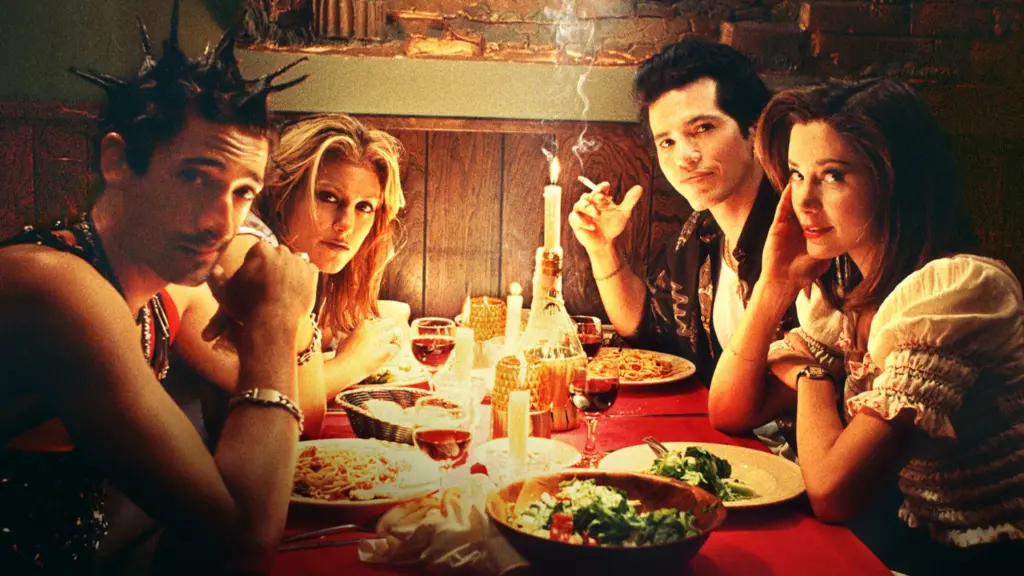
It’s 1977 and a dizzying tracking shot lets us follow Vinny (John Leguizamo) and his wife Dionna (Mira Sorvino) as they arrive in their car to a disco until they walk inside the club and start dancing to the hip and happening tunes of the day. Their fun night out will end up being wrecked by murder, as the so-called .44 caliber killer (Michael Badalucco) strikes again. The killer, not yet identified as David Berkowitz, continues to elude the police and commit more murders with his gun, producing newspaper and television coverage that plunges The Bronx and its surrounding boroughs into paralyzing psychosis and inescapable fear over the course of a sweltering summer.
A good portion of Spike Lee’s work focuses on the bonds and divisions that exist in tight knit communities, allowing neighborhoods to become a mirror for the issues that affect our nation as a whole. Summer of Sam was Lee’s thirteenth film and his first not to have a predominantly Black cast. Some contemporary film critics were surprised by this, since they had decided to put him in an artistic box labeled “Black Filmmaker” instead of “Filmmaker.” Lee was twenty years old during the real life events that inspired this movie so it makes sense that he would feel compelled to tell this particular story that took place in his city.
The screenplay by Victor Colicchio, Michael Imperioli, and Lee is full of sex, tension, fashion, drugs, and murder, brought to life on screen through Ruth E. Carter’s impeccable costumes and Ellen Kuras’ lustrous cinematography. Lee’s talents as director are on full display here, with many impressive cinematic choices from scene transitions, interstitials, and camera placement to the compelling performances he brings out of his cast. I’m of the (somewhat controversial?) opinion that John Leguizamo has long been one of our great actors, delivering standout work in most everything he appears in, including William Shakespeare’s Romeo +Juliet, The Babysitters, and The Odyssey. His character in Summer of Sam is an absolute mess, a paranoid serial cheater who is aware that there is no future for him if he keeps carrying on in this fashion. It’s not an easy part, and Leguizamo nails it.
Mira Sorvino was on quite a run in the mid-to-late 1990s, and her performance here as arguably the most sympathetic character in the movie, ranks as high as her work in Mimic, The Replacement Killers, and her Academy Award winning role in Mighty Aphrodite. As evidenced by his winning two Best Actor Oscars twenty-two years apart, Adrien Brody can turn in a strong performance when he wants to and he certainly does that here, allowing his punk rocker character Ritchie to act appropriately cringe as he speaks in an affected English accent while sporting liberty spikes. Jennifer Esposito is also very good as Ritchie’s girlfriend Ruby, juggling nuanced character work in some scenes and then in another scene screaming her head off while fronting a hardcore band called “Late Term Abortion.”
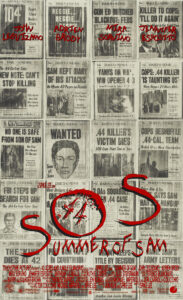
Terence Blanchard’s score unfortunately comes across as cheesy in the film’s quieter moments, but the movie also boasts one of the most impressive collections of popular music I’ve heard outside of a Scorsese film. The soundtrack, from Heatwave’s “Boogie Nights” to The Who’s “Won’t Get Fooled Again”, perfectly evokes not only the time period but also the varied temperaments of the characters themselves. A true epic at two hours and twenty two minutes, Summer of Sam (stylized as S.O.S. on the movie’s poster) is a sweaty, messy, grimy and important record of a city on edge and its population’s desperate reaction to being terrorized.