


The Awards Go To…

An Oscar is not a sign of greatness so much as a marker of a momentary convergence of attention and admiration. Every year, many of us voluntarily get caught up in the horse race of it all, the annual should win/will win. And if they’re at all like me, they come away from it sick to death of talking about the same handful of movies that were in the running.
Which raises the question of, “Then why are you bringing it up now??”. Valid. But, there is a method to this little bit of unasked-for madness. Ordinary film fans may be surprised to learn that the 2026-27 film awards season is already underway. Late summer hosts a myriad of beloved film festivals, including Venice, Telluride, Toronto, and New York. Each has its own established culture and cinematic ecosystem, and each bestows noteworthy awards to films in competition. Any such traction, considered alongside the results of earlier major outliers Cannes and Sundance, give way to the next phase: regional film critic groups’ year end awards. At least three regular ZekeFilm contributors actively participate in this phase each year.
With whatever light festivals and critics have managed to shine on the (ideally) worthy offerings, then quickly comes industry and guild awards. By this point, studio awards departments (yes, that is a thing) and film publicists have been working in overdrive to secure nominations and ultimately, wins. Then come the big fancy awards everyone knows about. People’s Choice, Golden Globes, etc. Finally, in late March/early April, all roads lead to the Oscars. That’s where certified members of the Academy of Motion Picture Arts and Sciences- film workers and artists across the board and from around the world- get to vote on the work of their peers. Do these people even watch most of the movies that they’re asked to vote on whilst working 12+-hour days on sets?Probably not, but one can hope they’re fair about it. Hence, the Oscars realistically can’t truly be any kind of legitimate be-all end-all, but it is undeniable that it’s the film award that history remembers. And that’s better than nothing.
We here at ZekeFilm said, “Why wait another six months to talk about the Academy Awards?” With the piece below, participating contributors have opted to opine about films of their own choice that have won two or more Oscars. By our estimation (well, a handy IMDb list’s), this is a healthy pool of at 320 movies. Here are our thoughts on just a few of those champs. This is how we chose to spend our August.
– Jim Tudor
Cabaret
Directed by Bob Fosse/1972
by Claire Meisch


When theatre transfers to the big screen, the results have been historically mixed. In terms of personal experience, my interactions with Cabaret stemmed entirely from scavenged slime tutorials scattered all over YouTube – if you know, you know. Each variation of the Emcee dazzles as they command the hypnotized crowd with each vaguely threatening musical number. The numerous Sallys are as equally devastating as deliciously entertaining, and the various Cliffs present themselves as an ideal narrative foil to their extravagant counterpart. These elements transfer painlessly from stage to screen with minor tweaking and adjustments. Perhaps one of the more lauded film adaptations of a Broadway production, Cabaret demonstrates the vast versatility of converting musical theatre to the big screen.
Opening with a rousing number from the club’s eccentric Master of Ceremonies (Joel Grey), the audience is graciously welcomed to witness the following series of events. Set in 1930s Berlin, the cultural landscape is on the precipice of dangerous political upheaval as the Nazi party comes into power. Cabaret tightens the lens to focus on the residents of the seedy Kit Kat Club. The promiscuous American Sally Bowles dances and sings for a modest crowd each evening while her head swims with dreams of breaking into the acting business. When British newcomer, Brian Roberts (Michael York) moves into her building, the odd couple develop an unlikely bond that blooms into a doomed love affair. Sally introduces her new roommate to her frivolous lifestyle in the moments between his various English language lessons. As their personalities mesh and their inner lives inevitably become entangled, Sally and Brian must make sense of their existence in a rapidly shifting world.
In director Bob Fosse’s capable hands, Cabaret twists into a glamorous vessel through which the crisis of a nation’s public morality is confronted within its sleazy underbelly. Musicals tend to be synonymous with happiness, which is why the original project experienced initial success. In this instance, fairytale endings and hopeful ballads are replaced by unflinching realism and a persistent sense of unavoidable despair. Fosse sinks even further into the real world by neglecting to allow any characters to spontaneously burst into a rousing number. Each song and dance interlude is strictly confined to the stage of the Kit Kat Club, which denies the audience even a brief moment of escapism from the dreary screenplay. As a direct result, musical numbers are sacrificed for the sake of fleshing out the kinetic relationship between our protagonists and the ideals they represent.
Each pivotal cast member is firing on all cylinders. Liza Minnelli is utterly magnetizing as the scandalous nightclub performer. She devours Fosse’s choreography as if it was created solely for her behalf and she commands each number with the experience of a Broadway vet. Michael York’s Brian is more reserved and stabilizes his roommate’s erratic tendencies. From the jump, Sally approaches her world with a caviler attitude and a staunch refusal to take any matter seriously – including Nazism. Her sporadic attempts to connect with Brian outside the physical are surface level at best. She is undoubtedly a charismatic entertainer, and the theatrics carry on long after curtain falls. Brian routinely battles her casual heartlessness by imploring her to comprehend the world around them. Though he willingly engages in her relentless pursuit of moral anarchy – most notably when the two expose that they have both been sleeping with the same man – his relationship with his Jewish clients Fritz Wendel (Fritz Wepper) and Natalia Landauer (Marisa Berenson) demonstrate his capacity for empathy and understanding of society’s faults.
Cabaret boasts catchy tunes aplenty, but it is the harsh narrative that elevates this particular musical. On the eve of the Nazi party’s reign, Germany faces an internal moral crisis. Running parallel to fascism is the rise of sexuality and other demonstrations of debauchery. These supposedly free acts are intermittingly disrupted by brutal violent acts of hatred and oppression. The Emcee bathes in the glitz and sensuality of the club as he encourages the crowd to ignore the worries of the outside world. There is an evil prowling outside the door that begs to be acknowledged. In a brilliantly bone-chilling final shot, the camera flips to expose an audience garbed in uniform and sporting swastikas. The beast has broken in and there is no ignoring the danger now.
Lawrence of Arabia
Directed by David Lean/1962
by Erik Yates
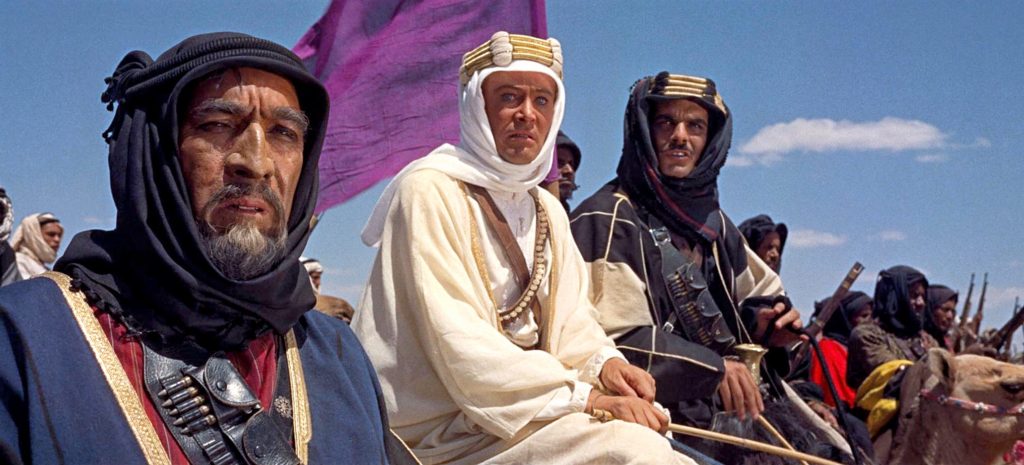
Lawrence of Arabia is a cinematic masterpiece that has long eluded me, but I have finally checked it off my list for this month’s film admission. While our current theme focuses on movies with at least two Academy Awards, this 1962 epic blows past that baseline with a staggering seven Oscar wins!
The film boasts an extraordinary ensemble cast, featuring Peter O’Toole in his legendary role as T.E. Lawrence, Alec Guinness as Prince Faisal, Anthony Quinn as Auda Abu Tayi, and Omar Sharif as Sherif Ali. Shot with Super Panavision 70 lenses, the cinematography brings the desert’s harsh, stunning landscapes to life. Filmed on location across Jordan, Morocco, and Spain, the movie looks absolutely breathtaking on my 75” screen—specifically the Restored Version, which is streaming on Netflix at the time of this writing.
Maurice Jarre’s iconic, Academy Award-winning score sweeps across the picture, injecting a sense of immense grandeur into every single frame. Through this visual majesty, we witness Lawrence’s fascinating evolution from an eccentric British officer into a fiercely loyal advocate for the Arab tribes. He commits himself to helping them secure their independence, even as Great Britain hides its own conflicting imperial ambitions—and even as the rival tribes unite to help the British overthrow the Ottoman Empire.
At nearly four hours long, the film allows Peter O’Toole to weave a deeply complex portrait of a tortured man. Lawrence is continuously pulled between his dual loyalties, haunted by his own disturbing enjoyment of the violence he commands, and ultimately left to watch his historic achievements fade away before his tragic, mundane death years after the war. Robert Bolt’s masterful script brilliantly explores both the psychological toll of warfare and the corrupting nature of power. Conflicting agendas run rampant among the British command and the tribal factions alike, weaving a dense political narrative with no simple answers.
While Arab audiences have widely embraced the film’s staggering scope and visuals, its cultural legacy remains complicated. The narrative has drawn valid critique for its “white savior” perspective, as the script frames the Arab forces as entirely dependent on a British officer to achieve their military victories. Yet, the film’s sheer cinematic power is undeniable. Decades later, its DNA can be seen in the works of Steven Spielberg, Martin Scorsese, George Lucas, and Denis Villeneuve—all of whom have praised its marriage of grand visual spectacle and deeply human, complicated storytelling.
More than sixty years after its release, Lawrence of Arabia fully commands the praise it earned in 1962. It remains an essential masterpiece that demands to be experienced on the largest screen possible.
Tom Jones
Directed by Tony Richardson/1963
by Justin Mory


The Best Picture winner of 1963, Tom Jones also won Oscars for director Tony Richardson, screen adapter John Osborne, and composer John Addison, with five of its actors, including Albert Finney, Hugh Griffith, Diane Cilento, Edith Evans, and Joyce Redman nominated, in addition to a nomination for its team of production designers under Best Art Direction, including Ralph W. Brinton, Ted Marshall, Jocelyn Herbert, and Josie MacAvin. That’s four wins and six nominations for those keeping count, reflective of the rare British production to receive such near universal acclaim in its day; a colorful historical pageant of zesty life unusually attuned to the freer spirit of emerging youth culture, as filtered through the unbridled artistic expression of loosening manners and mores.
Or so a reviewer might have said back then, which makes it all the more surprising how Tom Jones has apparently been embalmed in the intervening 63 years as a musty museum piece with its woeful “2.9” rating on Letterboxd, where users call it alternately “stilted”, “shrill”, “annoying”, “boring”, or just plain “bad”. Have we watched the same movie? Unfortunately, I can only imagine that its status as a Best Picture Oscar winner works against it, creating expectations and associations that Tom Jones neither fulfills nor lives up to, which I think overall misses the playful tone and giddy atmosphere that made it such a liberating view back in 1963.
Based on Henry Fielding’s four-volume 1749 novel The History of Tom Jones, A Foundling, the film opens with a silent movie-style prologue that places a mysterious child in the bed of its future benefactor Squire Allworthy (George Devine), who gives the abandoned child the name Tom Jones (Albert Finney). Reaching man’s estate with as passionate nature as his character is essentially good, Jones runs afoul of the disapproving elements of local morality represented by his tutors Thwackum and Square (Peter Bull, John Moffat) and the jealousy of the squire’s odious nephew Blifil (David Warner); all while representing himself as an entirely unsuitable suitor to his beloved Sophie Western (Susanna York), daughter and heiress of a neighboring and outrageously boorish country squire (Hugh Griffith). Banished from his home, Tom’s adventurous journey from the rollicking west of England towards London in all its Hogarthian glory – with many romantic and perilous interludes along the way in taverns and inns – may end either in the hangman’s news or feted by otherwise unforgiving fate itself.
Witty, lusty, scathing, and just plain fun, Tom Jones serves much of director Tony Richardson’s previous fame for contemporary kitchen sink realism exemplified by previous films like Look Back in Anger (1959) and A Taste of Honey (1961) as employed to comic ends on a historical subject; a French New Wave feel imparted to the playful performances and stylistics, the mock-sententious narration of Dublin’s famed Gate Theatre co-founder Micheál Mac Liammóir, and the part period harpsichord, part Georges Delarue-shimmering score of John Addison. And I mean, really, has anyone been more roguishly charming onscreen than young Albert Finney in the title role? Simultaneously innocent and debauched, one like Miss Western may in the end forgive him any number of romantic escapades while firmly believing him ultimately true in heart. I think the movie itself has much the same quality, and perhaps immediately succeeding our neo-Victorian era may again be rightly viewed as itself a true-hearted classic.
The Greatest Show on Earth
Directed by Cecil B. DeMille/1952
by Taylor Blake


Most of the time, Film Admissions is the excuse I need to finally catch up with the greatest movies of all time. This time, it’s my excuse to figure out if The Greatest Show on Earth really is as bad as they say. The short answer: Well…not no?
The greatest legacy of The Greatest Show on Earth is inspiring a young Steven Spielberg to pick up a camera after seeing its spectacle of a train crash (and then recreate it in The Fabelmans). “Spectacle” is the key word here—this circus drama is a lot of movie. Director Cecil B. DeMille spends many stretches watching tents going up and down, elephants loading on and off trains, and aerialists swinging up and over their trapeze. At times, this footage of a real circus feels like a documentary (with the most laudatory narration), and at others it brings the energy of an early backstage musical. Actors Betty Hutton and Cornel Wilde trained to perform much of their own trapeze work, giving an authentic tension to their characters’ risky stunts. (Dorothy Lamour and Gloria Grahame also performed some of their own stunts with elephants and weights.) DeMille is just as interested in the audience as the performers, frequently showing children laughing and jaws dropping on all ages. It’s no wonder a five-year-old Spielberg was dazzled by the extravaganza in front of him.
But even for those who don’t hate clowns, it does beg the question: Best Picture? Fun fact: It’s one of the few winners to earn only one other statue. Its second statue came in the now-defunct category Best Writing (Motion Picture Story), which should not to be confused with Best Writing (Screenplay) and Best Writing (Story and Screenplay), both awarded to other films. It’s difficult to find a credible resource explaining their distinction—Motion Picture Story evaporated before the end of that decade—so it’s hard to understand what voters saw in Greatest Show. Though Jimmy Stewart (in Ronald McDonald makeup for the entire runtime) makes the most of his supporting role, every character is thin in a barely-there plot. In Charlton Heston’s case, he’s a most unlikeable “hero,” a mediocre boss and terrible boyfriend who personifies the “show must go on” mentality to the point of delusion. Greatest Show’s greatest insult, however, is winning Best Picture over still-celebrated films like Singin’ in the Rain (not even nominated?), The Quiet Man, and, most of all, High Noon. The still-thrilling Western was a political football because its writer was investigated by the House Un-American Activities Committee, likely deterring voters into picking the least offensive alternative.
Even if you don’t know that embarrassing bit of Oscars history, Best Picture? Yes, I’m watching this through a modern lens, one more prone to cynicism and more vigilant of potential lawsuits, though I dare you to watch this and try to convince me their lack of safety protocols ever made sense. Instead of watching a clips of circus routines, wouldn’t you rather attend a live show under the big tent yourself? That would be a more memorable afternoon than watching this film.
Bound for Glory
Directed by Hal Ashby/1976
by Jim Tudor


When it comes to directorial winning streaks, two American filmmakers own the decade of the 1970s: Francis Ford Coppola, and Hal Ashby. While Coppola’s ‘70s run has and will culturally endure more than just any other run (we’re talking about The Godfather (1972), The Conversation (1974), The Godfather Part II (1974), and Apocalypse Now (1979)), a strong argument can be made for a certain superiority of Ashby’s concurrent run. It’s made up of Harold and Maude (1971), The Last Detail (1973), Shampoo (1975), Bound for Glory (1976), Coming Home (1978), and Being There (1979). Now that’s a freight train of formidable heft. Of those six titles, only Bound for Glory has lingered in my unseen column. Seeing how Ashby’s period-detailed biopic of Woody Guthrie scored two count ‘em two Academy Awards, I decided the time had come to jump on its particular boxcar.
Though a big-budget box office disappointment for Ashby and United Artists, Bound for Glory landed six Oscar nominations, winning for Best Cinematography and another for Best Original Song Score and Its Adaptation or Adaptation Score- a category that no longer exists, but one that perhaps certain critic groups could do with considering. Lauding of the actor-performed adaptations of so many classics of the Woody Guthrie songbook was pretty much a forego e conclusion amid the American bicentennial fever of ‘76. But Haskell Wexler’s transcendent cinematography is another matter entirely. Simply put, Wexler’s tactile sunscorched evocation of 1930s dust bowl desolation and the subsequent empty promised land of California is among the finest such renderings in all of cinema history. The socially conscious Wexler’s lighting and milieu both plops you into the stark reality of the collective hunger and poverty of the time and place, but also feels like some kind of dream.
To call David Carradine’s portrayal Guthrie “grounded” would be an understatement. Musician biopic tropes were cliches even when Bound for Glory was made, making it extra favorable that Ashby and screenwriter Robert Getchell manage to sidestep most all of them. This is true to the point that Guthrie’s signature song, “This Land is Your Land”- a song that wasn’t yet written in the timeframe of the story- only factors in at the film’s enigmatic very end. Perhaps true to its source material- Guthrie’s own 1943 partly fictionalized autobiography of the same title- our protagonist is, at times, anything but a faithful husband and father. Ashby delivers such dalliances with 1970s matter-of-fastness, without judgement or comment. The narrative speaks for itself in these matters.
As it rolls by for its 147 trsnsportative minutes, Bound for Glory is sublime in its journey but lesser upon arrival. What we derive from the experience of Ashby’s film is not nearly as potent as the takeaways of Harold and Maude, The Last Detail, or Coming Home. Nor is it as satisfyingly mysterious and intellectual as Being There. It’s not the decadent romp of Shampoo, either. Yet, one can’t say it’s a lesser film than any of them. This film wasn’t bound for the Oscar glory it was riding towards, but the awards it did garner are justly earned.