


Biopic on John Madden Hits Rock Bottom From the Start
DIRECTED BY DAVID O. RUSSELL/2026

If given my choice of several public figures with whom to spend a weekend watching football while eating buffalo wings and pizza, John Madden would be one of them.
Madden possessed a larger-than-life personality along with an encyclopedic knowledge of football. He was eccentric and spontaneously funny. The devotion he garnered from Oakland Raiders’ fans as the team’s head coach was surpassed by the adoration he received from television viewers across the country when he served as a sports broadcaster for 30 seasons.
This is the Madden whom I fondly remember and love, the one whom I’d gladly spend an entire weekend with discussing football — and anything else that happened to come up. I’m not alone in this assessment.
This contrasts sharply with the football personality portrayed by Nicholas Cage in Madden, released in theaters on November 11 by Amazon MGM Studios and now streaming on Amazon Prime Video. Directed by David O. Russell, this film offers a John Madden who is often remote, confused, unhinged and utterly lost in any environment that doesn’t have football as its central focus.

To briefly summarize my thoughts:
Madden is dreadful! It goes downhill from the start, evolving from bad to disaster to cluster- …, ah, -bomb (let’s say). In no way does Cage make viewers believe that he’s John Madden, even in his fat suit.
The movie highlights the long relationship that Madden had with Al Davis (played by Christian Bale), owner and general manager of the Oakland Raiders. Problems with the film’s storyline begin immediately as it quickly jumps from one phase of Madden’s career in football to another.
Madden and Davis have built a solid team in the Raiders. But they have trouble getting past the legendary Pittsburgh Steelers in the NFL playoffs and advancing to the Super Bowl. The Raiders lost to the Steelers three out of the four times they met in the playoffs during the 1972 to 1975 seasons.
The Raiders beat the Steelers in the AFC Championship game in December 1976, going on to win Super Bowl XI — the team’s first Super Bowl victory. This could be the beginning of a dynasty.

But that hope was dashed in the playoffs the following season. The Raiders lost the AFC Championship game to the Denver Broncos, throwing Madden and Davis for a loop.
The ups and downs experienced by the Raiders during this period could have made for some compelling scenes in Madden. Football offers the opportunity for drama, and good sports films capitalize on this.
But Madden fails spectacularly in this regard. We get a few quick scenes where they’re losing to the Steelers to a few quick scenes where they win the Super Bowl to a few quick scenes where they’re back on the losing end in the playoffs. It goes so quickly that’s it’s hard to keep up with what season they’re in.
The movie commits the same error in showcasing Madden’s career as a broadcaster. It rapidly moves through his first teaming with Pat Summerall (which started horribly) to his use of a telestrator to help TV audiences visualize what’s occurring on the field, peppering his chaotic illustrations with his trademark “Doink!” and “Boom!”
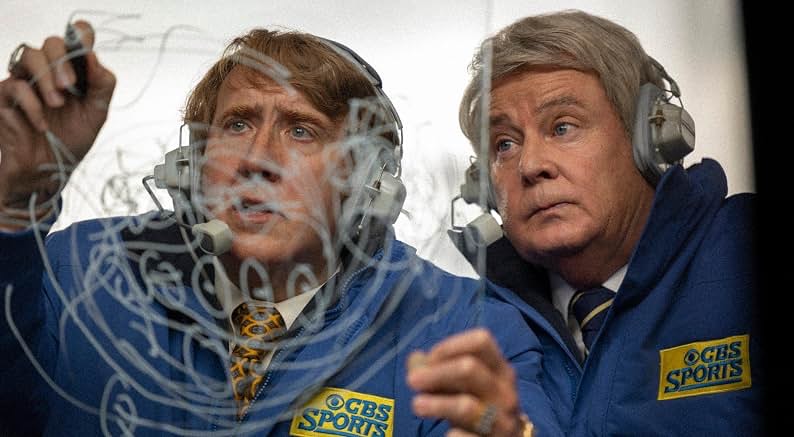
These parts of the film also fly by too quickly. Viewers aren’t given much of a chance to see why football fans came to love Madden in the broadcast booth.
The movie spends a good chunk of time in its latter half on Madden’s partnership with Trip Hawkins (John Mulaney), founder of Electronic Arts. Hawkins pesters Madden for a few years, trying to persuade him to collaborate on a football video game. Madden dismisses the idea at first before seeing its potential; he pushes the gaming professionals at Electronic Arts to make the graphics more realistic.
The Madden NFL video game goes viral (so to speak). This is accurately portrayed in the film, a fact that adds to Madden’s legacy even more.
However, viewers don’t gain any sense of what made Madden popular enough to base a video game on in the first place. It ignores the iconic broadcaster’s annual naming of his All Madden Team, for example, a highly coveted designation among NFL players.
In his November 17 review for The Hollywood Reporter, David Rooney captured the movie’s overall flaw with this lede: “Imagine being cornered at a party while sober by a wired cokehead determined to tell you a long, painstakingly detailed story without pausing for breath and you might have some idea of the exhausting experience of watching Madden.” I couldn’t have written that better myself.