


“We all go a Little mad Sometimes…”
Do we like to watch characters who descend into madness cause it washes out our abject fear of our own potential mental collapse? That is to say, is it mere catharsis? Or is it just that we like to watch people go nuts? Either way, the risk of this hard-hitting question being crass and insensitive is mitigated by the fact that we’re living in actual crazy times, where a little madness might be warranted, if not welcomed.
Here at ZekeFilm, our writers are not immune to the joys of this particular cinematic ogling, and we’ve gathered a bevy of titles that reflect our favorite freak-outs. Some are iterations of that slow switch from sane to not-so-well, while some are the fully sane surrounded by chaos. But whichever way you prefer to roll back the sanity for a roll in the cray-cray, we hope you enjoy our happy descent into Madness March.
– Robert Hornak
Hamlet
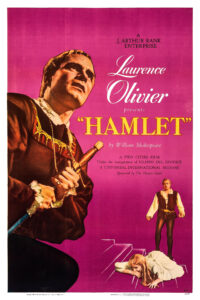
Directed by Laurence Olivier / 1948
by Taylor Blake
My first admission: I’d never seen the Oscars’ first major love affair with Shakespeare.
My second admission: I’m not a huge Shakespeare girlie.
But between Hamnet‘s eight Oscar nominations, “The Fate of Ophelia” reigning for weeks on the Billboard charts, and a soon-to-be-released version starring Riz Ahmed, Hamlet is having a moment four centuries after its first performance—it’s time I give Laurence Olivier’s telling a chance. Though I’ll never question his way with words—“To be or not to be” is just the start of Hamlet‘s bangers—I struggle with the Bard’s plotting. It’s not totally inaccurate to sum up Hamlet as, “They watch a play, hide behind curtains, then die.” Many of his tragedies would be avoidable if everyone checked their mail, listened to the soothsayer, asked their wife what happened to her handkerchief, and didn’t eavesdrop behind that curtain.
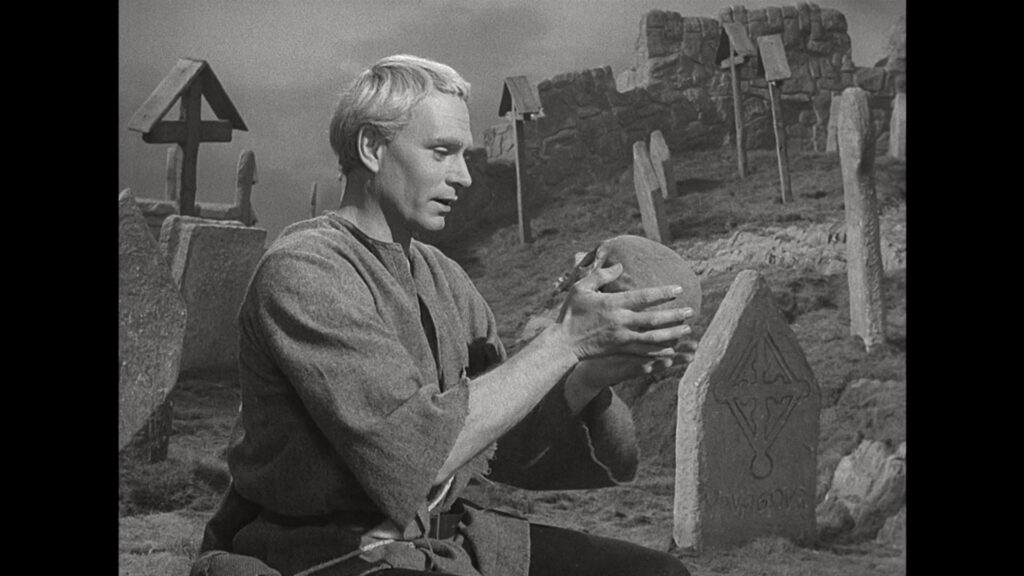
Then again, maybe the Shakespeare’s point was the tragedy was inevitable even if Polonius had asked Hamlet to his face about his feelings for Ophelia. Director/star Olivier begins his film with a non-Shakespearean thesis: “This is the tragedy of a man who could not make up his mind.” This smoky adaptation more resembles an M.C. Escher mind bender than a play, taking place outside of time and inside Hamlet’s cloudy vision and imagination. Brutalist sets and costumes adorned with off-kilter belts keep this Danish court feeling cold and unreliable, even spooky at times. With these hazy hallways, hilly graveyards, and winding rivers, it’s a wonder the characters don’t descend into madness and murder sooner.
The whole cast is capital-A Acting, but it never feels like a filmed stage production, a frequent problem for Shakespeare adaptations. I recently checked out the 1936 Romeo and Juliet, nominated for Best Picture that year. Though plenty of craft was on display in the costumes, sets, and choreography, the performers still felt like they were projecting for the back of the Globe Theatre. Olivier’s Hamlet feels like a film first, roving the camera around the stylized sets, sometimes even from the perspective of the king’s ghost. (Thank goodness Joel Coen took inspiration from this Best Picture winner for The Tragedy of Macbeth instead of most other Shakespeare adaptations!) Almost 80 years since its four Oscar wins, this take on Hamlet still feels innovative.
Apocalypse Now
Directed by Francis Ford Coppola / 1979
by Erik Yates
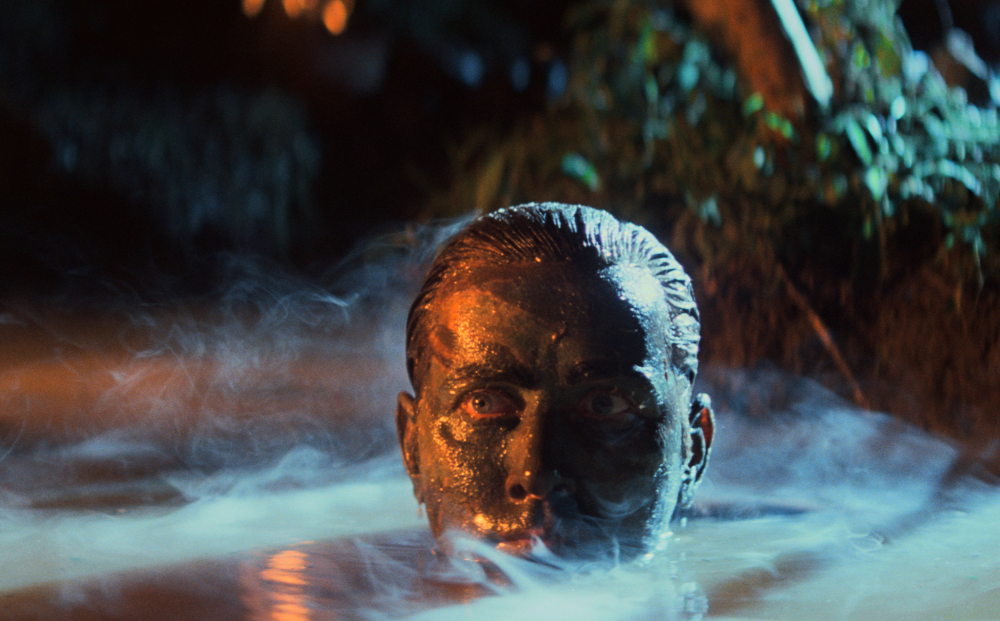
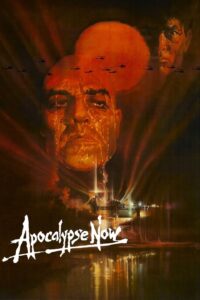
For a film about a descent into madness, Apocalypse Now starts off already there. With the backdrop of a jungle being napalmed, Captain Willard (Martin Sheen) is in full hallucination mode as he gets some R&R in Saigon, cranking music by The Doors in his hotel room and tripping on something…anything, that will take his mind off the war he is currently engaged in. He begins his journey in a sort of madness, but as we will see, there is still more room to fall. Capt. Willard is summoned for a black op mission to go up river and assassinate Colonel Kurtz (Marlon Brando), a once shining star of an officer who supposedly sabotaged his own ascent up the military ranks to go into the special forces, killing his future chances of obtaining the rank of general, or serving on the joint chiefs of staff. Now, Col. Kurtz is said to have gone mad, gone off grid, and is supposedly leading a whole bunch of military disciples who follow his commands alone. Along the way he meets a whole collection of soldiers who are in various points of their own journey into madness. The standout would be an Air Calvary officer played by Robert Duvall (“I love the smell of napalm in the morning”) who is obsessed with surfing and famously blasts “The Ride of the Valkyries” by Wagner as his helicopter division descends on the enemy. Other notable cast members that are featured in the film include a young Laurence Fishburne, Harrison Ford, Scott Glenn, and Dennis Hopper. This film’s production is equally a descent into darkness with Martin Sheen struggling in real life with alcoholism and having a heart attack while filming, rumors of cocaine use being rampant among the cast and crew, the investigation of whether real bodies were being used from a local graveyard for scenes in the film, to a scene featuring a real brutal slaughter of a water buffalo. Despite these controversies, and the film’s 3-year production and bloated budget, what director Francis Ford Coppola put on screen has largely been hailed as a masterpiece. While an unflinching look at the effect of war, and the varying spectrum of the descent into madness that we see amongst these characters, I found that seeing it for the first time some 47 years later, that it doesn’t hit me as even the best movie on Vietnam. Brando’s performance demonstrates the madness of the character, but many stories circulate that the madness depicted in the film may have just been him. Well-acted and ambitious? For sure. An important film in cinema? Yes, especially for its time. One of the best war films ever? It depends on whether you are interested in a real depiction of the Vietnam war or if you are more interested in the psychological horror war inflicts on its participants. Its inaccuracies of its depictions of the Vietnam War have been picked apart by veterans for years. Its look at the madness that war brings upon both those who fight and those innocent individuals who are caught in the crosshairs, makes it required viewing.
Naked Lunch
Directed by David Cronenberg / 1991
by Ethan Tarantella
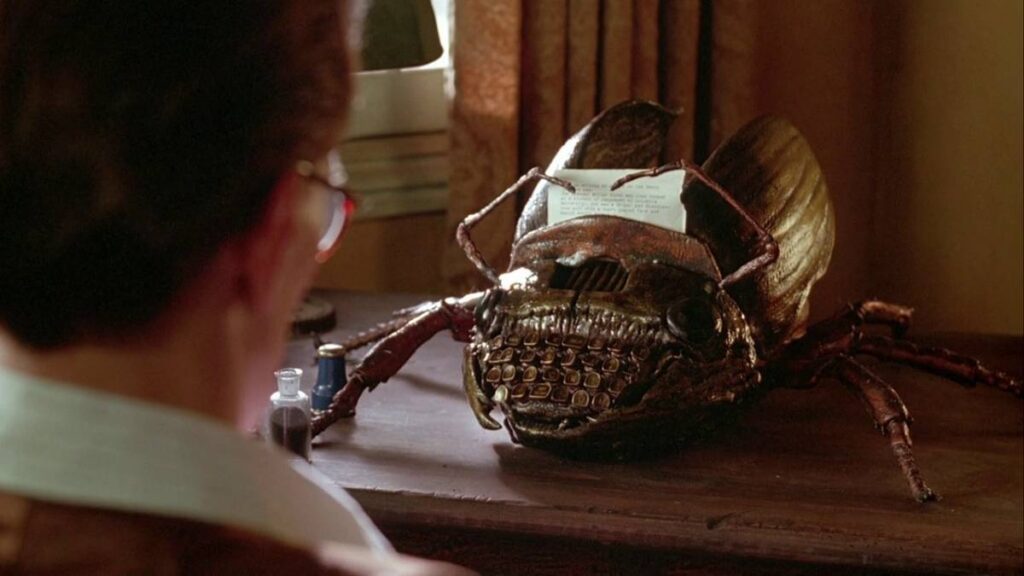
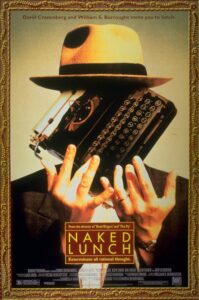
When I first saw Naked Lunch fresh out of high school, hot off the high of a David Cronenberg summer after seeing Crimes of the Future, it made quite a little impression on me. Beyond being my introduction to the works of William S. Burroughs, later reading his crazed, unadaptable novel of the same name, Cronenberg’s cocktail of capturing the spirit of the book while turning his adaptation into a slapdash biopic on the writer crafted some unforgettable grotesqueries that can only be explained as the work of a madman or a junkie far off the deep cut. Talking bugs that communicate through their hairy assholes, a sex scene involving a typewriter transforming into a creature featuring every sexual organ imaginable, a man typing inside the gaping maw of an monstrous humanoid that secretes a milky jism from its throbbing rod on top of its head, Roy Schneider in drag, and quite possibly one of the most disturbing depictions of rape ever put on film.
But what really got to me, as someone trying to come to their own with their sexuality at the time, was in Cronenberg’s handling of Burroughs’ own journey with being a perverted queer. As William Lee (a pen name that Burroughs would insert in other works such as his novella Queer) attempts to figure out his unexplored queerness and his self-internalized disgust around it, he always tries to separate himself from it, whether as a secret identity or viewing it in revolting sights like a homosexual centipede monster.
A man living in the repressive age of mid-century America, Naked Lunch’s William Lee’s , self-hatred towards his sexuality leads to Cronenberg creating a series of metaphoric vices in the avatar’s odyssey of sex, drugs, and bugs. As Peter Weller’s perfectly reserved performance signifies, his restrained identity gives him a mantra that the typewriter is the most dangerous thing of all. A center for expressing his sexuality, an encourager for his growing drug abuse to bug powder, black meat and other harsher substances, an inspirer for Lee’s double identity/drug-fueled coping mechanism as a secret agent infiltrating and writing reports about Interzone, the symbolism never differentiates for him, interconnecting into an ever-shifting web of demons that furthers his descent from reality to better understand himself.
It is a film that gets at a lot of things. It constantly quotes Burrough’s writing, including an extended reciting of “The Man Who Taught His Asshole to Talk”, makes the connection between Burroughs killing his wife Joan Vollmer with his identity as a writer, and brings in Cronenbergian flair via Howard Shore and Ornette Colman’s score and ominous noir to make a movie trying the peel back the complexities of everyone’s favorite beatnik. It has the dry depravity of the iconic horror director and the crass, unflinching vulnerability of the iconic writer, making for an odd combination that work perfectly well with each other to tell a tale of someone drinking Mugwump cum to try to both find the center of himself while fighting his inner self from taking over. It is ultimately a movie about the insanity of writing; what it takes from you and what you give to it in order to come out a complete person, despite the endpoint being continuing to live with guilt and your own ambiguities.
Just remember to exterminate all rational thought, then maybe there can be some control in this Kafka high.
L’Amour Fou
Directed by Jacques Rivette / French / 1969
by Justin Mory
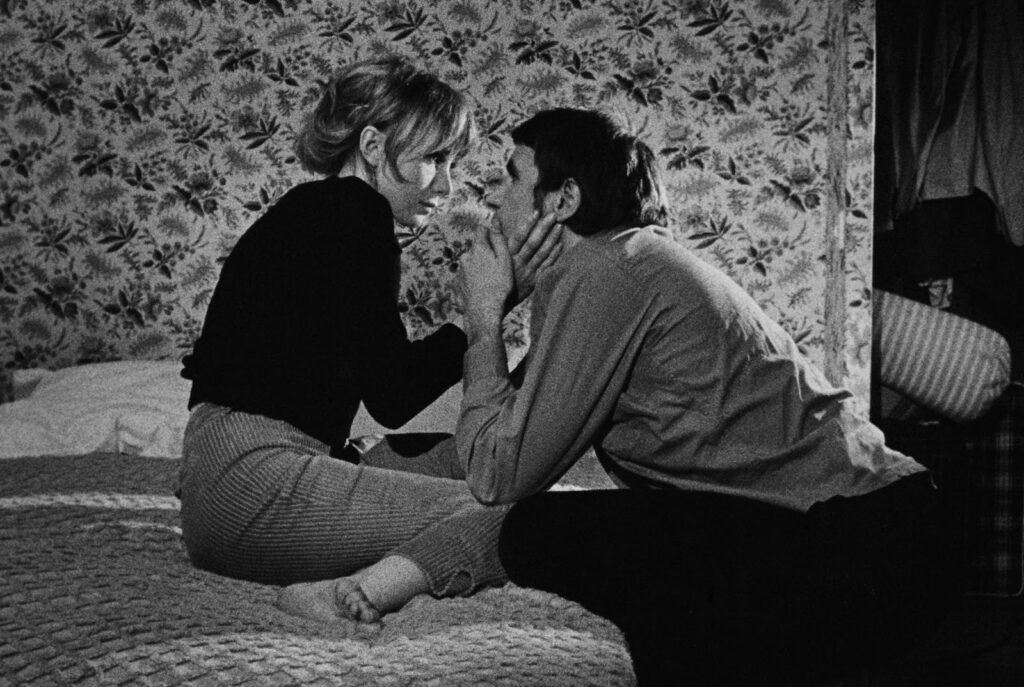
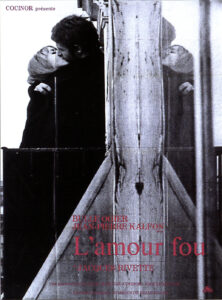
Viewed by some as the last New Wave film, L’Amour Fou within the continually searching filmography of director Jacques Rivette falls between the protracted production that eventually resulted in his first feature, Paris Belongs To Us (1961), and the monumentally radical, form-breaking Out 1 (1971), which depending on whatever version you sit down for may take more than half a day to fully watch. All of these broadly feature the rehearsal of a play or plays, a scenario that Rivette would even later return to in L’Amour par terre (1984) and Gang of Four (1989); which in the specific case of L’Amour Fou documents a reinterpretation of Jean Racine’s Andromache, as itself documented by a French television crew led by Cinéastes de notre temps director André S. Labarthe.
The hall of mirrors stylistic approach, switching back and forth between Labarthe’s crew “subjectively” capturing the rehearsals in handheld, closeup, sprocket-whirring, grainy 16mm, and Rivette’s “objective” longview, gliding silently in 35mm on dolly tracks behind, opens on lead actress Bulle Ogier, as the play-within-the-film’s lead actress Claire; immediately quitting the production directed by her husband Sébastien (Jean-Pierre Kalfon), who himself is also playing the lead role of Pyrrhus. Everyone involved seems to take the potentially devastating development very sophisticatedly, or Frenchly, if you will, with Sébastien immediately replacing Claire with Marta (Josée Destoop), whom it transpires is Sébastien’s ex-wife. Marta, however, is also best friends with Claire, Claire continues to attend rehearsals as an interested spectator, and all initially seems hunky dory.
Until it isn’t, the escalation of emotions almost imperceptibly develops through jealousy, paranoia, pin-gouging, razor-tearing, attempted dog-napping(!), and eventually an orgy of mutual destruction in the couple’s enviable Paris garret. Building deliberately through the film’s running time of 4 hours in 15 minutes, at a pace often frustratingly glacial, it takes almost that long to figure out that anything – or point of fact, everything – is terribly terribly wrong. But even the dullest of viewers, such as myself, will eventually catch on the moment a sledgehammer smashes through the screen of a television. No one in their right mind, especially in a film financed in a capitalist country, say, would ever destroy a TV.
Insanity is of course apparent from the French title, itself taken from a 1937 surrealist text by André Breton, which has been used to retroactively describe an all-consuming, destructive passion experienced by lovers, most notably portrayed in world literature by Emily Brontë’s 1847 novel Wuthering Heights. A prime influence on surrealists, again retroactively claimed as a surrealist text – which has gained some cultural currency of late through Emerald Fennell’s controversial 2026 adaptation – the great screen surrealist Luis Buñuel previously adapted Wuthering Heights as a contemporary-set Mexican melodrama in 1954, and, coming full circle here, Rivette himself reset his own 1985 WH in the 1930s French countryside. Rivette’s is by no means a surrealist vision, but his Russian Doll-nested, reflectively mirroring aesthetic, where the drama onstage feeds into real-and-reel life drama, not unlike the reel-to-reel audio tapes prominently featured throughout, creates a disconcerting Ouroboros effect – the director was himself experiencing a breakup with co-writer and frequent collaborator Marilù Parloni during L’Amour Fou‘s lengthy production – that is difficult to dismiss as merely art imitating life, or vice versa, in viewing. If love is a form of madness, enjoying a rigorously honest love story is possibly even moreso.
Last House on the Left
Directed by Wes Craven / 1972
by Jim Tudor
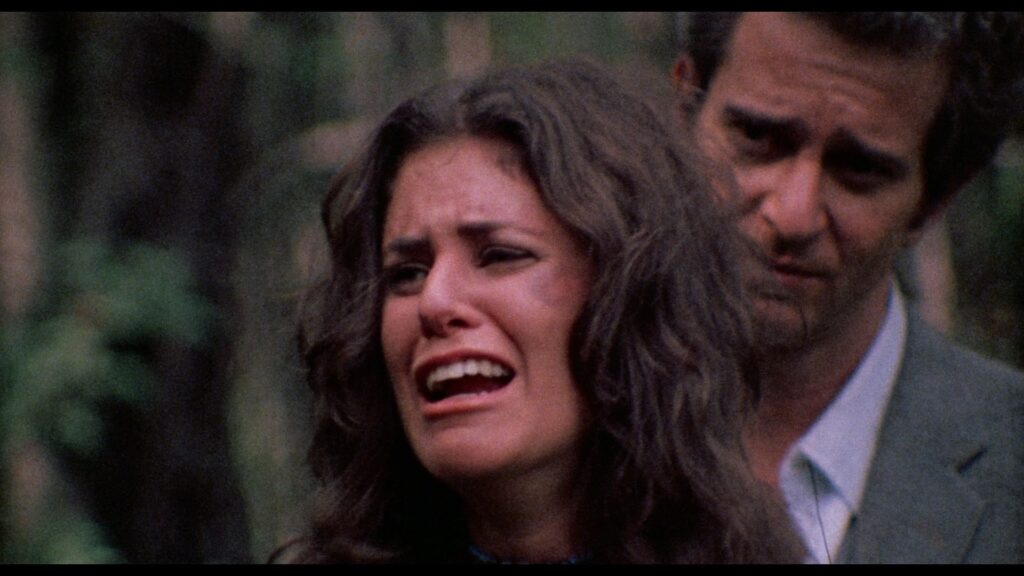
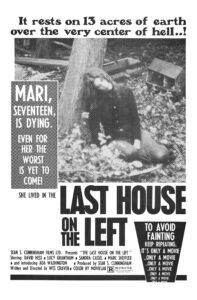
Even as a Wes Craven fan, I’ve managed to bob and weave around Last House on the Left for decades. Today, I was finally spurred on to check that long glaring box by the prospect of lecturing on no less than Ingmar Bergman. As virtually any horror fan who’s in the know is quick to tell you, this feature debut by a young barely-tested hippie Craven is actually directly modeled on Bergman’s dark ages tragedy, The Virgin Spring. While it’s certainly likely for film buffs to find value in both films, the gulf of cultural prestige, tonal consistency, and utilization of meager production values couldn’t be wider. For years and years, I’ve heard the caveat of admiring fans parsing the wildly off-kilter DIY rape-revenge, Last House: “The music cues are dopey.” “The bumbling cops are extremely out of place.”, “Technically speaking, the house isn’t on the left nor the last house there”, and, “Must it turn into a Home Alone movie in the third act?”. Of all the nits that will forever be picked about this movie, that last one holds the most water with me. (Though all have their validity). That the slain teenage girl’s parents immediately go into brutal vengeance mode against her killers is, though understandable, completely forced within the “crushing reality” tenor of the central killing of the two protagonist teen girls by their Manson Family-esque attackers. (To be sure, the dark if rare reality of hippie brutality was lost on no one in the early 1970s… not even on the innocuous hippies that made this challenging film).
It’s logical to suspect that no one making this movie had kids of their own yet, and if so, they actively disassociated big time from the gruesome reality they were taping into, as the assault and murder scenes are truly, effectively horrible. The fact is, however, Craven had been a father since at least 1965. He did in fact briefly depict the parents’ worst nightmare moment much better in Scream. Here, though, sloppy-to-the-point-of-absurd tonal whiplash does a number on any viewer of any sensitivity. It’s hard to simply go with Craven and company as Last House shifts gears to a grieving father meticulously making traps to hinder and kill his only child’s murderers, who just happen to be in his house at that point. Craven would go back to this third act trap-rigging goofiness with his true breakout film, 1984’s A Nightmare on Elm Street. Even the notion of average teen girl Nancy effectively rigging her house with traps for Freddy Krueger is more digestible than the Last House version. Cutting from a guttingly unforgettable sequence of humankind’s savagery towards its fellow humans to two comedy-relief police officers running out of gas and bickering while kooky saloon piano music plays, I can somehow handle. the real world is, after all and at any given moment, a place of all manner of weight and tonalities. The funniest most absurdist thing might in fact be playing out only a few miles from the worst tragedy. In a movie, especially this movie, it IS jarring. But it is two different things in two different places. Also, thematically, the cops’ uselessness makes sense. The grieving parents, who should be shattered beyond any comprehension, formulating and executing the plans they execute, is another matter.
And yet… for all the many weirdo flaws in active and consistent play here, the performances of Last House, along with its uncompromising commitment to whatever it’s doing from one minute to the next, go a loooong way. As a critic, it can be hard to know what to do with a film like this. So I waited most of the day to write this. Many hours later, I find myself still thinking about Last House in ways I probably did not expect. The movie speaks directly to the lingering post-Manson murders milieu of crushed idealism and bloodlust adorned in peacenik clothing. It’s also a bunch of ragtag filmmakers spinning their first film out of nothing and taking whatever time they need to make it, presumably during the cracks of their real lives at the time. I avoided this film entirely because its premise always sounded so revolting. It is, but not in a way that showcases the humiliation and torture of its protagonists the way producer Sean S. Cunningham’s Friday the 13th and its many sequels would. Like the tonally diverse and sometimes unbelievable world it depicts, Last House contains unexpected truths amid the hard parts, the cringy parts, and the parts that are just plain unbelievable.
The Snake Pit
Directed by Anatole Litvak / 1948
by Max Foizey
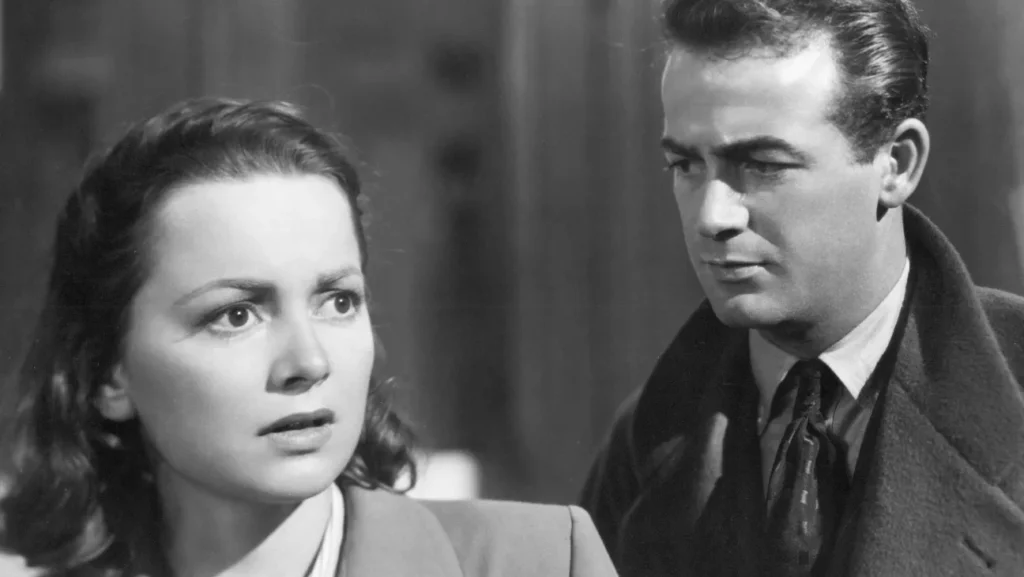
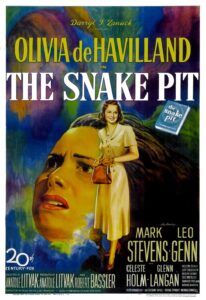
A precursor to films like One Flew Over the Cuckoo’s Nest and Girl, Interrupted, Anatole Litvak’s The Snake Pit is both a compelling drama and an arresting time capsule of once-modern mental health treatment. Millen Brand and Frank Partos’ screenplay, based on Mary Jane Ward’s semi-autobiographical novel of the same name, concerns the plight of a young woman named Virginia Cunningham (Olivia de Havilland). She is a bundle of nerves. She’s talking to a woman she does not know. How does this woman know her name? Virginia is having trouble remembering things. Someone calls for her to come back inside of a building. It’s a hospital. She is surprised to learn that she is a patient there. It is a mental health facility. Virginia slowly begins to realize that she has been institutionalized. She becomes fearful. She wants to leave. The doctors will not let her. She does not know why she has been committed. She does not remember her home address. She does not recognize her visiting husband Robert (Mark Stevens).
Through flashbacks we see moments from Virginia and Robert’s life together, first as a happy couple, then as Virginia exhibits frequent wild mood swings. Virginia’s erratic behavior only worsens over time. Concerned for her sanity and safety, Robert decides to have her committed to the Juniper Hill State Hospital. With treatments that include electro shock therapy, this is an understandably frightening experience for the lost and confused Virginia, and she is not alone among the patients in her desperation to get out of the hospital and return to her normal, everyday life. The kindhearted caregiver treating her, Dr. Kik (Leo Genn), is sympathetic to her condition but cautions that she has much to sort out before she can be released.
The Camarillo State Mental Hospital in California served as a filming location for The Snake Pit, lending authenticity to a film that is as engaging today as when it was released. While much of the therapy on display is dated by today’s standards, some of it is rather forward thinking, including the concept that Virginia’s mental health was affected by traumatic events not only in her recent past and her childhood, but in her infancy before she could even speak. The film was a success upon release, and helped to influence public opinion about the importance of funding for mental health programs.
Leo Tover’s steely cinematography and Fred Sersen’s impressive special effects place the audience in the terrifying state of isolation that Virginia is experiencing, and some scenes do indeed come across like a horror movie. Olivia de Havilland’s quiet narration puts us inside Virginia’s troubled mind as her unease and terror grow with each day that she is confined in the asylum. The Snake Pit works as well as it does due to de Havilland’s powerhouse performance. Conveying Virginia’s fragile mental state through sheer intensity, de Havilland vacillates between confused and confident, frightened and aloof, joyful and delirious. It’s one of my favorite film performances.
Vertigo
Directed by Alfred Hitchcock / 1958
by Robert Hornak
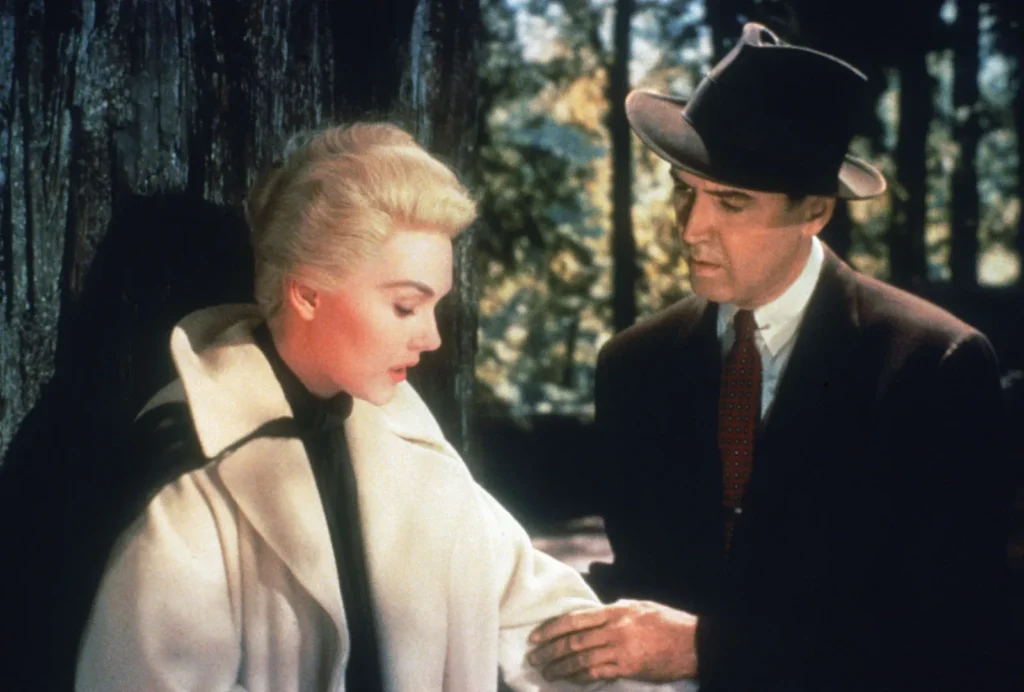
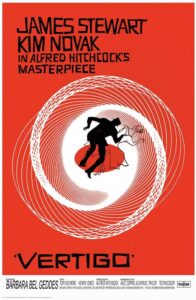
It’s clear to me here in my middle fifties (nearby the apparent tree ring of the lead), married, a father, and with many notebooks full of the details of mistakes made, married with some good choices missed, that this movie’s an indelible metaphor for regret by way of mad obsession. It asks in drawling Technicolor swaths how deeply the dolly-zoom can telescope down into the burnt-out psyche of a man lost and floating through years soldered and cinched by guilt. Surely Scottie, post-rooftop fiasco, wants no one to ever try and help him again, certainly not willing and available Midge, yet his reverse-manipulation of Judy is the opposite, controlling impulse writ large – imbuing a perfect stranger with the qualities and traits of his obsessive focus like Henry Higgins with a me-too death wish.
Across the plot, we wait for Scottie to come to his blue-eyed senses, but instead watch him enveloped in red and green lights that wrap around him like weighted blankets that usher him into sleep sweats and thousand-yard stares into staircases. His mid-movie check-in to a San Francisco mental ward is fulcrum from reliable narrator to gauzy rambler, befitting and imbuing the unsettled structure of the movie – the long discursions, Judy’s seemingly premature flashback-explanation of how it all went down, the obscure mystery of how a man can behave this way toward an unwilling woman he claims to love – all of it out of reach of logic but staking it way down into the reasonable torrent of shared subconscious.
But beyond mere psychology, this eventual regret-obsession is dipped in shades of horror from the start when Scottie’s given his mission as a ghost story, one that fits his journey into the category of paranormal investigation – conjuring out the theory that a woman’s been possessed by a hundred-year-old ghost, an eldritch theme Hitchcock doubles down on amidst the Redwoods, the tree-rings of which spiral the storyline backward from merely the last century to many centuries, connecting Scottie’s own tragic past to an unknowable world of darkly dripping history.
Thus it is that a casual opening favor for a friend becomes, over the long screen time, a deep-dive into the lengths a man will go to recapture the pure hit of love-at-first-sight inside an already perverse attempt to eradicate his own myriad regrets. It’s Hitchcock’s masterpiece, not of suspense, but of universal confession. And yet the shock of any second viewing is that the entire first half is all a scam – Gavin and Judy have set Scottie up. This is truly the king of all patsy movies: Scottie has fallen in love with Judy’s impersonation of Madelaine, who’s already dead. And this poor man’s greatest loss is that in his attempt to flee the regrets of his life, he’s created many more. His physical form, standing atop the ledge in that final shot, is a kind of ironic crucifix – perhaps he is a man who has sacrificed much to finally destroy his vertigo, but he may never truly come to life again.