


In Every Toys R Us A Heartache
DIRECTED BY DEREK CIANFRANCE/2025
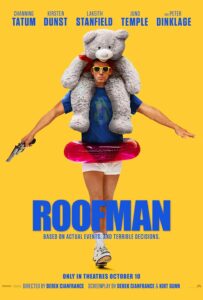
The craziest thing about Derek Cianfrance’s Roofman, despite its potential exaggerations, is how the many cliche story beats that Jeffrey Manchester (Channing Tatum) goes through actually happened. For a film that uses its “can you believe this is a true story?” marketing gimmick to make its relatively quirky premise of a robber hiding out in a Toys R Us feel crazier than it actually is, when one hears the plot of Roofman, they would expect the real life equivalent to be more boring. It is a very simple (and possibly unentertaining) premise that screams that Cianfrance and writer Kurt Gunn had to make stuff up for it to be more engaging. But no; the fact that the real-life Manchester was an active Church member, was dating someone, and had the time to go to a dentist’s office while evading authorities for several months proves that life can be stranger than Hollywood storytelling.
Of course, leave it to Hollywood to flatten it. Manchester’s adventure is given the studio comedy treatment, transforming him into a happy-go-lucky protagonist who just wanted to provide for his three kids and make his ex-wife proud. Though, with a job hunt that only gets tougher with no one finding the skills he learned from serving in the 82nd Airborne Division worth their time, it leaves him with a small, dingy house and not enough money to buy a bike for his daughter’s birthday. But thanks to his army buddy Steve’s (LaKieth Stanfield) advice to focus on his gift of observation, Jeffrey manages to turn his life around by noticing the entries and exits of his local McDonald’s, what time they take company earnings to the bank every week, and a way to break in through the building’s roof. It turns out his army expertise works perfectly for armed robbery.
For two years, Jeffrey earns enough money to join the middle-class lifestyle, robbing over 40 McDonald’s in North Carolina until the police arrest him during his daughter’s birthday party. Of course, the observant robber manages to figure out a way to escape prison, thanks to a crafty board to hide himself while riding underneath a delivery truck. Once he makes it out to the free world, he finds no way to return to his past life. His family is now antagonistic towards him, and all that Steve can help him with is a future meeting to give him a new identity once he gets back from “vacation”. With cops crawling all over the city of Charlotte, the only spot Jeffrey can find to lay low is a hidden section in the backwall of a local Toys R Us. Surviving off of Peanut M&Ms and dying of severe boredom, he soon entangles himself into the lives of the Toys R Us staff, listening to the audio from the baby monitors he hid around the store to track them and entertain himself. The line between spectator and participant soon crosses when he uses the store’s computer system to give employee Leigh Wainscott (Kirsten Dunst) a day off to look after her kids.

Roofman itself, throughout its two-hour runtime, slowly transitions from a crime film into a rom-com as Jeffrey makes himself known to Leigh, meeting her at a church she volunteers for as he drops off refunded toys for their toy drive. Hiding under the identity of John Zorn, a guy who just happens to be new to town for a top secret government job, his good-guy attitude charms Leigh enough to start a relationship, and even seems to fill in the vacant hole her inattentive ex-husband left behind as he bonds with her two daughters Lindsay (Lily Collias) and Dee (Kennedy Moyer). Although, sticking to what happened in real life and the conventions of a crime film, Jeffrey’s new life doesn’t last too long.
Despite how easy-going Roofman makes itself, from the charming performances of Tatum and Dunst along with Cianfrance’s workman-like filmmaking providing a comfortable tone for audiences to have fun with, its style only shows a sliver of a story that would align itself with Cianfrance’s grittier works. Trading the dramatic chops of Blue Valentine and The Place Beyond the Pines for something more crowd-pleasing, there is still a larger story surrounding Roofman that Cianfrance can only hint at.
Taking place in the 2000s, Manchester’s plight and desire for better things brings in a capitalistic worldview. Even though the events of Roofman happened before the 2008 recession, Cianfrance can’t help but make connections to America’s present economic state. Notice the number of product placement for businesses now notorious for going bankrupt in the past 15 years, from the inclusion of Blockbuster Video or a scene of Jeffrey going to Red Lobster for his church’s singles event (doesn’t help that in real life, Manchester was hiding in an abandoned Circuit City next door to the Toys R Us). Notice that ever-present feeling of dread coming from Jeffrey’s unsuccessful job hunt, or in Leigh’s struggle in taking care of her kids while stuck working under her uncaring boss (Peter Dinklage) at a toy store. In Cianfrance’s version of Charlotte, everyone is under the same pressing thumb as the wanted criminal, forced to accept the struggle of getting by no matter how much it strains their personal relationships. The only difference is that Jeffrey goes against the system he was placed under, his criminal status serving as an extension of his audacity to not play the same game and get nothing like the rest of them. It’s notable how whenever he commits these robberies, he shows a kindness towards the McDonald’s workers as he holds them at gunpoint and sticks them in a freezer.

Even then, his seeming kindness often feels like a facade. Getting a second chance as John Zorn, Jeffrey essentially has the same personality, but the fact that he purposefully hides his true self comes off less as a way to protect himself and the friends he made and more of a sociopathic tendency. He becomes closer and closer to Leigh, spending nights at her place and fixing her tumultuous relationship with the angsty Lindsay, and the fact that he is simply playing a lie while digging himself into her life without her knowing his true nature makes their relationship unsettling. It’s a common trope in romantic comedies for the guy to put on a double identity for a woman to gain interest from her, essentially holding power over her as he has a better understanding of the truth as he manipulates/charms the love interest. It’s proven to somehow be charming in older comedies like Pillow Talk, but when applying this concept to a biopic romance between a real-life wanted criminal and a single working class mother it brings out the disgust. It seems like it wants to recreate the same fun from such films, but the closest it gets is some uncomfortable banter of Jeffrey constantly saying No Homo to his crush after she guesses his sexuality. And figuring that Roofman sticks to Manchester’s perspective of what happened, including opening and closing narration from him, it’s evident that he doesn’t show Leigh realizing that the charming man she dated and allowed near her kids is the same guy who ended up pointing a gun at her while robbing her workplace. There is a darkness beneath the surface of Roofman’s likable story, it’s just surprising that Cianfrance doesn’t try to bring it out into full force.
That reluctance to go deeper into the more uncomfortable truths surrounding the life of Jeffrey Manchester, from a capitalistic world that inspired him to rob, the relationships he built within the community of Charlotte that were founded on lies, or even his growing tendency to resort to violent acts like setting the local dentist office on fire or pistol-whipping a guard, shines through. It all gets brushed away to make way for a diluted story that certainly goes down easier, but carries less of an impact. A good cast might be able to bring out the charm from a lighter version of this story, yet the inherent sadness of a guy resorting to robbery and violence, having to live a lie to be a part of a community, and then be in jail for the rest of his life permeates throughout.