


Olivia Wilde Cannot Resist the People Upstairs.
DIRECTED BY OLIVIA WILDE/2026

In case you weren’t invited the first five times this movie was made, Olivia Wilde is here to ring your bell. With A24’s The Invite, the actress-turned-filmmaker seems to not only be angling to erase the real-world stigma kicked up by her previous directorial outing, the strained Don’t Worry Darling (2022), she also seems intent on helping secure the world record for the most times a single film has been made and remade in a few short years. The Invite’s opening titles casually credit Cesc Gay’s 2020 Spanish comedy of sexual curiosity amid relationship strain, The People Upstairs, as its source material. Fun fact: intimately sandwiched between them are four count ‘em four more: there’s the Italian Neighbors (2022), Switzerland’s The Neighbours from Upstairs (2023), the French Maybe More (2024), and South Korea’s The People Upstairs (2025). That’s one a year- a truly eyepopping amount of fast and scattered cinematic procreation. I don’t know whether to get it a box set or a vasectomy.
But let’s hold off on that. While I can’t speak for the other five versions, Wilde’s U.S. adaptation of the initial comedy four-hander (two male/female couples at a dinner party; neighbors whom, in different permutations, have been circling one another with varying degrees of lust in their hearts) goes down quite well. Though the film’s ubiquitous trailer goes as far as to reveal that the adventurous visiting couple, played by Penelope Cruz and Edward Norton, get around to inviting the more traditional husband & wife- Wilde and Seth Rogen- to swingaround fun town, it leaves us wondering only one thing: will they or won’t they? Thankfully, there’s plenty more to The Invite than that.
Were it not for a handful of quick (and frankly, unnecessary) early scenes depicting Rogen miserable at his school-teaching job and Wilde stress-shopping for groceries, The Invite would be an all-in-one-locale movie. That locale is Wilde & Rogen’s impeccable apartment, a place straight out of the more tasteful depths of Pinterest. The abundance of windows, doorframes, and mirrors that continuously dictate shot composition ensures that despite the small cast in the singular setting, The Invite defies ever being mistaken for a filmed play. It also quite vividly suggests that the director did her Alfred Hitchcock due diligence, probably quite recently.
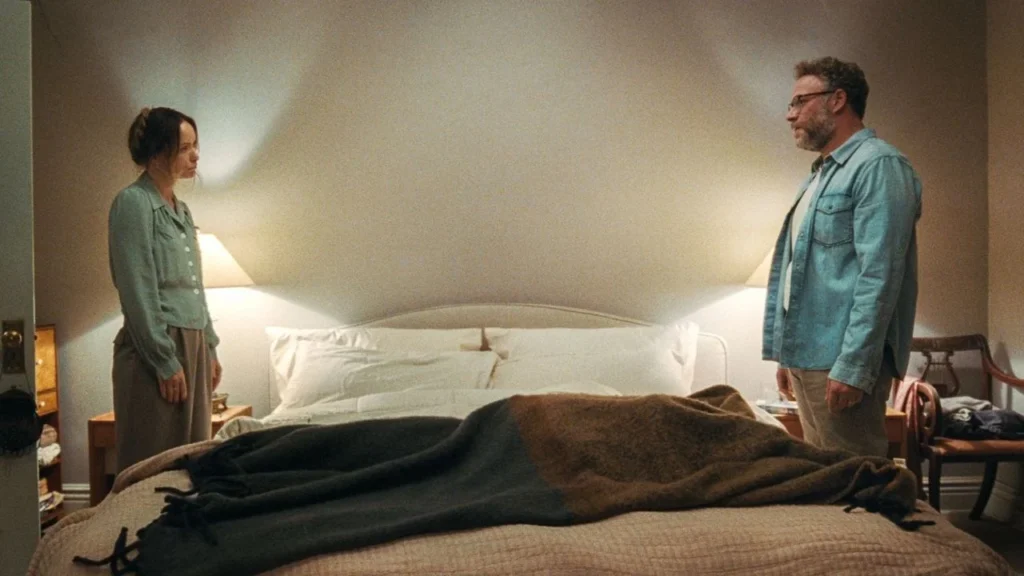
Just before the dinner party, Rogen spills in the front door, a victim of his bad back. Somehow, he missed his wife’s reminders (reminders that she insists were numerous and acknowledged by him) that the upstairs neighbors would be joining them for dinner. He’s committed the cardinal sin of forgetting to pick up a bottle of wine on the way home. This is a dinner she’s obsessively slaved over and continues to slave over even as they fight. The neighbors are immediately aware of their hosts’ fighting, setting the more awkward-than-thou vibe for the rest of the evening.
Cruz, exuding a controlled smolder, is an intuitive sexologist. Her strange but friendly beau, Norton, really loves nice rugs. Rogen very much wants to scold them for their very loud and very distracting regular sexual escapades that can be heard through the floor. But soon enough, it’s apparent that Wilde is angling to learn the secret of Cruz’s voluminous orgasms.
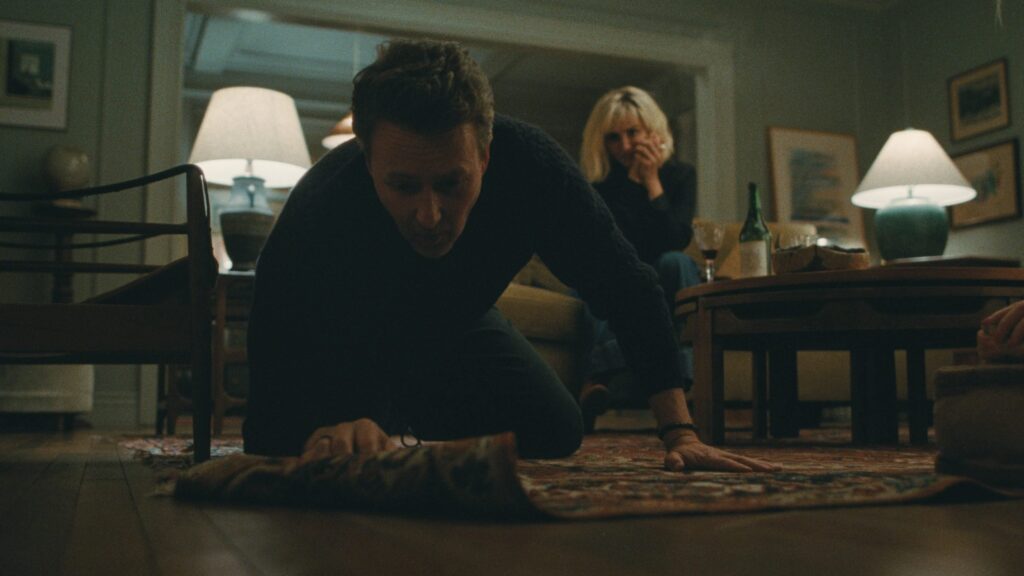
Though the most resonant moments of The Invite are arguably its soberingly dramatic parts, it is technically a comedy. And thanks primarily to Seth Rogen, who’s gracefully transitioning into one of our sharpest elder statesmen of film comedy, there are plenty of good laughs. If anything, The Invite may be visually overcooked what with Wilde’s newfound penchant for reflective surfaces and all. The frayed psychology may not always match the drapes, but the effort is kind of admirable.
The “will they or won’t they?” of it all is very real, the final answer to which will not be revealed here. (Nor will any presumed similar resolutions of the Spanish, Italian, Swiss, French, or South Korean versions). (Now thatcould be a fun new party game: “Salad Dressing, Olive Oil, or The People Upstairs?”) The Invite lets us into its rather private party for a lot of earned laughs but also an equal amount of relational knife-twisting. I imagine many curious couples going to check out the potential taboo swingin’ polyamory of The Invite will learn the same lessons as its characters: sometimes the hot night you imagined leaves you reflecting unexpectedly. Because today and always, the lurid notion that there’s something more desirable just beyond your home is obviously pulsating the world over.