


Benoit Blanc Investigates Faith and Murder With a Gothic Twist
DIRECTOR: RIAN JOHNSON/2025
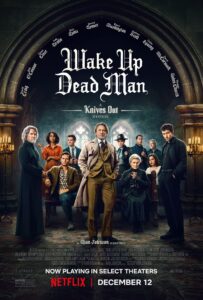
Staying true to your beliefs doesn’t mean staying beholden to everything that has come before.
This a piece of wisdom Monsignor Jefferson Wicks would do well to learn. Known for his family’s legacy of bold preaching, Wicks (Josh Brolin) has earned a cult-like band of parishioners who both admire his aggressive stances and fear his wrath. Vera (Kerry Washington) grew up in his church, Dr. Nat (Jeremy Renner) finds comfort after personal loss, and writer Lee (Andrew Scott) finds inspiration for his work. Cy (Daryl McCormack) hopes to gain political points with his connection, Simone (Cailee Spaeny) believes his faith could bring healing, and Martha has served at Our Lady of Perpetual Fortitude since Wicks’s grandfather ran the place. But Catholic leadership suspects not all is well in the small town of Chimney Rock. The parish’s bishop (Jeffrey Wright) sends Father Jud (Josh O’Connor) to join the pastoral staff, hoping his kind heart will thaw the cold congregation. But even the eager Jud grows frustrated with Monsignor Wicks’s mind games, power plays, and accusatory sermons, so when Wicks drops dead on Easter Sunday, Jud is the prime suspect. Enter Benoit Blanc (Daniel Craig), the only detective who may be able to reveal another solution.
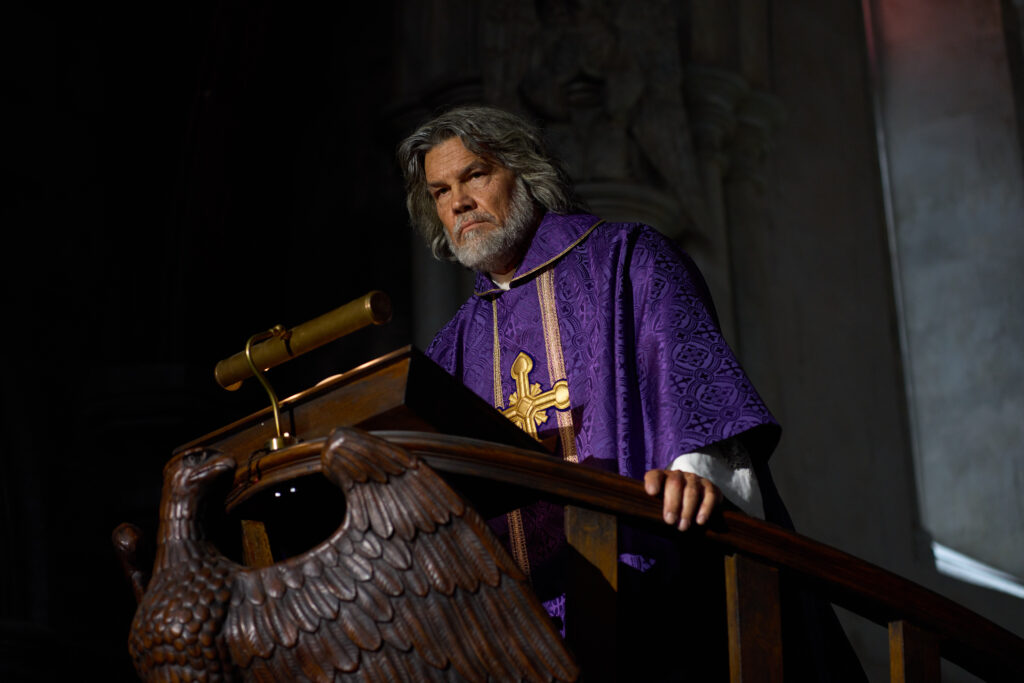
Unlike the obstinate Wicks, writer/director Rian Johnson proves once more he isn’t beholden to genre conventions or franchise expectations. His philosophy may not be as extreme as Kylo Ren’s in The Last Jedi—“Let the past die, kill it if you have to”—but his tendency to zag makes him one of our most exciting working filmmakers. Wake Up Dead Man is another banger of a Benoit Blanc whodunnit, but a little darker, a little more somber, a little deeper. The original Knives Out borrowed motifs from soapy family dramas, Glass Onion leaned into the ensemble comedy format, and this case comes with a dash of Gothic gloom and dread. Fewer cameos, fewer jokes, and less screen time for Craig are all risks, but Johnson shows no interest in doing anything twice.
Instead of examining an affluent family’s lack of self-awareness or a billionaire’s ego, Dead Man explores the nature of faith, largely from the perspective of Father Jud. One needn’t have deep familiarity with the Bible to keep up, but it wouldn’t hurt—religious symbolism wallpapers the detailed sets, not to mention the plot, dialogue, and characters’ names. (Has there ever been a more appropriately named Martha?) Jud and Blanc are teetering on a metamodernist tightrope between the rational and the spiritual as they investigate, and with far more complexity than you’d expect from a series so entertaining. It’s not unusual to poke fun at the wealthy in pop culture, but Johnson takes another risk in Dead Man by lasering in on religious hypocrisy, doubling it as a thinly-veiled political metaphor. Wicks is the most malicious character we’ve seen yet in a Benoit Blanc case, and Brolin plays him more unlikeable than Thanos. Still, because Father Jud is as winsome as anyone Blanc has ever met, the movie never feels like a diatribe against faith as a whole. It may not come with the heft of something like First Reformed, but its criticism of tyrannical leadership is less a dagger and more a needle: sharp, precise, aiming for a cure. The narrative twists are thrilling as always, but the ideas about the omission of truth, the dangers of idealogical isolation, and generational trauma (see Exodus 34:7) are what will stay with you.
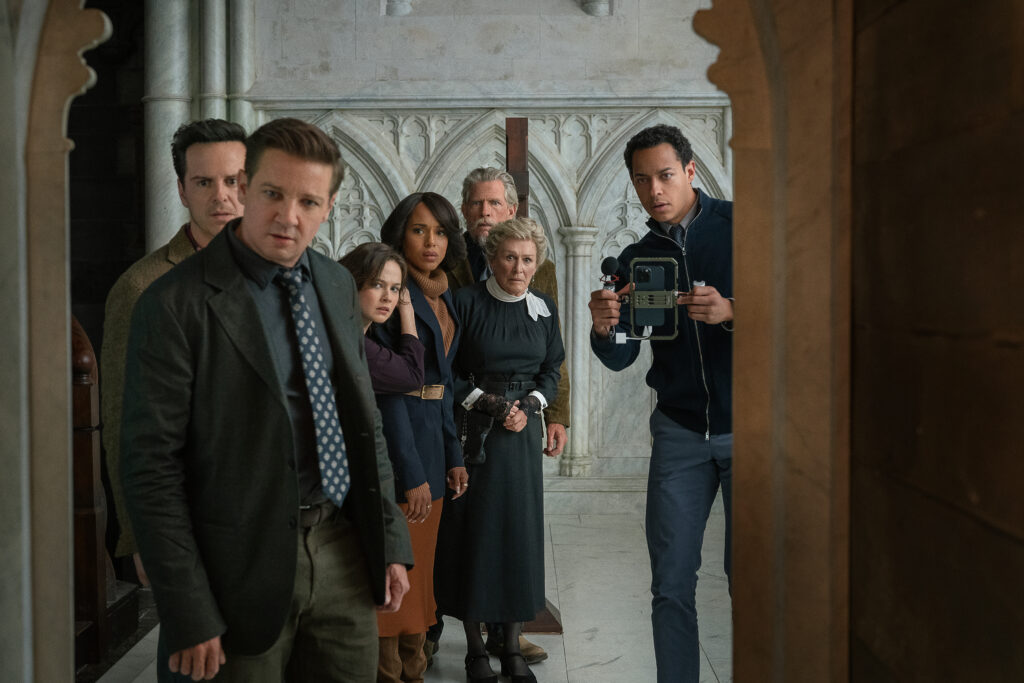
But even with the modified tone, Johnson hasn’t abandoned the core of what a Benoit Blanc whodunnit is (with Joseph Gordon-Levitt and Noah Segan cameos to boot). The script wears its inspirations on its sleeve—or perhaps on its entire coat—paying homage especially to John Dickson Carr’s The Hollow Man, plus the usual nods to Agatha Christie, Clue, and other classic mysteries. Our star-studded ensemble has full awareness of their participation in a detective story, though this highlights one of the subgenre’s recurring weaknesses. Does a large cast provide fun red herrings in a structure dependent on quick reversals? Yes, but it also carries on the grand tradition of underserving overqualified people. There was no way 1974’s Murder on the Orient Express could give us everything we wanted from Bacall, Balsam, Bisset, Connery, Finney, Gielgud, Perkins, Redgrave, and Widmark, even if their sitting side-by-side on a train sounds like a great idea. Dead Man’s strong focus on O’Connor works narratively, but it leaves several performers with threads so short they feel like they may have been condensed for time. Still, Orient Express gave Ingrid Bergman her third Oscar, so why shouldn’t Glenn Close finally got her due from the Academy for this one? She’s as good as ever, and a films as convicting, thoughtful, and gracious as this one are always worth celebrating.