


The King of Pop Gets the Biopic Treatment
DIRECTOR: ANTOINE FUQUA/2026
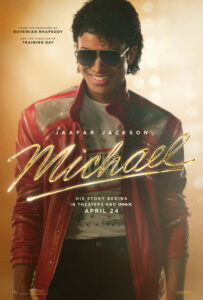
JIM TUDOR: Not to be startin’ somethin’, but I really liked Michael. I now realize that puts me very much in the critical minority, but hopefully my reason won’t sound too off the wall…
The contemporary musician biopic is probably the most innately stupefyingly formulaic niche in all of popular cinema. We know that. Whether you consider the starting point 1980’s Coal Miner’s Daughter, 2004’s Ray, 2018’s Bohemian Rhapsody, or something else, the template has become almost comedically apparent. (Although effective spoofs 2007’s Walk Hard: The Dewey Cox Story or 2022’s Weird: The Al Yankovic Story did nothing to slow down the hit parade). The challenging life pre-fame. The ambitious self-determination and subsequent “going for it.” The Big Time! But wait, there’s trouble! Okay, the trouble’s sorted out. Cut to: A Most Triumphant Performance! The End. If your musician biopic doesn’t follow that form, it’s liable to end up nowhere. Case in point: Springsteen: Deliver Me from Nowhere.
So what does that leave us with? Arguably not much. Yet, I believe it’s still possible to derive enjoyment from such films. An inordinate amount of any given musician biopic’s perceived success or failure rests on the casting of the subject. They have to look right. They have to sound right. (And all the better if they can actually sing the songs). They have to get it, have it, and fully commit.
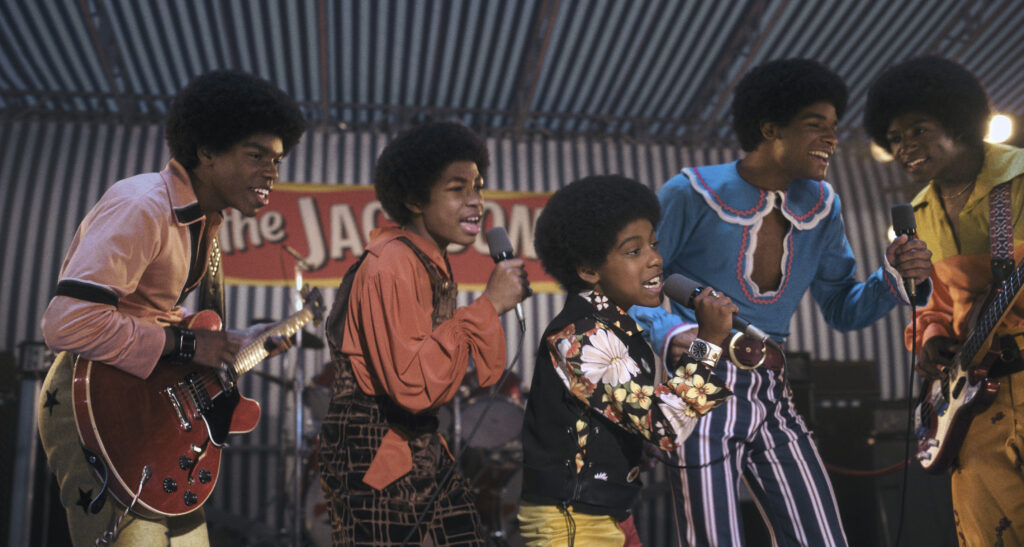
Then there’s the director, who’d better understand that the real star of the film—the person why audiences are interested in the movie in the first place—is literally not on screen. The musician biopic director best get out of the way of the subject matter (take your artistic flourishes elsewhere), and figure out how best to keep things moving to the requisite beats. If that means eliminating or simplifying certain moments or characters, then they do that with extreme prejudice.
In the case of the understandably controversial Michael Jackson biopic, Michael, star Jaafar Jackson and director Antoine Fuqua hit those marks and then some. For a fully vetted, Jackson family-sanctioned biopic of someone as enigmatic as Michael Jackson was, this film fully delivers the goods it intended to deliver. It’s the bullet points version of a supernova talent as we wish and hope he actually was: a kind and harmless soul. (Admittedly, this is the Michael Jackson I and so many others grew up with). To go in expecting anything more nuanced is futile. Plus, I rocked out in my seat for much of the movie.
TAYLOR BLAKE: I’m of two minds about this movie because music biopics have two goals, and Michael only succeeds at one of them.
The first goal is to revive the feeling of being at a Michael Jackson concert at his peak, which is likely the main concern for moviegoers. On this level, it’s more than a success—as you said, it invites you to rock out in your seat! You also noted the job of a music biopic director is to get out of the way, but I’d like to give credit where it’s due: Fuqua has made some of the most fun action movies of the century, and he knows how to shoot and edit an action sequence. Every concert and every behind-the-scenes music video shoot feels like a thriller (sorry), which speaks to why Michael was so compelling an entertainer. Jaafar Jackson has spoken publicly about the amount of time he put into prepping to play his uncle, and it shows. He is an incredible dancer and his vocals are blended with Michael’s to make this feel as “authentic” as possible. Combining his family resemblance with prosthetics, some moments it feels like the camera has transported back in time. If Jaafar chose to impersonate Michael in a Las Vegas residency next, he’s just made a compelling case for it to sell out.
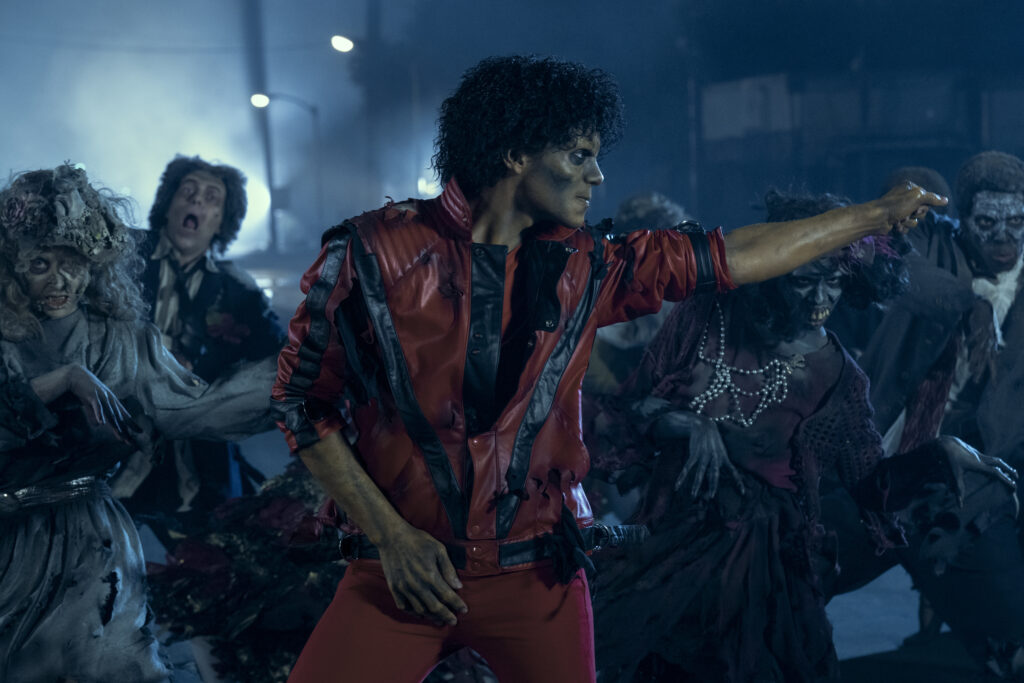
The second goal—and the frequent stumbling block for music biopics—is revealing something new to audiences about the icon. The best biopics—in recent memory, think First Man; I, Tonya; Lincoln; or Oppenheimer—give you the greatest hits and greater insight into their interior life. Yes, we want to see Neil Armstrong walk on the moon and Nancy Kerrigan get whacked, but we also want to know how Abraham Lincoln passed the 13th Amendment and whether Robert J. Oppenheimer regretted his greatest creation. In short, biopic audiences don’t just want to feel like they’re at a concert—they want to feel like they’re invited for a conversation around the dinner table in their home.
The irony for music biopics is musicians have already invited us to hear their innermost thoughts in their work—what can a movie reveal when they’ve already sung aloud their diaries?—and Michael faces a steeper uphill battle because of his level of fame. Jaafar Jackson may be an excellent mimic, but his attention to physical detail attempts to hide a vacuum the script leaves in his soul. We exit Michael still as a member of the crowd at the stadium, keeping whatever opinion we had of the King of Pop before we entered. More than anything else, Michael is an exercise in brand management, reinforcing the same bullet points the Jackson estate has been repeating with such intensity that John Mulaney spoofed it as recorded dialogue so canned even a chimp could be trained to deliver it. This Michael is an innocent, a genius, and a victim of his father’s abuse and the media’s decades of unwavering attention. Most events in this movie happen to him, allowing him to make few active choices.
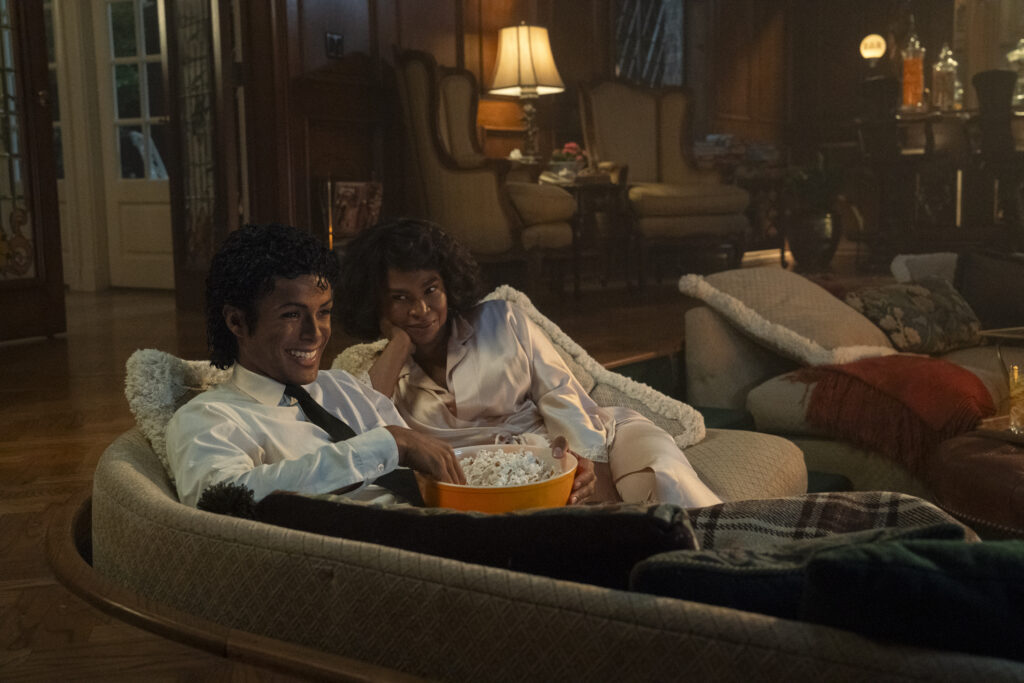
JIM TUDOR: I agree with your assessment of the weightier biopics you mention, although I might also suggest that we might be zeroing in on the difference in expectations/execution of musical and non-musical biopics. Your observation that the real-life “musicians have already invited us to hear their innermost thoughts in their work” is an excellent one. That perhaps gets at the core of why these films often feel even more redundant than simple reenactments of lives of people touched by greatness. They’re redundancy within redundancy. And as we’ve seen, scenes of sudden lightbulb-like inspiration or impassioned writing of lyrics at a table don’t make for the most believable moments. The closest Michael gets to any of that is a moment of him watching a news report on gang violence and declaring, right there and then, that he will use his music to bring together the warring Crips and Bloods. This of course results in “Beat It.” That’s just one of many instances wherein Michael Jackson is portrayed as saintly. It’s all just so brightly broad…
I have no beef with Michael Jackson coming off as a complete unknown of sorts. Back in the day and all the way to his early end at age 50, there was always an unknowable mystique about him. Whenever he (rarely) allowed for a crack in that veneer, it invariably gave way to perceptions of him as a “weirdo,” or worse. The film notoriously stops in 1988, before the later child molestation accusations really became a scandal, something that most people I knew assumed he was guilty of. We likely never will know the truth of all of that, and any suffering of any victim shouldn’t be discarded from history. At the same time, though, we should never, ever look to movies as a source of historical record. Movies consult history, take what they need from it, do as they please with that, and move along. Michael, by stopping in 1988 (and with an abrupt time-jump to get even that far), doesn’t so much dodge this glaring issue as simply sidestep it. What we’ve got is a glossy, extremely impressively detailed fairy tale version of Michael Jackson. I suspect that there’s an audience very ready for that.
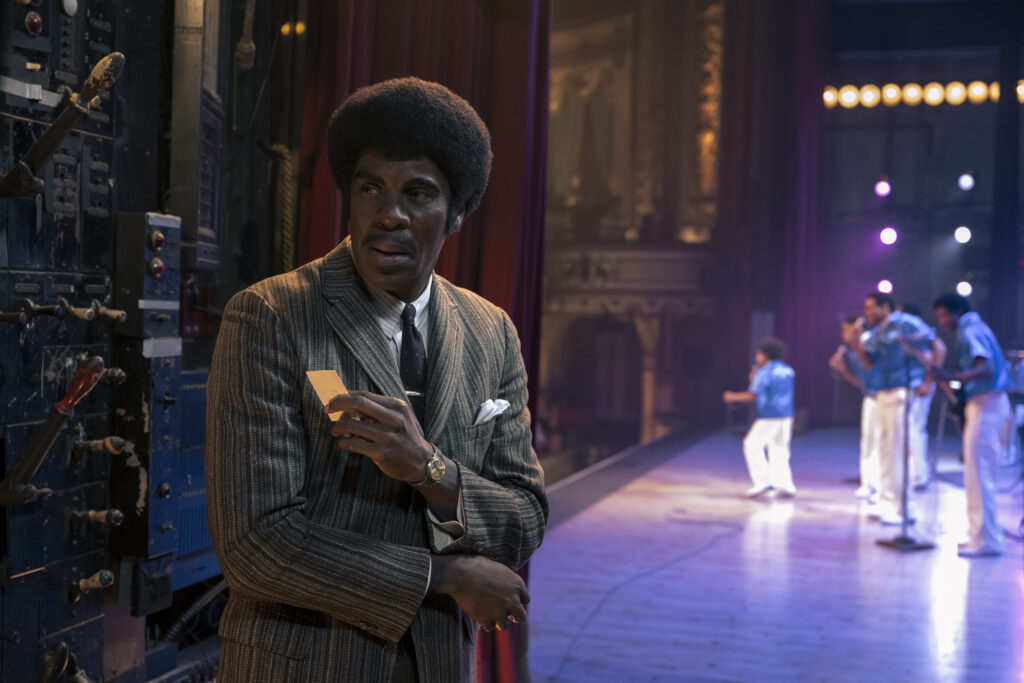
On a personal note, when I was 10 years old in 1984, Thriller was the first album I ever bought with my own money. My brother and I actually split the cost. Just down the way in that Venture store, you could buy any of three different authentically detailed Michael Jackson jackets for only $40. Imitation white sequined gloves were a dime a dozen it seemed. There was no escaping it—everyone was a fan of Michael Jackson back then. Every kid was trying their darndest to moonwalk. The fan fervor depicted in Michael is not exaggerated. Fuqua, who I’ve always wanted to appreciate as a director far more than I have been able to (with the reserved exception of the first Equalizer film, and maybe Training Day) understands how to sell the recognizable reality around the fictional and factionalized. (That goofy scene where corrupt dad Joseph Jackson [the always great Colman Domingo] smokes and schemes by the fireplace with a Satanic-coded Don King? I love it!) It’s a far more mature tenor than his normal bravura style would allow for. Within that restraint (no gaudy color grading, no hyper-controlled color palettes, no Tony Scott wannabe stuff), he keeps Michael moving like a freight train. (It goes so fast some folks may not notice that little sister Janet Jackson and a few other lesser known siblings don’t exist in this carefully cultivated reality).
TAYLOR BLAKE: What’s fun about this two-shot review is we’re creating an unofficial series I’m calling Gen X vs. Millennials on 20th Century Music Icons. We were in sync on the joy of the Paul McCartney documentary Man on the Run in February, but we’re about to diverge here almost as much as we agreed there, largely because of our generational differences.
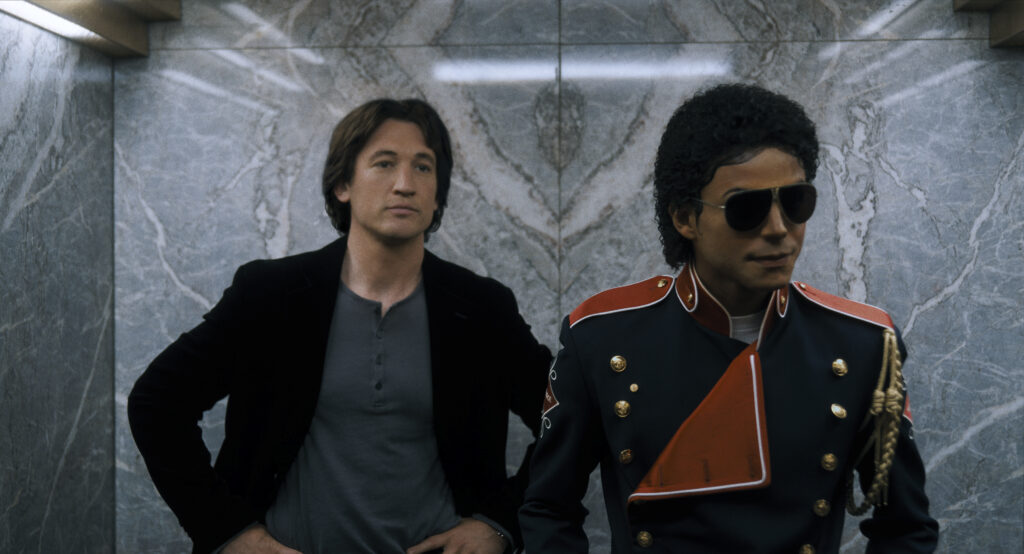
You might remember that Farrah Fawcett died the same day as Michael Jackson, and in my at-the-time 14-year-old mind, they were the same category of celebrity—that is, my parents’ celebrities. Fawcett’s passing had earned a brief mention on the morning news, so I was baffled when Jackson’s death was covered for hours straight later the same day. I had only known Jackson as, at best, a “weirdo”—I’m not even sure I’d heard him called the King of Pop before. I knew him as the man with drastic cosmetic procedures who had dangled his son off of a balcony and had maybe done much worse to other children. When the concert documentary film This Is It was released later that year, several of my classmates and I pushed a teacher to explain why she cared to go. Those of us who have only known MTV as a reality TV channel have never known him without controversy, so leaving this movie with no better understanding of Michael means it’s nigh impossible to rock with the fairy tale version this movie is selling.
I’m also of two minds about ending the story in 1988. On the one hand, it’s a fair way to sidestep an unpleasant topic that wouldn’t fit with the crowd-pleaser vibe Fuqua and the Jackson estate are going for. (The producers for Michael include his siblings Jackie, Jermaine, La Toya, Marlon, and Tito; his son, Prince Michael Jackson; the owner of the property formerly known as Neverland Ranch, Ron Burkle; and several others involved with his estate, including John Branca, Karen Langford, and John McClain.) On the other hand, only depicting his first 30 years gives more weight to Domingo’s cartoonish, unnuanced villain; Miles Teller’s exposition-dumping appearance as Branca; and every terrible wig that graces anyone’s head at any point in the runtime. I’d also argue it makes sister Janet’s nonexistence more glaring. (She “kindly declined” to be depicted in this film, while daughter Paris has spoken more critically about the film as a whole.) Perhaps if Michael had shown the same level of craftsmanship in the script, supporting performances, and the hairpieces as it did in recreating the thrill of seeing him live in concert, it’d be easier for younger folks to entertain the fairy tale version for a few hours.
I like hearing about 10-year-old you saving up to buy Thriller because it reminds me he had a long, barrier-breaking career for decades before the troubling allegations against him. I agree a movie like this shouldn’t be treated as journalism, and in the last 17 years, I’ve come to appreciate his music and the cultural impact he made before he made the word “Neverland” cringeworthy. (I would’ve loved more time with moments like the desegregation he forced at MTV.) No matter what one thinks about the idea of cancelling a public figure, his legacy is too big to excise from pop culture, and it’s worth trying to reconcile (or at least wrestle with) what he means to us today. There is a good film to be made about that, but not one that would get permission to use his music.