


Chris Pratt Revisits Minority Report for a Post-ChatGPT World
DIRECTOR: TIMUR BEKMAMBETOV/2026
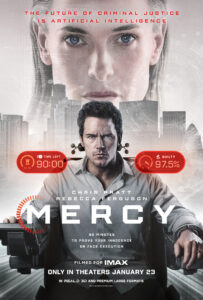
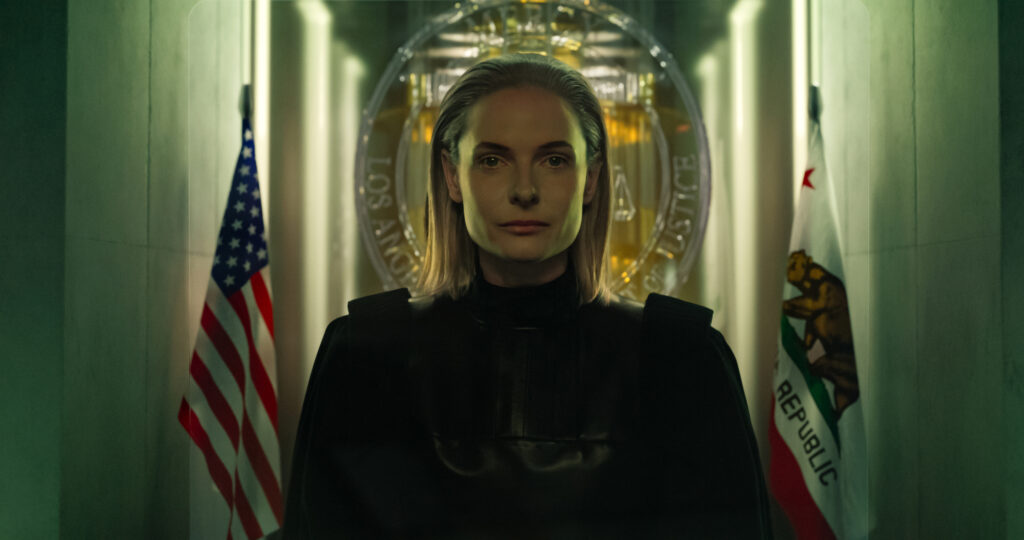
Strapped to chair, blurry-eyed, a flat female voice in his head. Chris Raven (Chris Pratt) wakes up in a room he knows all too well. Once you’re in the Mercy Chair, the artificial intelligence-powered justice system has already determined there’s a near-100% chance you’re guilty of a capital crime. Chris has spent his LAPD career championing this system to reduce the surfeit of crime that has overtaken Los Angeles, but now that he’s the prime suspect in his wife’s murder, he has 90 minutes to prove reasonable doubt. A.I. creation Judge Maddox (Rebecca Ferguson) will provide him with with any resources he asks for, including almost any photo or video in the city thanks to the legalized surveillance state. With no jury to consider a verdict or lawyers to aid his case, he must convince the algorithm to stop the clock before it runs out, triggering his execution.
Like an essay that ChatGPT spits out minutes before class, Mercy might be called legible but certainly not good. A murder mystery with a real-time countdown is an excellent premise, and even as the plot pushes the limits of absurdity (really, not a single lawyer allowed in this chamber?), the tension never wanes. In a post-ChatGPT world, there could be a worthy update to Minority Report, and Alfred Hitchcock showed us there’s no way to exhaust the drama of a framed man fighting a predetermined verdict. (See: The 39 Steps, Dial M for Murder, I Confess, North by Northwest, Saboteur, Spellbound, Stage Fright, To Catch a Thief, and The Wrong Man.) Pratt works as a wrongly accused everyman, and Ferguson deserves extra credit for not phoning in her performance, which boils down to 90-minute FaceTime call. Very little else about Mercy works, including the ill-defined job responsibilities of Chris’s partner at the LAPD (Kali Reis), his stock character teenage daughter (Kylie Rogers), rote plot twists, or the technological advancements and confusing political setting the film posits will occur by 2029. A script needn’t hide its inspirations (in addition to Minority Report, they include Speed, Searching, and told-in-real-time classics like 12 Angry Men), but in this case, it only recalls better versions of this story.
The bigger question Mercy left me asking: Why is this the kind of project Pratt keeps choosing? He made his name as a funnyman, but since he joined the Guardians of the Galaxy, he hasn’t made any live action comedies outside the Marvel Cinematic Universe. (His last non-MCU, non-animated comedy feature: 2013’s forgotten Vince Vaughn vehicle, Delivery Man.) A supporting performance from Guardians co-star Chris Sullivan and a cameo from Parks & Recreation scene stealer Jay Jackson are reminders of the roles that let him operate at his full power. Like in Passengers, The Magnificent Seven, Jurassic World, and The Tomorrow War, he plays Chris Raven with a mostly straight face. Like in his Amazon Prime series The Terminal List, he’s focused on protecting and/or avenging his wife and daughter. Like in last year’s Netflix disaster The Electric State, he’s starring in subliminal advertising about how A.I. is our friend. Mercy is more fun than the misguided, joyless Electric State (which might be the worst movie I’ve seen this decade), but it’s not not product placement for Big Tech, even if director Timur Bekmambetov told Vanity Fair that Amazon wouldn’t let him use A.I. to make this. A decade ago, Pratt felt like one of our most promising leading men for action-comedies, but none of his junky, self-serious sci-fi adventures has matched the delight of Star-Lord, an effulgent blend of his comedic timing and believability as an action hero. It’s not too late for him to pivot with a more grounded comedy or by flexing another genre muscle like he did in the underrated Magnificent Seven remake. It’s time for him to rework the his career formula to prove he’s still got the charm that won us over in the first place. When it comes to storytelling, an audience will choose a beating heart over an algorithm every time.