


Joel Edgerton Stars in Adaptation of Denis Johnson’s Novella
DIRECTOR: CLINT BENTLEY/2025
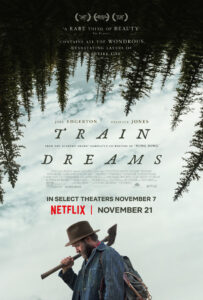
“The first kiss plummeted him down a hole and popped him out into a world he thought he could get along in—as if he’d been pulling hard the wrong way and was now turned around headed downstream.”
That’s the kind of poetic prose you’ll find in Denis Johnson’s 2011 novella Train Dreams and the kind narration of you’ll hear in its 2025 film adaptation. Fourteen years after its publication, Will Patton narrates the story of Robert Grainier again after reading its 116 pages in the audiobook. The film follows many of the same plot beats, though with a few variations. Robert cuts down trees and builds bridges alongside other loners and eccentrics. He falls in love, gets married, and has a daughter. They build and live in a log cabin. He watches the West change from the 1910s to the 1960s.

The New York Times called Johnson’s work a “small masterpiece,” and every moment of this adaptation betrays its creators share that belief. Train Dreams reunites the screenplay team from the best movie of 2024, Sing Sing, and again Clint Bentley and Greg Kwedar find empathy for an isolated man. Bentley, also in the director’s chair, shoots golden hour landscapes, sparking campfires, and roaring forest fires with the kind of elegance you’d hope when depicting Pulitzer Prize-nominated prose. With the caveat that some of the year’s biggest Oscar hopefuls are still to be released, this may be the best-looking film of the year. (Once again, I ask Netflix for longer theatrical runs of deserving titles!) As an episodic memory piece set to a string-heavy Bryce Dessner score, it’s a dreamy, 102-minute montage.
Because that also means it’s also heavier on vibes than on story, I couldn’t help but think of another recent literary adaptation, 2022’s Where the Crawdads Sing. The Crawdads novel must have been compelling if it sold all those millions of copies, but you’d never know it from the formulaic plotting and clunky dialogue we saw on the big screen. Train Dreams is a flat-out better movie than Crawdads, but it faces a similar problem for a non-reading viewer. It is beholden to its source material, but it loses the narrative’s full power in translation from one medium to another.

Edgerton is an actor I’ve been rooting to get on the Academy’s radar since I saw him rage as Tom Buchanan in 2013’s The Great Gatsby. (Another literary adaptation that suffers in its loss of the author’s prose!) Plagued with guilt and unable to connect with most people, Robert is a hermit created by this changing landscape but never at home in it. Since Edgerton excels at conveying emotion with little dialogue, his performance never feels redundant to Patton’s narration or dwarfed by the natural beauty around him. Also predictably great: William H. Macy as a loquacious dynamite expert Robert befriends. Who is just predictable: Felicity Jones, who has already played the role of Supportive Wife™ to a Tortured Man™ with little distinction between this, The Theory of Everything, and The Brutalist. (Like Crazy and On the Basis of Sex represent the beginning and end of her spectrum of The Wife Character™ energy.) To be fair, Gladys is underwritten compared to her two Oscar-nominated parts—this is Robert’s movie start to finish.
Jones, Kerry Condon’s brief appearance, and the non-linear time narrative are barometers of a larger concern. On the one hand, they’re the characteristic of the transient evolution of America in the 20th century that Train Dreams is interested in. On the other, it’s as if the film stands at the edge of the ocean and only wades a few feet into the water—or perhaps in Johnson’s words, pulls hard the wrong way upstream. Its ideas—the causes of Robert’s isolation and grief, man’s impact on the environment, our responsibility for crimes we witness and don’t stop—are big and weighty. Its explorations are slight and smoky. When inveterate Robert’s gentle slope of an arc resolves, it’s only because Patton tells us it’s so.