


Who Do You Think You Are, I Am!
DIRECTED BY JOSH SAFDIE/2025
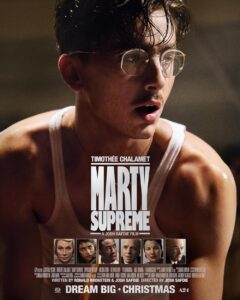
Earlier in the fall, all eyes were on Benny. Hot off winning the Best Director award at Venice, his first film since he and his brother’s Josh Safdie separation was looking to be a big hit. The Smashing Machine, an MMA sports biopic with Dwayne Johnson as Mark Kerr- his most serious film role in years- was quickly getting attention while Josh’s movie, another sports film with Timothee Chalamet, invited befuddled confusion. Only going off of a trailer with no public festival release, the most talked about aspects of Marty Supreme was its diverse cast ranging from Tyler the Creator to manslaughterer/Shark Tank personality Kevin O’Leary and its overdramatic premise about the sport of ping pong.
Yet, when The Smashing Machine came out to an underwhelming response, the hype train immediately started for Marty Supreme. Having a secret premiere at the New York Film Festival, it quickly garnered acclaim and excitement that carried over into its release a month later. And once these two films are compared, it’s easy to understand why they got the reactions they got.
The Smashing Machine, in its small-scale storytelling and intimacy, is the exact opposite of Marty Supreme, a more unhinged beast that spreads its wings in epic scale. As Smashing Machine works to bring an unexpected arc in the realm of sports movies, a tale of a guy who never loses a match only to do so for the first time in his career, there was something missing from the complete picture. As much as Benny wanted to pry into the personal life of Mark Kerr, down to his film’s mis-en-scene and camerawork matching the approach of the Kerr documentary of the same name, there was an arm’s distance held against him at the same time. He can portray the ups and downs of his relationship with Dawn Staples (Emily Blunt), but not his process of recovering from drug abuse while in rehab. While he does show the flaws within Kerr’s determination to win and how he treats people, the involvement of Kerr in the production (including appearing as himself present day in the film’s epilogue) implies a forced reassurance. Don’t worry everyone, despite the scenes of Kerr breaking down doors and yelling at Dawn, or overdosing after losing a fight, everything turned out to be okay. Benny initially sacrifices the chance to let the audience stew in the aftermath of these scenes, feeling the ambiguity of Kerr’s character and questioning if he will ever be able to better himself, a strategy that Marty Supreme does in spades.
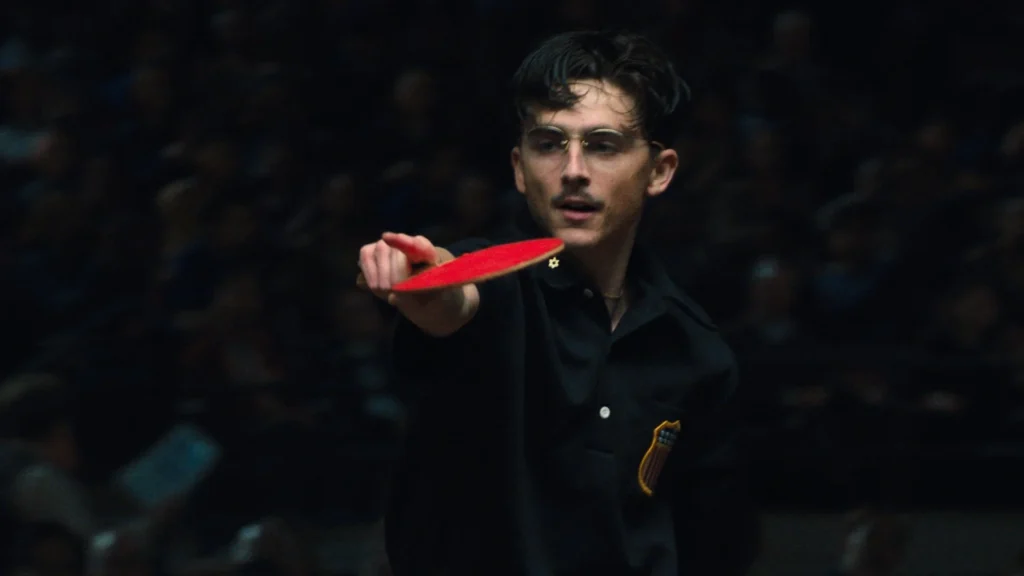
For every failed attempt The Smashing Machine had in getting into the nitty gritty of Mark Kerr’s flaws and vulnerability, Marty Supreme gladly showcases it with its own subject. Hopefully only slightly inspired by table tennis athlete Marty Reiser, Marty Mauser (Timothee Chalamet) is a person who was born thinking he was destined to be the best. Forced into the confines of a conventional life in 1950s New York, Marty looks at his day job of being a shoes salesman at his uncle’s shop in the Lower East Side as another hurdle to jump over to accomplish his ultimate dream: Being a world-famous table tennis player.
Even when he is given an offer to be manager, a position that would lead to a financially comfortable life, Marty sees the promotion as an offense to his life goal. For someone who is already trying to sell novelty orange ping pong balls with his name on them, he can’t afford to sidestep his dream at the moment, not before he has to travel overseas to compete in the British Open. Maybe that’s why he later points a gun at his co-worker after closing and leaves with $700 for this trip (Don’t worry though, Marty promises to pay his boss/uncle back when he returns).
This is the energy that Marty rides on during his journey into reaching stardom, the constant nonchalance over his actions adding to his hope that everything will be repaid in the end. Unsatisfied with his staying place for the Open, he scams his way into getting a room at the Ritz, which becomes the film’s starting point of one thing leading to another. Charming his way into meeting actress Kay Stone (Gwyneth Paltrow), he uses his connection to pitch his dream to her millionaire husband, ink company CEO Milton Rockwell (Kevin O’Leary), sweettalking him enough to at least attend the semifinals. He does so, only for Marty’s plans to start backfiring; losing the Final to Japanese athlete Koto Endo (Koto Kawaguchi), Rockwell becomes interested in being a sponsor for the sport in Japan, even offering Marty a chance to play in another match with Endo, in exchange for the American to play the heel. Refusing the deal and severing ties with his potential money source, Marty earns his way back to New York by going on a global tour with the Harlem Globetrotters, only to be met with the consequences of his actions.

Working on a similar structure to Safdie’s previous film Uncut Gems, Marty Supreme differentiates its tone and central character from feeling too much like a clone of writers Safdie and Ronald Bronstein’s anxiety-inducing thriller. Defying the impossible task of upping the life-or-death hijinks riddled throughout Uncut Gems, Marty goes through his own bouts of highs and lows in his journey of making enough money to make it in time for the World Championships. This time, his skill in gambling his way out of his life’s problems only reach more absurd heights, his life-changing chances of fate ranging from throwing an apple into a bowl to a falling bathtub.
This period of the movie, as Marty becomes a fugitive and uses and abuses his resources in a hellish drive to finally get what he wants, makes up a majority of the film’s plot. His knack for getting himself in and out of constant trouble becomes a compelling trait thanks to Chalamet’s talent in finding an innocence within Marty’s character. A young, bratty 20-something desperate to show he has something to prove, the contrast between Marty’s simple dream of being a star player and bringing an elevated reputation to his sport in America with his brash nature and selfishness gives variety among the other Safdie protagonists-with-a-goal-and-a-death-wish. Unlike Howard’s addiction purposefully turning every factor of his life into a big gamble, or Connie’s desperation to free his convicted brother only keeping him farther from achieving that act, and even Mark Kerr’s ambition driving him towards drug abuse and contempt, Marty Mauser is simply a kid high off the American Dream. Living in a post-WWII environment, the belief that any American can do anything if they put their mind to it is the only thing encouraging him to believe that in the end, no matter how many hustles, sacrifices, and dumb decisions he makes, everything will turn out fine. Even if he is now broke, on the run, or has a baby on the way after accidentally impregnating his married friend Rachel (Odessa A’zion), he will make sure that his impossible dream will come alive, despite his colossal ego making the goal feel like getting a camel through the eye of a needle. The only redeeming quality of Marty is a genuine, respectful love for the sport that he wants to be the face of.

Chalamet, in what becomes a career-defining performance (mirroring his own growing desperation to finally win an Oscar after being Hollywood’s golden boy for about a decade) gets to make such an unlikeable screw-up become an enthralling symbol of the perversions of the American Way. Somehow he lives his life with-and-without consequences; he lies to reporters about his parents being deadbeats while saying his game against Bela Kletzki (Géza Röhrig), a Holocaust survivor, will “finish the job” that Auschwitz couldn’t (his New York Jew background allows an excuse for his brash remark, but also exemplifies his lack of understanding about the gravity of things outside of his American self). His obsession with making himself a legendary force to be reckoned with leads to him not taking seriously his status as a wanted criminal, still continuing his descent into fulfilling his “purpose”. Marty’s mindset of thinking he’s untouchable even though he’s at his lowest point brings commentary on recent masculine attitudes seen in young men. His boyish nature in treating everyone like a stepping stone to success brings to mind the constant valorization in modern hustle culture, in thinking of everything as a strategy to outsmart, outdo, outmaneuver a person’s way into a better life. With this in mind, the nature of Marty’s feverish devotion to the grindset calls into question how much this sudden trend was always embedded in American values, a logical endpoint to a country’s inflating desire for capitalistic growth and excess; generations of men prioritizing their selfish desires and forcing the world to owe them the acclaim they think they deserve.
In fact, his time in New York downright becomes mythical. His constant attempts to make money with all the random opportunities thrown at him that end up going wrong only end up fitting into his personal narrative that his life is an epic story waiting to be told. Merging with his belief in exceptionalism, Marty shows an appreciation for personal myth-making. Previously being enamoured with Kletzki’s tale of providing his friends with honey he happened to find by their concentration camp, covering his body with the substance so it wouldn’t be detected by Nazi officers, it’s implied he’s enraptured by the bravura of it over the significance. It explains why he thought it would be appropriate to force his friend to tell it to Rockwell, thinking of it as a cool story to impress people. This is how he thinks of his current predicament; caught up in series of neverending situations, they are nothing more than obstacles for his heroic self to overcome, a future fun story to brag to reporters to show off how far he’s come, how much he had to dedicate himself to reach the success he rightfully deserved to reach.
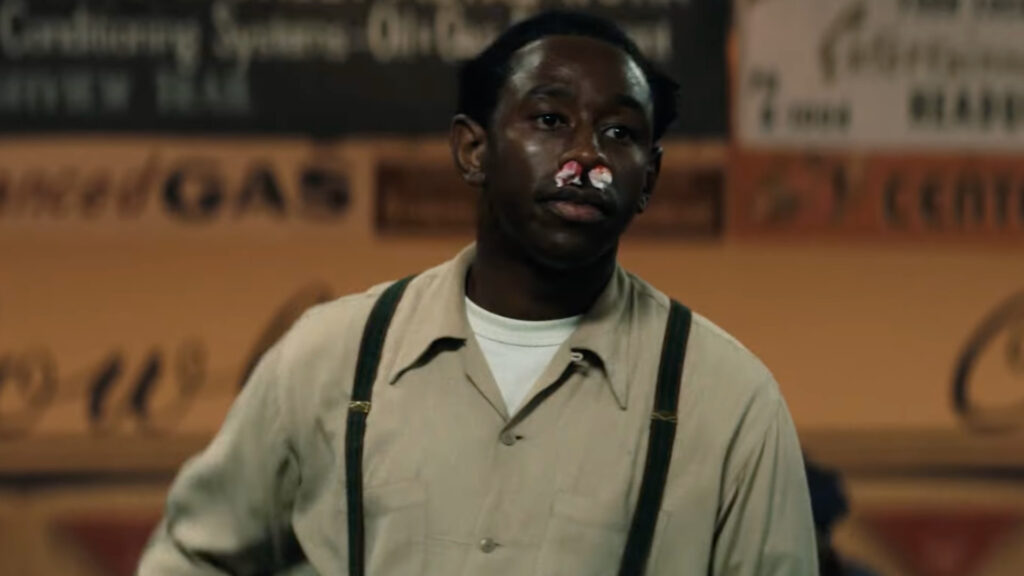
This commentary on all-American myth-making then becomes interesting in how much Josh Safdie blends it with different eras of this country’s idealism. Taking place at a point in time where America felt at the top of the world, mixed with a genre that served as a metaphor of American idealism in the 80s, and then topped off with the white-knuckled tension of the 2020s thriller, where our Great American Men still defy the odds despite worsening their lives, Marty Supreme is a collage of different aesthetics but similar ideals (an idolization of American values, whether as endorsement or critique) that comes together to tell a story figuring out why the country has an undying, misguided need to dream big. It is there in its ironies, such as bookending the movie with two well known ’80s needle-drops that come off as mournful instead of invigorating, an opening credit sequence of sperm racing into an ovum that turns into a ping pong ball, and ultimately in its third act.
Marty Supreme and The Smashing Machine, unintentional or not, fit well into the Safdie bros’ duology of films featuring men desperately trying to reach a goal. While Good Time and Uncut Gems serve as stone-cold crime thrillers, Marty Supreme and Smashing Machine’s turn as sport dramas still work into their collective fascination of finding the various reasons why someone would destroy their and other people’s lives to achieve a personal want. Applying their lens to a more legal but just as competitive industry, the two films serve as companion pieces, their different protagonists’ journeys for greatness sharing the same devotion and destructiveness, albeit with various outcomes.

After seeing Connie fail and get arrested, Howard winning his biggest gamble yet only to immediately be faced with a fatal comeuppance, The Smashing Machine gives Kerr a chance to learn to lose and accept his failures, perhaps winning the best outcome out of the four, living a quiet life but earning a place in MMA history. Marty Supreme, however, gives its protagonist an ending that serves as a fitting end to the Safdies’ quadrilogy of men fighting to beat the odds: Marty, after going through a hell of his own making, ends up getting what he wants. Finally proving himself as a champion of the table tennis world for the sake of the artform as much as his ego, only to come back from his dream and have the weight of all he’s done crash down on him in a suffocating blow. And now that he’s one of the proud few who has fully achieved the American Dream, who has finally become a legend as glorious as the honey story, the only thing he can do is sit with the empty feeling of being on the winning side with all the repercussions he’s made along the way.