


2000s Campy Cinema Emerges from the Dead in Witchy Horror-Comedy
DIRECTED BY MEREDITH ALLOWAY/2026
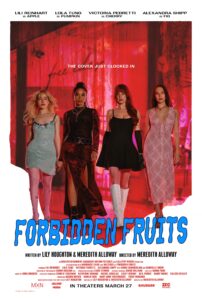
In one of the first scenes of Forbidden Fruits, one of our femme fatales pours her scalding hot latte onto an older man’s crotch as he masturbates. Clearly, there is an aggressive tone being set here. Director Meredith Alloway approaches her feature film debut with bold gusto, but it becomes painfully evident that she may have bitten off more than she can chew in this instance. Cowritten with Lily Houghton and based off her play “Of the woman came the beginning of sin and through her we all die,” Forbidden Fruits gears up to tackle an array of heavyweight topics from consumerism, female friendship, and misogynistic culture – all from within the confines of an American mall. The list of ingredients suggests a delicious final product, but the result is a conglomeration of brilliant ideas combining into a vibrant hodgepodge mess of genre and tone.
The setting of our story is tightly concentrated within the hallowed walls of a Texas shopping mall. Here, a group of vaguely 20-something women work together at Free Eden – a high-dollar boutique that is a straightforward rip-off of Free People. Apple (Lili Reinhart), the Regina George stand-in of the crew, runs the ship with a ruthlessness that tetters towards obsessive. Cherry (Victoria Pedretti) fills the role of the sensual ditzy blonde with her bubble skirts and vivacious personality, while Fig (Alexandra Shipp) is more mellow and level-headed. These women rule their environment with an iron-grip, and they carry a distinct aura of authority as their stilettos click down the linoleum floors. Their close ranks expand after Fig takes a keen interest in Pumpkin (Lola Tung) after a brief chance encounter. The group plucks her from the nearby pretzel shop to join their coveted crew, and that is precisely where things get strange – and a bit silly.
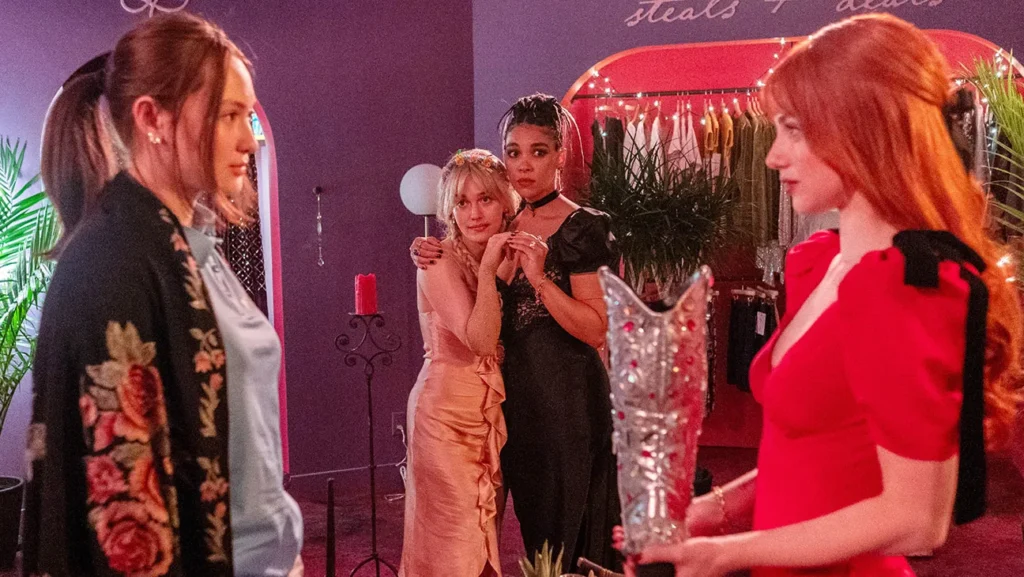
Before the newcomer is welcomed onto the staff, certain strange initiations must be completed. These women are a coven – in the loosest definition of the word – that dabble generously in soft magic. Performing rituals out of a rhinestone cowboy boot and directing their prayers to Marilyn Monroe (the ultimate female martyr according to Apple), their version of the occult is drenched in glitz and glamor. This is more like the kind of witchcraft one would practice with friends at sleepover during the haunted midnight hours. It would be undoubtedly ludicrous in any other project, but it is treated with an identical level of seriousness expected of a human sacrifice. As Pumpkin is pulled further into the group’s orbit, intentions become murky and sinister truths emerge from the shadows.
It is not a particular intellectual reach to guess the genre of film that inspired Alloway’s approach. She has obviously spent an immeasurable amount of time consuming the campy female flicks that dominated and defined pop culture in the 90s and early 2000s. Dripping in sequins and short skirts, this film feels like the twisted love child of The Craft and Mean Girls – except these girls have sex in dressing rooms on Wednesdays. There is a clear vision in terms of visual aesthetic and the approach feels uniquely nostalgic in that way. The dialogue, however, is polluted with Gen Z terminology. The contrasting generational inspirations creates an unsettling dissonance that can be distracting at times. It is as if Free Eden exists in a vacuum of space untouched by the passage of time.
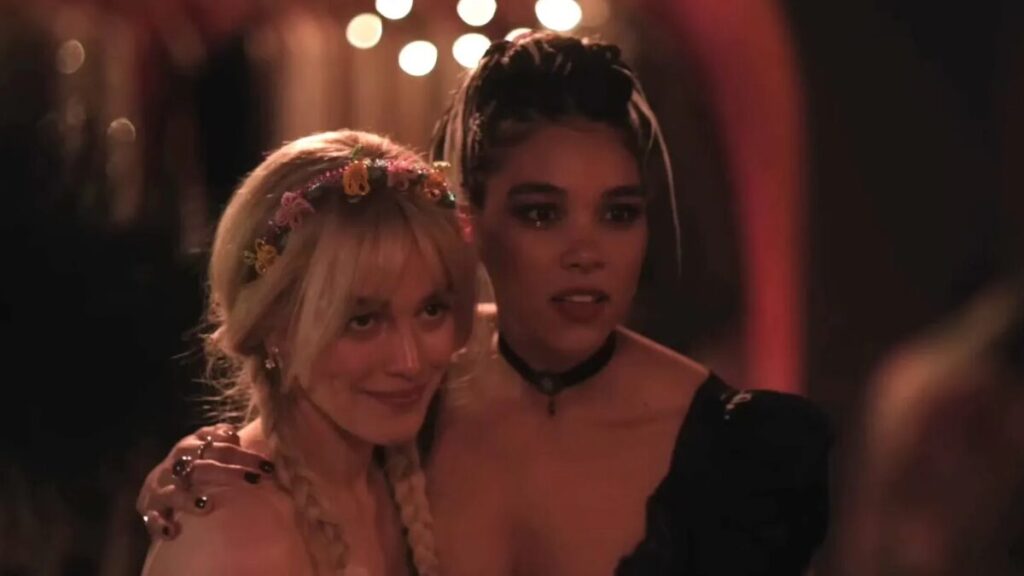
Nothing about Forbidden Fruits is subtle and that includes the performances. Reinhart is deliciously villainous as the domineering Apple. Confidence oozes from her, as does her violent distaste for men. Apple has dedicated herself to transforming Free Eden into an oasis separate from the misogynistic mechanisms of the outside world. Within its concrete walls, these women flex the power that comes with discovering the freedom of autonomy. When both her paradise and her command are threatened, it is the resulting spiral that begins to fracture the group. In comparison, Shipp and Tung are slightly more muted personalities that have a sliver of rationality to their character. At the end of the day, it is Pedretti who steals each scene with her bubbly bimbo approach to Cherry. With her high-pitched tone and vivacious attitude even the choppiest, cringe-worthy dialogue flows naturally. Her complex relationship with Apple is perhaps one of the more interesting aspects of Forbidden Fruits, but we hardly breach the surface there.
That is ultimately the glaring weakness at play: there are simply too many moving parts. Numerous intriguing subjects are hinted at and entirely abandoned in the next breath. Characters start to show dimension and then are promptly shoved right back into their stereotypical box. Alloway appears more concerned with establishing a cult-classic image than an actual coherent plot. It is guaranteed that a select pool of patrons will greatly appreciate the messy effort here for what it is, but a vast number won’t even click play. This is the exact kind of film you throw on the TV during a slumber party while you gossip and giggle with your girlfriends – perhaps with a glass of wine in hand.