


Yorkshire!, or Wuthering Heights and It’s Completely Different but Also Not Wuthering Heights
DIRECTED BY EMERALD FENNELL/2026
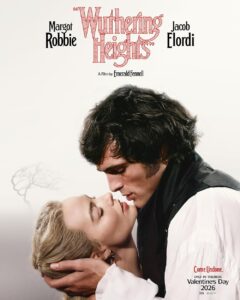
Unfaithful adaptations are nothing new, nor anything to be overly critical of. The Shining, one of the most infamously unfaithful adaptations, is still regarded as one of the greatest horror movies ever made, and James Whale’s 1931 adaptation of Frankenstein takes liberties in adapting Mary Shelley’s novel on screen. With Emerald Fennell, in adapting Emily Brontë’s classic work of gothic literature, she largely ignores the main themes and commentary from the page and uses its premise to capture something else.
An offense that has largely been criticised ever since it was announced, Fennell’s idea in making “Wuthering Heights” could potentially create space for some artistic nuance. Having the film be a reflection of her experience reading it as a teenager rather than something more direct, Fennel focuses more on the emotional highs and lows, the clash of romance and cruel reality, the whims of fantasy with the restriction of Earth’s controlling pull. She experiments in finding the sensations embedded within Wuthering Heights (or really the first half of it), a feat that, for the most part, works in her favor.
After starting off with an opening depicting a man having an erection while being hung by a noose, Fennel provides enough tonal whiplash to throw everyone, from Brontë lovers to couples looking for a nice Valentine’s Day date, off from what they were expecting. A crowd jeering at a corpse before proceeding to have sex, the harsh strings of Charli XCX’s “House” playing over this juxtaposition of life, death, and lust. John Cale’s weary narration stating “Am I living in another world?” as a young Cathy Earnshaw (Charlotte Mellington) and her companion Nelly (Vy Nguyen) race through the expansive Yorkshire moors to their estate Wuthering Heights, a house built in-between two black, jagged boulders next to a blood-red river. And once a stop-motion sequence made up of hairs entangling themselves to form the title card appears, with Charli screaming “I think I’m gonna die in this House!”, all pre-conceived notions fly out the window. For what was expected to be either a period romance or a dark gothic story akin to the novel, Fennell dares to create something else entirely.
Taking place inside this heightened, fantastical version of Wuthering Heights, Cathy lives in the isolating West Yorkshire with her father Mr. Earnshaw (Martin Clunes) and their servants until he comes back from town one day with a boy (Owen Cooper) from the streets. Naming him Heathcliff, Mr. Earnshaw gives him to Cathy as a “pet”, where they eventually bond over their shared abuse from her father. Throughout this part in their lives, Fennel’s fairy-tale aesthetic works in applying Cathy and Heathcliff’s child-like sensibilities to a world they see as wondrous and bleak. While waiting for the rain to clear, standing under a church straight out of a German Expressionist film, the chemistry between the child actors shine in a scene demonstrating Cathy’s naive but hopeful optimism and Heathcliff’s pessimism, expressing a tenderness not typically shown in Fennel’s other work. Promising Young Woman and Saltburn, through their veneer of irony and heavy focus on genre-filmmaking, always had some distance apart from the story’s sincerity. They came off as films that wanted to be thought of as clever instead of finding an emotional throughline. In what’s the most surprising aspect of “Wuthering Heights”, Emerald Fennel’s journey in exploring her inner teenager allows it to be her most genuine film yet.
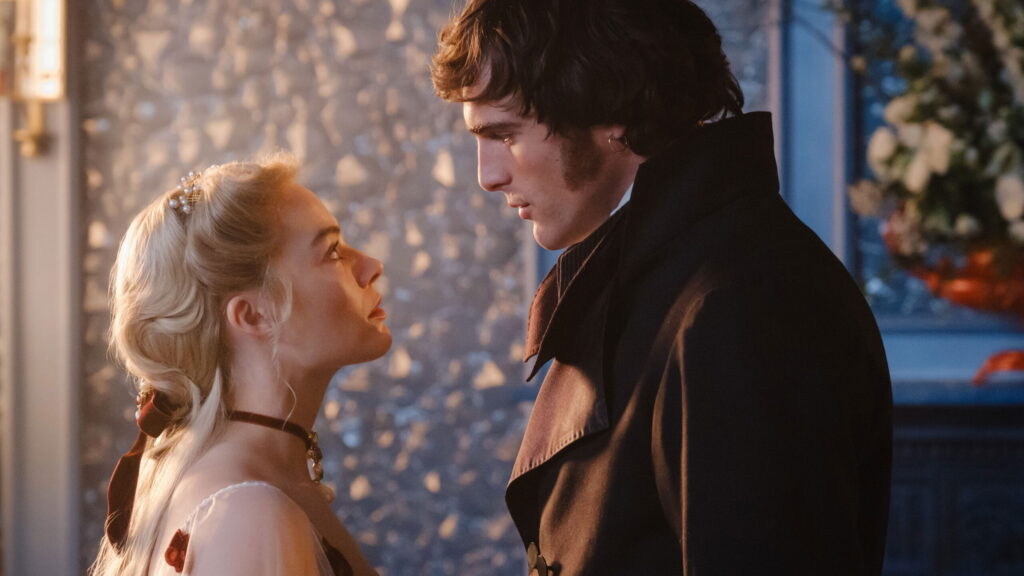
This welcome change continues onward to when Cathy and Heathcliff are older (now played by Margot Robbie and Jacob Elordi, respectively), continuing their quasi-romantic relationship as “teenagers” until the respectable Lintons move into a nearby manor. Charmed by siblings Edgar’s and Isabella’s (Shazad Latif, Alison Oliver) decadence and upper class lifestyle, Cathy grows infatuated with the former, causing a rift between her desires for a better life and the bearded, untamed Heathcliff. Her love triangle with both is short-lived after a misunderstanding, leading a heartbroken Heathcliff running away on horseback and a reserved Cathy deciding to take up Edgar’s hand in marriage.
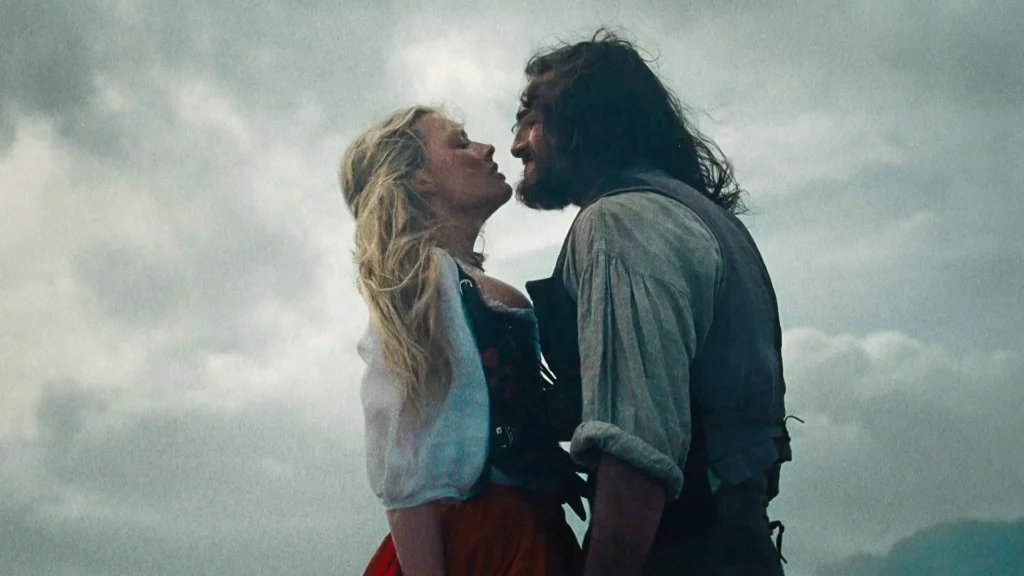
During this period, Fennell’s balance in expressing the primal, sexual lusts between the main leads through the natural gushes of wind and dirt of the earth with the nonsensical brushes of emotion (the pretty, anachronistic costumes designed by Jacqueline Durran, the camerawork of Linus Sandgren bringing out a picturesque beauty amidst the wilderness of Yorkshire while showing off the popping VistaVision colors of vibrant red skies and luscious green grassblades being put into people’s mouths) make “Wuthering Heights” a film all of its own. Taking a route similar to the works of Rodgers and Hammerstein, the mise-en-scene portrays the story in such an emotionally driven environment, giving it a power through its visceral filmmaking to craft a potentially unique take on a story that has been adapted for centuries. Deviating from the realism of Andrea Arnold’s version, and going farther than the more Hollywood takes from William Wyler and Peter Kominsky, it strives to go beyond being a new version of Brontë’s novel and instead ventures into a pastiche of gothic phantasmagoria.
Only capturing the imagery and sensations of Wuthering Heights, Fennell ignores everything revolving around the story’s themes. Heathcliff is a white person and not a person of color (an issue prevalent through most adaptations of the book that is validly criticised), making his experience of being considered an Other by the Earnshaws and Lintons an issue of classism instead of racism. His devious nature is sanitized, having less of a darkness that leaves him with little complexity besides victimhood. The source of abuse and prejudice comes from a single entity, the destructive Mr. Earnshaw, instead of this attitude being shown in every character. Any bud of the novel’s unpleasant nature is essentially plucked out, leaving only the core premise the same. If it were under a different name, “Wuthering Heights” would’ve worked just as well as a mash-up of gothic literature akin to Saltburn, her prior attempt at homage that was then criticized as a rip-off of The Talented Mr. Ripley. It seems here Fennell just can’t win; if titled something else, the Wuthering Heights comparisons would’ve been apparent, but because it is titled “Wuthering Heights” (the quotation marks may give it a tongue-in-cheek attitude with itself, but never transitions into full-on camp), the hatred still remains. So then it doesn’t help that, after making a film that feels like Emerald Fennell has finally gotten into her own wavelength, “Wuthering Heights” falters the more it takes from the story.
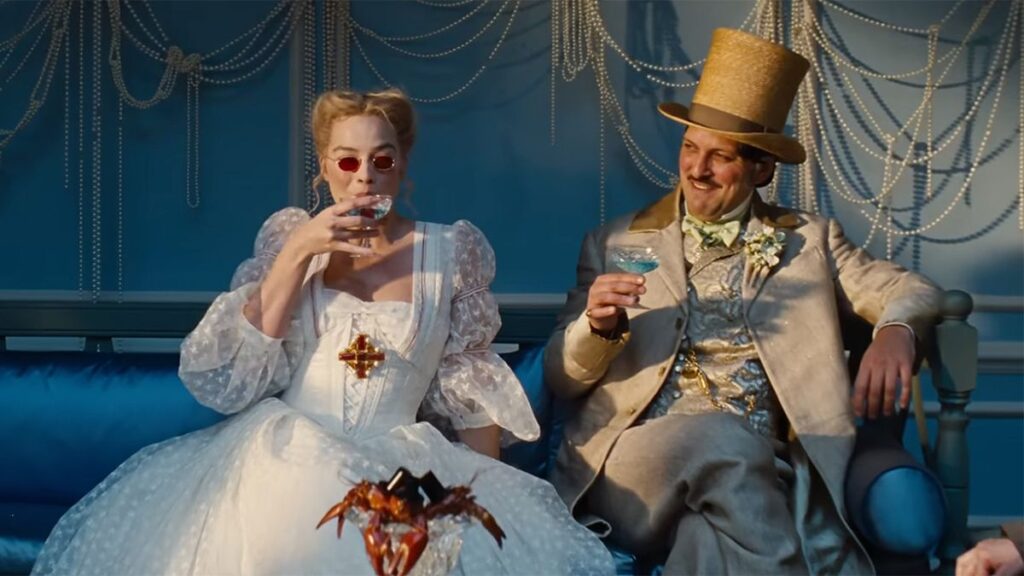
As the film picks up years later, with Heathcliff returning from his travels, now rich and conventionally attractive, Cathy’s love for him reignites. She engages in a fiery sexual affair with her childhood friend/servant/adopted pet, which is where Fennel’s screenplay sadly runs into some issues. Having set up a lot of potential ideas for her script to go (the connection between nature, sex and death, the rich Lintons cannibalizing the wild Cathy via making her bedroom walls the same color and texture as her skin and making dolls of her with their wife/sister-in-law own hair), it disappointedly doesn’t take these concepts anywhere further. Cathy grows to like living with the Lintons during a quick, upbeat montage of her married life -Victoria Boydell’s editing quickens the pace but doesn’t leave much pathos-, so any conflict that arises from her affair is instead a regular marital dispute instead of anything symbolic of repression. And everything that is set up from its bombastic opening and sexual charge between Cathy and Heathcliff is undone once the plot aligns with an earlier scene of Isabella talking about Romeo and Juliet. As she laments, oh how that nurse ruins everything for the poor doomed lovers, in a story so sad but also so romantic. Once Nelly (Hong Chau) finds out about the affair, replacing Mr. Earnshaw as the antagonistic force in the second half (making Fennell’s thematic disdain for the lower classes ruining the lives of her rich characters much more apparent), it’s understood that Fennel is not interested in making a gothic story, but rather using its aesthetics to create a tragic period romance with none of the ideas attached to the genre.
Since she took the most compelling parts of the novel out of her script, her version of a tragic love story can’t help but be frothy. Suzie Davies’ imaginative production design, Charli XCX’s needle drops and Anthony Willis’ brooding score may aid in giving some emotion to this fraught tale of woe, but in the end it proves to be for naught. Once it reaches its forgone conclusion spoiled by Isabella, there is nothing to be felt out of a romance that has spent its time withering away long before the ill-fated end.
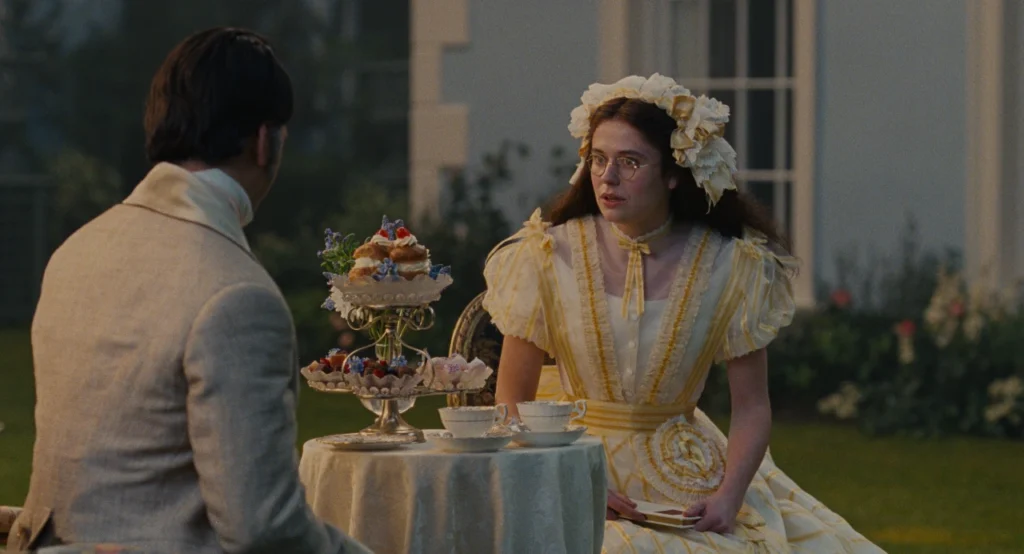
What does one come away with after such an experience, of watching something that confidently showed promise only to meander into nothingness? While there is appreciation for Fennell not trying to adapt everything in Brontë’s novel, seemingly knowing her limits and having a better understanding of who she wants to be as a storyteller, the fact that she couldn’t stick the landing only proves she still suffers from the same instincts that has led to endless criticisms and controversies surrounding her other work. Her reliance on shock value appears throughout, from BDSM horseplay to changing an abusive relationship from the novel into consensual servitude that serves for faux-sexiness instead of substance. Unlike the juvenile debaucheries in Saltburn, these scenes of scandal feel tired. Her choice of having a white man play Heathcliff while the antagonistic Nelly and the less desirable Edgar are played by people of color pokes holes in her attempt at color-blind casting. Her effort at dragging a long, tedious affair only leads to its conclusion and catharsis feeling empty. And now, by making something that’s connected to a masterpiece of gothic literature, it only makes her script look worse in comparison by failing to craft something just as compelling as the work she was deeply affected by as a teenager.
In other words, this tragedy was doomed from the start when she decided to call it “Wuthering Heights”.