


You’d Have to Stop the World Just to Stop the Feeling
DIRECTED BY YORGOS LANTHIMOS/2025

In an unnamed town somewhere in America, two people start their day. Michelle Fuller (Emma Stone), CEO of renowned pharmaceutical company Auxolith, spends her time before work exercising, eating healthy, and doing a thorough skincare routine in her large, modernist mansion. Meanwhile, Teddy (Jesse Plemons), a conservationist Auxolith warehouse worker living in a farmhouse at the edge of town, explains to his cousin Don (Aiden Delbis) about the reason why he’s committing to his masterplan.
As he exposits his views of the world to him, telling him about the natural order seen through the behavior of the honeybees he farms outside his house, Teddy’s explanation of the bees dying off because of Colony Collapse Disorder becomes foreboding. Mixed with the cross-cutting of Michelle’s morning exercise becoming more violent as she practices fighting with her trainer, there’s an implication suggesting these two lives will soon come together, not in peace but in war, as if both sides are preparing for a future fight. A fight that, unknown to Michelle, comes sooner rather than later.
Bugonia, a remake of the South Korean thriller Save the Green Planet!, chooses not to match the original’s fun exercises in genre-bending, instead perfectly aligning with Yorgos Lanthimos’ observational perspective seen throughout all his films. This is made clear during the kidnapping sequence; as Teddy and Don chase Michelle around her house, the camera far away from them as she tries to fight them off, almost getting away from her kidnappers until Teddy drugs her with a syringe, there is a coldness amongst Lanthimos and The Menu writer Will Tracy in keeping a literal arm’s distance from their characters. An iciness that allows for the premise of Teddy and Don kidnapping and holding Michelle in their basement, believing her to be an alien sent to watch over the human race and influence its destruction, to both be unsettling and morbidly funny.
As is usual with Lanthimos’ films, his offbeat humor via his actors playing their roles deadly serious while saying ridiculous lines or doing terrible actions adds commentary to his latest subjects’ behavior. Michelle, the PR-trained girlboss CEO, is shown during her workday to be the most stereotypical depiction of said kind of person, passive aggressively telling her workers they can leave at 5:30 -a consequence of an implied controversy that she passes off as simply an “unpleasant incident”- but only if they don’t need to catch up on work, or in forgetting lines about the importance of diversity in a video shoot. Teddy, on the other hand, acts as a person obsessed with conspiracy theories, believing every word of the extraterrestrial threat, despite any absurdities like the alien “Andromedans” being able to communicate through their hair. He is so committed to this theory that, fearing that Michelle would try to seduce him and his cousin, he forces Don to join in on chemically castrating themselves.

Essentially, Lanthimos and Tracy bring out the oddities in their two extremes: The psychopathic conspiracy theorist who believes in the most ridiculous things anyone has ever heard of, and a capitalist so uninterested in the ethics of her business no matter how much she verbally talks about her dedication to improve that, to anyone way below her social class, she may as well be an alien sent to exploit humanity.
But the engrossing factor of Bugonia doesn’t come from the writer and director making some insightful commentary on the state of things (Between this year’s Eddington, One Battle After Another, and countless others, there’s already enough political/social satires made to be the be-all-end-all of talking about 2020s America). What makes Bugonia work is in the thought experiment of putting two differing ideologies in a room and seeing who comes out alive.
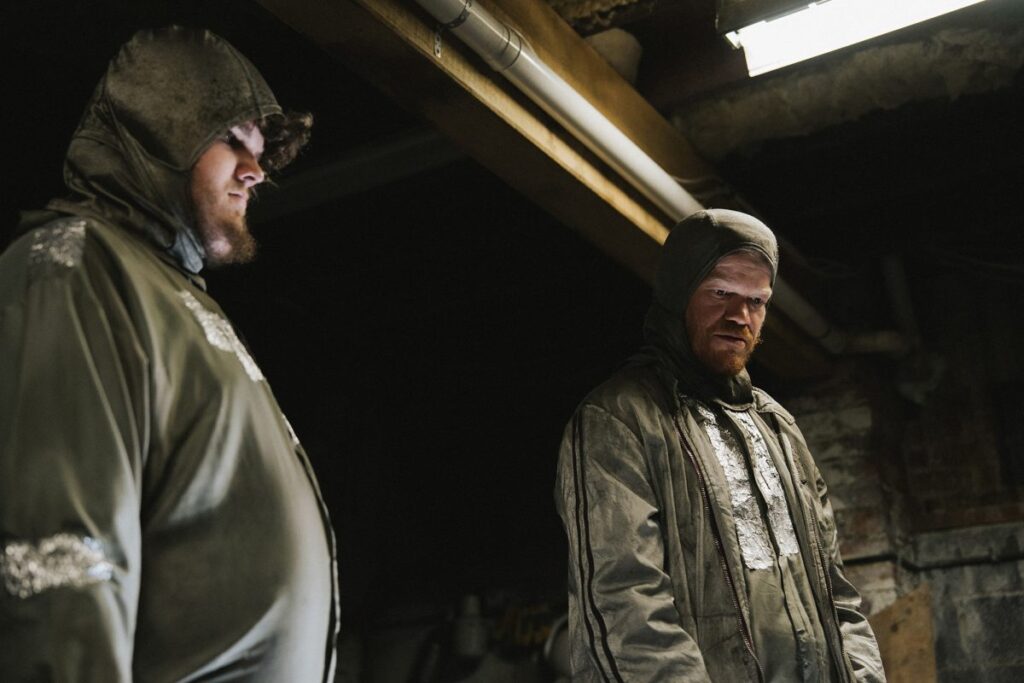
Having her chained to a bed, head shaved, covered in antihistamine and replacing her suit with grimier clothes, Teddy’s intimidation strategy of visually depowering Michelle proves to be a match for her verbal attempts to de-escalate the situation. At first coming off as humorous with her non-chalance at her circumstance and desperate attempts to “have a dialogue” with Teddy, once given enough context she starts to get into his head, caring for his plight while trying to make him see reason. Although, her attempts are equally matched with Teddy’s idiocy, a man who doesn’t know that chemical castration only leads to a person’s hormones going out of control and making them more emotional. With Teddy slapping her after the two get into an argument, later beating up an old car out of frustration, the “3 Days until the Lunar Eclipse” countdown in the original (referring to Green Planet!’s Byeong-gu attempting to stop the end of the world that he predicted would be caused by the Andromedans) is now an unintended timer for Teddy’s inevitable breakdown.

Alongside Tracy’s writing for the duo’s fight for dominance, Lanthimos has these potentially-repetitive conversations become visually compelling. Robbie Ryan’s cinematography, including a 4×3 aspect ratio and VistaVison, complement the chamber thriller. The increased intimacy of the camerawork, as well as angled close-ups of Plemons and Stone’s faces as they figure out their next move, adds a personal nuance to the film’s light social commentary while gorgeous in its Dreyer-esque framing. And with all three actors doing the most with their archetypes, filling in the missing pieces in their characterization to blossom into feeling like people, Stone, Plemons, and Delbis are remarkably great in their roles.
Which leads to the most surprising factor of Bugonia, a quality that has started appearing in Lanthimos’ work since Poor Things, which is his ability to bring out humanity and tragedy in a story so inhuman. A trait used fantastically in Kinds of Kindness, it works with a similar effect in the captivity-thriller. Revealed in surrealist dream sequences, Teddy’s connection with Auxolith stems deeper than simply working for them. With his mom (Alicia Silverstone) comatose in the hospital -a result of a Auxolith drug trial gone wrong- his contempt for Michelle oozes through his exterior shell of being humanity’s savior. Living with only his cousin, his other family members having died for unexplained reasons, he takes advantage of Don’s insecurity to lure him into his conspiracy, building a connection by promising better things for the two of them. Don quickly becomes a pawn for Teddy and Michelle’s fight for power, either being thought of as a secondhand man or a potential weak link to exploit for freedom, ultimately leaving him with zero agency. The only reason why he became complicit in Michelle’s kidnapping is not out of revenge but so he can go to space, away from the other people he believes he doesn’t fit in with.
For Michelle, she fits the most recognizable archetype in Lanthimos’ work, the God character. Fitting with The Killing of a Sacred Deer’s Martin and Kindness’ Raymond, she serves as an omnipresent influence in the two men’s lives, down to the framed photo of herself in the breakroom of Teddy’s workplace having the same religious aura as a cross. Where she differs is that she’s less malevolent in her intentions towards those lower than her; while Martin may get some satisfaction at inflicting pain upon people, Michelle causes her actions without realizing it, but even then doesn’t care too much about it. And once he is away from the person he thinks of as his personal torturer, local cop Casey (Stavros Halikas) proves to be another source of torment for Teddy. Constantly bothering him daily, he serves as a walking reminder of the trauma he inflicted upon Teddy when babysitting him as a child, an incident Casey passively wants to bury the hatchet over while awkwardly flirting with him. A notable change from the original’s police procedural perspective, Bugonia’s more negative depiction of the police adds to Teddy’s misery.
This emotional aspect, through Jerskin Fendrix’s bombastic score, almost becomes a character of its own. Building towards an explosive finale, the emotion and horror in the music intensifies as Teddy becomes more violent, not only bringing out the terror in his psychopathic acts but also a sadness to the story at large. A man influenced by his worst impulses and beliefs, the depressing central story of Bugonia is watching someone desperately fighting against the aches of his life in the most disturbing way possible, torturing a captured Goddess in his basement and destroying everything just to feel some sense of control. But ultimately, like the other Lanthimos protagonists that came before him, his desire for control is thwarted.
Despite the tragic nature giving depth to the humor and horror of Bugonia, Lanthimos and Tracy ultimately harm its success. In an ending that differs from the more ambiguous conclusions in Lanthimos’ storytelling, its conclusive nihilistic statement on human nature deflates the thematic complexity that gave the film momentum. With the established small-scale setting and isolated spaces giving the story a layered subtext via its personal nature, the switch to making a reductive statement on the entirety of the human race ruins the momentum it had going for it. Ending a movie about the ways people influence each other with the Yorgos Lanthimos version of Peace on Earth is not only self-satisfactory (never thought to see “we are the virus” being taken seriously in a Lanthimos film), but is so contradictory to how messy Bugonia allowed itself to be emotionally that it doesn’t feel like a satisfying payoff. It can’t help but ruin what was beforehand an incredibly solid thriller.
Bugonia’s flaws are perhaps a symptom of what’s been affecting Lanthimos. His misanthropic takes on humanity has softened over the years, recognizing the pitiable nature of people abusing themselves without wallowing in pretension. But in this, his ideas clash with his thoughtfulness; he ends up rubbing the viewer’s face in how screwed humanity is, an indulgent gesture that is either a misguided attempt at recreating the original’s ending, or a sign that his recently announced break from filmmaking is needed. His directing and crew craft a compelling genre film that stands on its own, albeit with the sad reminder of Lanthimos not reaching the same heights as he did before. He has his usual tricks that still work as well as before (extreme violence, a darkly comedic tone, pop song needle-drops, the human/animal comparison, stone faced acting, etc.), yet Bugonia still ends on a sour note.
