


Grief is a Universal Language in Scarlett Johansson’s Directorial Debut Eleanor the Great
DIRECTED BY SCARLETT JOHANSSON/2025
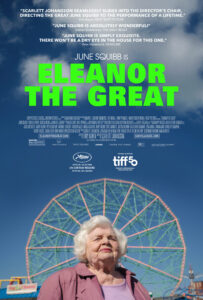
Who among us hasn’t given in to the urge to tell a little white lie? To elaborate just enough to make ourselves appear a little bit more interesting than what we are? For Eleanor Morgenstein (June Squibb), her fibs flow off the tongue with careless ease. Eventually, her quick mouth lands her in a tricky predicament and triggers a series of misadventures. In her directorial debut, Scarlett Johansson balances the weight of several heavy subjects ranging from aging all the way to the Holocaust. The results are mixed and held together mainly by its whip-smart, endearing protagonist. Eleanor is ready to share a fascinating life story. But does it actually belong to her?
For over a decade, Eleanor and Bessie (Rita Zohar) have shared both a home and their lives together. Best friends since childhood, the bond between these women is undeniable. They march through life side by side with lively attitudes and sharp wit. Their routine is forever altered when Bessie tragically passes away, leaving Eleanor alone and feeling adrift. Faced with returning to a solitary apartment, our protagonist decides it’s finally time to return to her home state: New York. Her daughter Lisa (Jessica Hecht) and grandson Max (Will Price) welcome her to their home in Manhattan, although with a slight reluctance. Her family has little time to entertain their new guest, and a tightly wound Lisa encourages her mother to participate in activities at the local Jewish Community Center. An initially kind encounter with a stranger lands Eleanor in a sticky situation when she is invited to a meeting of Holocaust survivors. Instead of clearing the air, Eleanor chooses to adapt her late friend’s story of survival as her own. Her words catch the attention of the young Nina (Erin Kellyman), and she insists on chronicling Eleanor’s history for her journalism course. As the unconventional friendship between the two women develops, Eleanor finds herself more and more trapped within her lie.

At 95, June Squibb seems poised to tackle Hollywood right alongside her more youthful counterparts. There is an edge to her that has not faded in age, and her quick comedic delivery gives this film the juice it needs. Kellyman is a wonderful scene partner for her. As Nina, she softens all of Eleanor’s rough edges with her youthful optimism. She is processing her own grief over the death of her mother only a few months prior. Now, Nina is stuck in a home with her nonresponsive father Roger (a criminally underutilized Chiwetel Ejiofor) who has become emotionally closed off. In Eleanor, Nina has found a kindred spirit that she can share her complicated emotions with. Where her elderly counterpart is more reserved in her grief, Nine wears hers like a raw open wound. Together, the pair start the shaky journey towards healing. Eleanor the Great functions best in these intimate moments when the duo explore their newfound relationship.
Johansson does not suffer from a lack of material to experiment with. This type of character-driven script has bright potential, but the end result feels rather toothless. That is not to say that some points stick the landing – mainly thanks to the efforts of both leading ladies – but the blunders stick out like a sore thumb. Most notable is the somewhat cringe inducing behavior of the film’s protagonist. After a while, it becomes a genuine struggle to watch Eleanor continue to deceive such kind, caring people. Johansson tries to soften the blow by including flashbacks of Bessie recounting her own history, yet the awkwardness remains. Misguided as her actions are, this is a woman who shoulders the responsibility of carrying on her best friend’s memory. The concept of preserving memory is present yet never fully fleshed out quite enough to truly justify Eleanor’s actions. The dubious morality at work is manageable primarily due to Squibb’s own natural charisma.

Though uneven in spots, Johansson pulls together an admirable character-driven feature aimed at pulling on some heartstrings. To her credit, it did absolutely work on me. Squibb is the glue that manages to pull everything together. Without such a presence, Eleanor the Great dissolves into sappy, character-driven project that hesitates too much to explore beyond the surface level. If nothing else, it is at least a beautiful examination of the power of female friendship and the acknowledgement of love within grief. It is good, just not great.