


“He Thinks This is Better, and I Think I Sort of Agree with Him”: A Defense for the Lesbian B-Movie Trilogy
DIRECTED BY ETHAN COEN/2025
There’s a bit from The French Dispatch where art dealer Julian (Adrian Brody) analyzes Moses Rosenthaler (Benicio Del Toro)’s modern art piece, saying that he tested the artist’s skills via forcing him to create something technically impressive. Once he did exactly that, Julian came to the conclusion that the seemingly amateurish art was actually something enlightening. It’s not a showcase of an artist’s poor skills, but a creative choice that invites forward introspection.
That may be a pretentious idea to apply towards Ethan Coen and Tricia Cooke’s Lesbian B-movie trilogy, but the thought still stands. Everyone knows that Ethan Coen, alongside his brother Joel, has made films considered to be pieces of art. Fargo and No Country for Old Men received widespread acclaim and are constantly put on greatest films lists, so there is an objective standpoint in believing that Coen is, in fact, good. So, through investigating why he would spend his time apart from his brother making lesser quality films that have made fans desperately yearn for their reunion, his talents would seem clear. Ethan Coen is the guy who came up with the wacky dream sequence in The Big Lebowski, or was more involved in the comedic entries in the brothers’ filmography such as The Ladykillers or Raising Arizona. And based on the differences between Ethan’s singular work and Joel’s recent adaptation of Macbeth, the former is the one who brings the comedy and the latter adds on the philosophy, drama and nuance. Divided, Joel seems to fare better than Ethan, but the question still remains: Is there any value to be taken from the Lesbian B-Movie Trilogy?
What makes said trilogy interesting, beyond how much they contrast from the Coen’s acclaimed works, is that they are an exercise in lesser filmmaking. Last year’s Drive-Away Dolls, noticeably cheaper and wonkier than the average Coen production, took advantage of its limitations and turned it into charm. There was fun in how much Coen and Cooke indulged in making a comedy that allowed itself to be strange in its own flow, from its non-judgemental look at women’s sexuality, out-of-nowhere trippy transitions featuring Miley Cyrus, and an eclectic soundtrack that made its Tarantino influences very well known. Amongst the camp, the titled-onscreen Henry James’ Drive-Away Dykes was the duo’s idea of a B-movie: cheap, loose, and a platform to express a non-mainstream voice, in this case an unapologetically queer one.
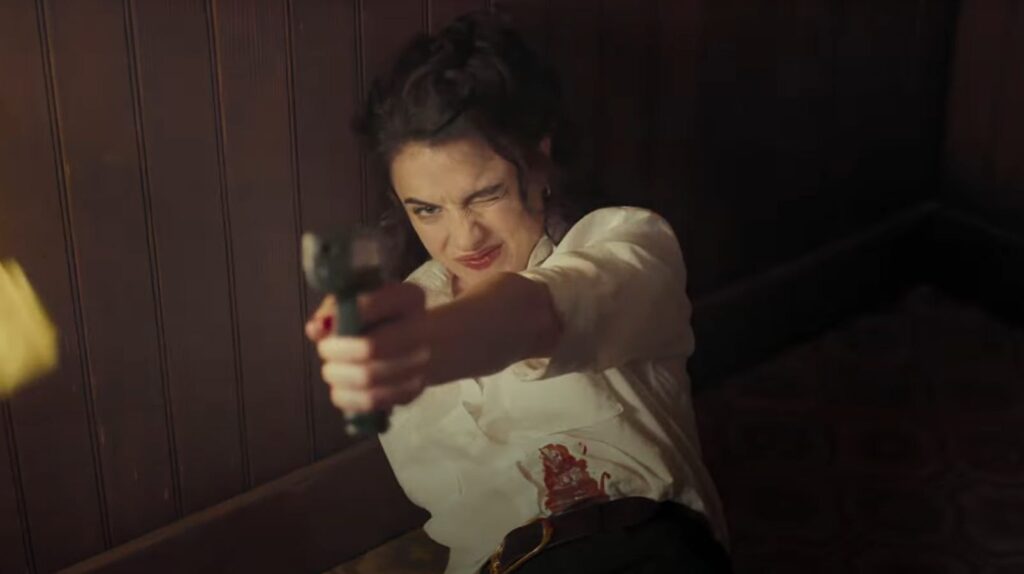
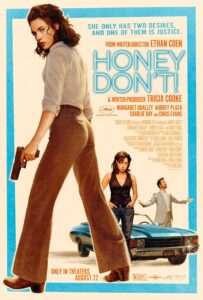
Their latest entry, Honey Don’t! is interesting in that it’s the opposite of Drive-Away Dolls. Stripping itself of any of the visual weirdness that Dolls wore on its sleeve, Coen and Cooke’s latest entry is a quieter movie.
The setting is in Bakersfield. It doesn’t matter what time period this story takes place in -as akin to its predecessor’s heavy emphasis in its depiction of Y2K America- for the atmosphere of the sleepy town reveals that it’s nothing more than a dead end. Dry, run-down, and bleached with time thanks to the everlasting sun beaming down on the city, the fact that Honey Don’t! takes place in the present day is a surprise since it can easily be confused with the vast, drab desert environment of No Country for Old Men. All the buildings featured in the film look like they’ve been there for decades, and every character shares the same indifference in living in such a depressing-looking city.
This factor is where Honey O’Donahue (Margaret Qualley) comes in. A professional private detective feeling just as stuck in a rut as everyone else, she spends her work investigating petty infidelity cases for clients, or being brought in for police investigations by detective Marty (Charlie Day), a cop who just can’t get over O’Donahue, both in the fact that he has a crush on her and also the fact he doesn’t believe she’s a lesbian. Outside of her job, she helps take care of her sister Heidi’s (Kristen Connolly) numerous kids, despite the lack of appreciation she shows Honey despite always calling for help.
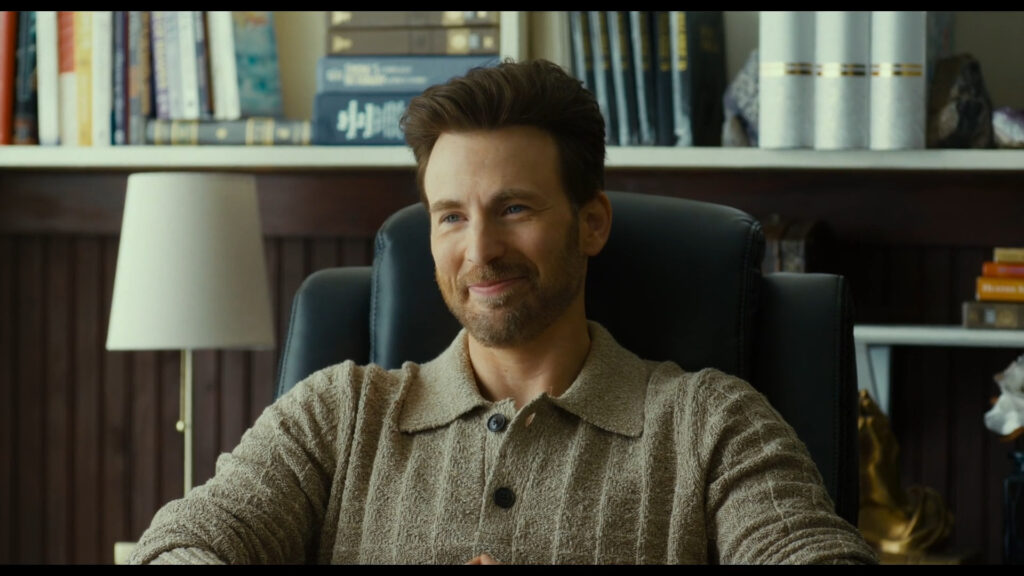
Surprisingly, even though the main premise of Honey Don’t! is about Honey investigating a puzzling murder case, Coen and Cooke remain focused on their characters’ lives over the potentially thrilling mystery. Honey’s life and sexuality are put into the primary focus, while all the other factors -including a sideplot of cult leader Reverend Drew Devlin (Chris Evans in his funniest role in years) running a drug empire with “the French” and covering up multiple murders- are humorously non-chalant. In fact, despite being set up as the film’s main antagonist, the story of Devlin, his empire and church The Four-Way Temple being the reason behind the murder Honey is investigating is comically wrapped-up without the detective’s involvement, as is the usual touch of Coen’s sardonic humor.
Instead, Honey is put on a different journey that brings out a less fun truth. Getting involved in a tryst with police officer MG Falcone (Aubrey Plaza), she gets to have a break from the humdrum life she built for herself, only for her two lives to eventually clash in a third act that dangerously plays into regressive, homophobic tropes, albeit while playing into the specific tone that Honey Don’t! builds. In a town like Bakersfield, everyone has their own baggage and pangs of loneliness. It explains why people would be drawn to a religion that calls for its members to act as bottoms to God (a heavy part of Devlin’s sermons revolve around “submission” in how to serve God), or how someone with their own trauma can either act out in destructive ways or feel stuck in a state of limbo. In the case of Honey and Heidi’s father (Kale Browne), a man who was both abusive and absent in the sisters’ childhood, their strained relationship and reluctance to move on from such a tired place makes more sense. For Heidi’s eldest daughter Corrine (Talia Ryder), her hectic homelife with several siblings explains why she would be okay being in an abusive relationship. At least she finally has something for herself.

Honey then serves as a light for the characters’ lives despite her own issues. Getting to help out her family and able to resolve certain issues brutally and effectively make her a contrast to the depressing world of Honey, Don’t!, as well as allowing Qualley to further explore her acting chops in a movie where she gets to be the sole lead role. While her turnout here isn’t as expressive as Drive-Away Dolls’ Jamie, the newfound space she’s given after working in supporting roles for many years can’t help but feel refreshing as she gets to show she can carry a film on her own.
Even though Honey Don’t! doesn’t reach the same highs as the other films that Ethan has worked on in the past, it sits in an odd spot. It shares the same qualities as Dolls, keeping the cheap, low-budget look while featuring A-list actors, but is more dreary in comparison. It captures a spirit not typically seen in B-movie homages (the fact that these movies can indeed be bland), creating variety in a trilogy that is trying to bring this type of film back into Hollywood. And as a movie working to bring back the B-side thrills of yesteryear, it works better as a slice-of-life film about the goings-on of a queer detective in a city only getting more wrung-out. As for Honey, her life may not have improved or gotten worse by the end, but at least she doesn’t let the weariness get to her.
Despite these films never being critical or box-office darlings, the fact that Coen and Cooke are continuing with the third entry is in itself inspiring, not caring to bow down to making mainstream-approved art again or simply giving up. It is a choice, something that only Ethan Coen and Tricia Cooke can make. Hopefully Go, Beavers! can perfectly cap off this strange but fascinatingly fun trilogy.