


American Psychosis
DIRECTED BY ARI ASTER/2025

A standoff occurs at the local general store.
Because of a sudden mandate, the people of Eddington are forced to cover their faces, leading to those brave few who refuse to take part in it being discriminated against. Because of this, workers are kicking them out of the store. No one else cares to intervene in the scene, including the town’s own mayor, who haplessly allows this senseless division to occur. That is, until the heroic, do-gooder sheriff happens to come in, realizes the situation, and sets things right. He confronts the store workers and the mayor’s harsh treatment of their fellow man, buys a citizen’s goods for them after the latter was removed from the premises, and once said citizen thanks him and offers to pay him back, an opportunity arises.
PedroFor anti-masker sheriff Joe Cross (Joaquin Phoenix), this incident of seeing people not wearing masks during the height of the COVID-19 pandemic and violating the grocery store’s policy convinces him to run for mayor against Ted Garcia (Pedro Pascal) in the upcoming election. A decision that, he fails to realize, would soon turn an already-bad situation into a wild, incomprehensible hell.
Despite the Civil War-level political ragebait seen throughout Eddington– such as depicting the town’s BLM protests as virtue signaling while anti-maskers are given a more sympathetic light- Ari Aster does something far more interesting than Alex Garland could ever dream of: He plays with form.
Since Eddington follows the perspective of an old-fashioned sheriff, Aster appropriately meshes his modern political dark comedy-thriller with the tropes of a classic Western. Already a genre known for having conservative ideals, the thought process is now more clear: In this small town in the middle of New Mexico, the small population and empty streets communicate a potential death of Eddington and the small towns like it that fade within time. With COVID now accelerating that alienation, Joe’s at-first well-meaning goal to keep the town from eating itself alive only becomes more and more futile. Joe’s incompetence as a police officer leaves Ted angered that his election opponent thinks he could do a better job despite the latter’s history of officers quitting or dying of fentanyl overdoses (or as Joe hastily tried to defend himself with, the officer actually died from handling fentanyl). His peace-making skills prove ill against the growing tide of liberals advocating for justice in the aftermath of George Floyd’s murder. His home life isn’t faring well either, with his traumatized wife Louise (Emma Stone) becoming more avoidant of him while her mother (Deidre O’Connell) extends her supposed-to-be-short stay at their house and continues to try to convince them of her many internet conspiracy theories. With all these various viewpoints coming at him, Joe goes from someone trying to keep the peace to a person who thinks everyone is his enemy. Eddington shifts from trite political satire to a dark character study.

Aster’s typical themes and archetypes are there; Joe is basically another version of the title character from Beau of Afraid, a man who proves unskilled at living a capable life and is then tortured for it; O’Connell’s Dawn is a new form of Aster’s the mother-terrible, a conspiracy theorist whose quest to indoctrinate Louise tragically backfires; the cults make a return, where Dawn takes Louise to a Qanon-esque cult leader Vernon Jefferson Peak (Austin Butler), a charming and attractive man who soon shares a better connection with her daughter compared to any other character, including her husband. Of course, this all goes back to Aster’s main idea in all of his films, a story about people desperately wanting control.
Everyone in Eddington is fighting for some sense of stability, despite how much they don’t deserve it. Teenagers like Sarah (Amélie Hoeferle) advocate for George Floyd to make up for discovering her complicity in white privilege, though her friends Brian (Cameron Mann) and Ted’s son Eric (Matt Gomez Hidaka) take part in protesting as a ploy to have sex with her. Joe’s fellow officers Guy (Luke Grimes) and Michael (Michael Ward) aid their sheriff in his election campaign, though they prove to be just as inept and immoral as their boss. And Ted, the seemingly righteous voice of reason, is trying to win the election in order to finalize the decision to build an environmentally harmful data center (named in one word “solidgoldmagikarp”) near Eddington.
As Aster implies in the film’s heavy use of cell phones and laptops, every character is caught inside their own world. Everyone sees themselves as the hero in their own Western, fighting the good fight in order to preserve their ideology. Of course, this us-and-them mentality in Aster’s world only leads to two things: At best, a petty argument (such as an argument-turned-slap-fight between Ted and Joe at the former’s outdoor fundraiser humorously set to Katy Perry’s “Firework”), and at worst, people violently dying.
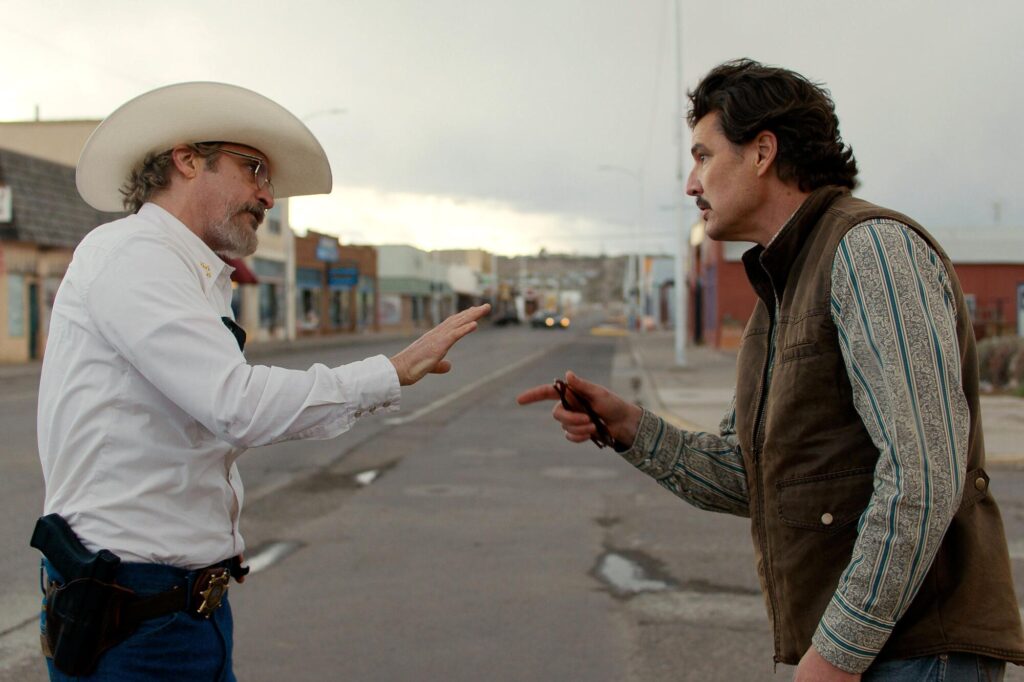
It’s interesting how easily Eddington could’ve been another “can’t we just get along?” mouthpiece, but Aster chooses to muddy things up. Joe’s descent into madness is less a product of opposing politics and more self-inflicted; everything that happens in Eddington is because of his incapability to handle a situation -even his campaign announcement was really a self-centered ego boost and not a gesture of goodwill-, causing him to ironically lose more control of his life. At first, Aster seemingly makes a point about both sides fueling each other’s fire, only for the film to keep going until any political sense is gone. What is left in the final half hour of Eddington is nothing but a COVID-induced brain fog of modern American madness.
There are certain qualms to have with what Aster does in his script. The late-introduction of a cartoony Antifa terrorist group works in Joe’s exaggerated beliefs that the Libs are out to destroy him and his way of life, but in establishing that they are in fact an in-universe representation of Antifa ruins the point. The fact that the representatives around Black Lives Matter are privileged teenagers and no one facing actual injustice leads to a skewered depiction of the organization. And with so much going with his ensemble cast, it can lead to some characters’ conflicts/flaws being treated lighter than others.
Yet, what helps Eddington work is in its dread. The stylistic filmmaking from cinematographer Darius Khondji and editor Lucian Johnston elicit a growing pit in your stomach as each character makes worse and worse decisions, as Daniel Pemberton and Bobby Krlic’s score bring out the western influence while simultaneously making viewers uneasy.
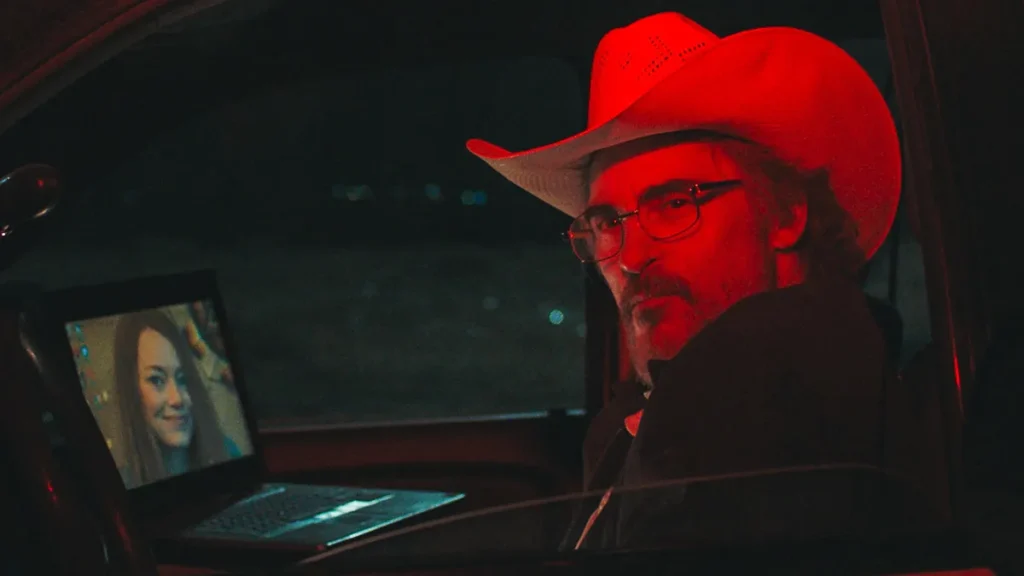
For what gives Eddington potential is how it adapts the Western into the modern age. Instead of a lone rider coming into town, the film starts with a strung-out homeless man ranting to himself. Replacing the moral sheriff who upholds the law, Eddington has a cop who is really bad at his job to the point of destruction. The modern equivalent of the opposing, seedy gangs looking to cause trouble are now progressive leftists trying to inspire change and rebellion. And equivalent to a train station that symbolizes the domestication of the Wild West, there is the AI-generating solidgoldmagikarp.
In flipping genre tropes on its head, Aster turns a genre filmgoers used to look up for aspiration and turns it into a reflection; instead of a microcosm where good can prevail, Eddington is a place that only appears to get worse. Aster doesn’t ask to respect the far-right or to see the flaws in the far-left; any chance of communion between the two is beyond the point of no return. He instead reflects on the modern American’s need for security contrasting with their ego and greed, and how that combination doesn’t invite safety or a step towards a better future, but apocalypse.
Aster is not like Alex Garland where he asks us to “don’t do that”. He’s smart enough to know there is no solution in how to undo America’s division. He just wants us to sit with our own insanity for two-and-a-half hours.