


Henry Golding and Beatrice Grannò Star in a Sci-Fi Romance That Goes on, Well, Forever
DIRECTED BY NACHO VIGALONDO/2025
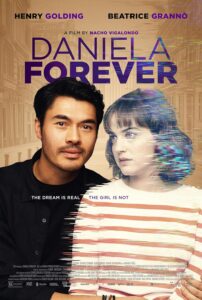
If you had the chance to get back the person you lost, would you? This intriguing question is the starting point for director Nacho Vigalondo’s newest sci-fi drama, Daniela Forever. Akin to such films as Inception and Eternal Sunshine of the Spotless Mind, Vigalondo explores the possibility of the dream world and the melancholy of lost relationships through the sci-fi genre. The premise is very promising, but what follows is a film that takes so many twists and turns that it eventually collapses into a nonsensical final product.
Months after the unexpected passing of his artist girlfriend, Daniela (a tragically wasted Beatrice Grannò), professional DJ Nicolas (Henry Golding) is floundering aimlessly in his daily life. Even though he is surrounded by a support system of friends and family, Nick feels distinctly alone. His despondency is enhanced by the claustrophobic aspect ratio that Vigalondo applies to every scene set within the real world. The color palette here is as dreary and uninspiring as they come, which only highlights the all-encompassing despair of our protagonist. In the fog of his grief, Nicolas is suddenly offered a once-in-a-lifetime opportunity: an experimental drug trial that relieves depression through the practice of lucid dreaming. When Nicolas takes the pill, he is plunged into a strange world that he has the power to control. More importantly, Daniela is alive and well here. Now, he has a second chance with her.
After recovering from the initial shock of seeing his dead girlfriend, Nicolas begins to stretch the boundaries of his new dreamscape immediately. His rebellious streak is instantaneous, and he apparently grasps every minor intricacy of this mystery drug within minutes. This fake world is flooded with light and color, and Vigalondo flips to widescreen to signify the difference from reality. The details surrounding the lucid dreams are arguably the most conceptualized aspect of Vigalondo’s film. The way Nick is able to control both his physical surroundings, and the inhabitants of his dreams, is genuinely fascinating. This specifically applies to the main object of his affection, Daniela.

The Daniela that exists in this uncanny space is built entirely from Nicolas’ perception of her. Long gone is any of her autonomy. In the dream world, Nicolas has complete control over both her memory and her actions. There is something deeply unsettling in watching Nicolas puppet her around with little to no hesitation. When Daniela begins to show even a little resistance, he is able to simply wipe her memory and have her be obliviously happy. Vigalondo does not excuse Nicolas’ horrific actions, but it is obvious they are built from the fear of losing the safe space Nicolas has created for himself.
Unfortunately, after the initial introduction to lucid dreaming, this is where the film begins to crumble. Vigalondo is clearly full of fascinating ideas, but his execution starts to fail not long after the first half hour. The constant flips between the real and fake world are often confusing and choppy even with the different coloring. The entire second act is stretched to the limit. By the time climax comes around, it feels more like a relief rather than exciting. Certain concepts feel entirely fleshed out and well-conceived, namely the rules around the dream world, but then are immediately followed by scenes that seem hastily added to fill time. Both Golding and Granno work with what their given and give admirable performances, but it feels like they are holding back slightly from their full potential.

Daniela Forever is a project that would benefit immensely from a shorter run-time. There is enough compelling material here to craft a truly wonderful short film, but itstruggles to find its footing as a feature-length movie. As a director, Vigalondo seems to be searching for his own footing. The moment he finds it, I can only imagine that we will be in for a treat. Until then, we will simply have to ponder the final question Daniela Forever leaves us with – how well do we truly know the people we love?