


Romance on the Rocks in Japan- and the Right Bike to Ride Through it all
DIRECTED BY NOBUHIKU OBAYASHI/JAPANESE/1986
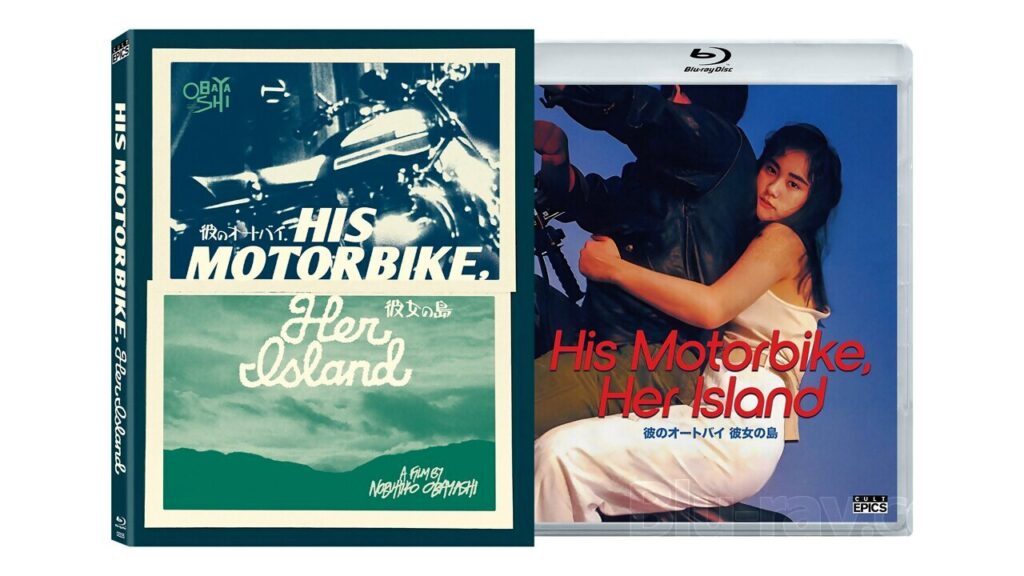
BLU-RAY STREET DATE: AUGUST 12, 2025/CULT EPICS
“One of those monochrome dreams…”
Whether filmmaker or filmgoer, showing and settling into picturesque moments of motorcyclists motorcycling along has always been key for enthusiasts of the vehicle. No less than Tom Cruise himself has demonstrated this time and again, as quieter portions of Top Gun to various Mission: Impossibles make time for the star to take an open-air ride. Something as seminal as Dennis Hopper’s Easy Rider’s greatest pleasures lie in the extended stretches where they’re simply biking across the U.S.
Within the opening minutes of Nobuhiko Obayashi’s off-kilter romance, His Motorbike, Her Island (1986), it is apparent that such a rule of thumb is not restricted to within American borders. Future prolific yakuza film actor Riki Takeuchi makes his screen debut here as Koh, a young cool biker dude in a black leather jacket. Koh doesn’t have much use for girlfriends or even other friends. Or so he says. Early in the story, he ventures off to ostensibly nurture a broken heart, post-breakup. To his credit, this severance was pretty messy… How often does a breakup result in a motorcycle jousting match with the girl’s angry brother? Apparently, that’s just how these guys roll. (At least until they can’t roll any longer).
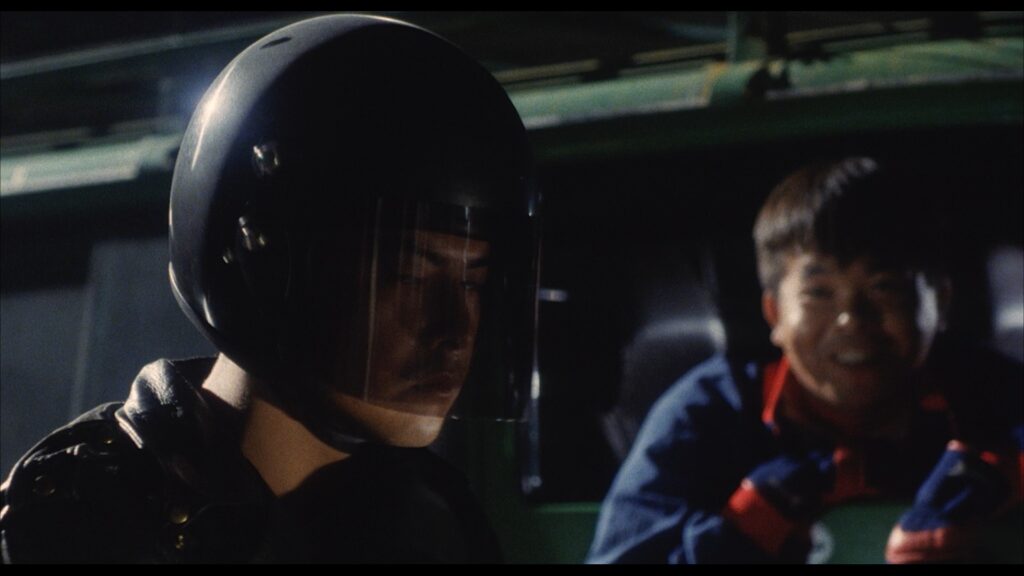
Since the 1950s, there has been a rather specific Japanese youth subculture centering on motorbikes known as bōsōzoku. But these characters, despite their two-wheel obsessions, don’t seem to be a part of that. Yet, Obayashi himself is all too keen on fetishizing Koh’s bike, a sleek, sexy, and (so we’re told again and again) quite powerful Kawasaki W3 oh yeah baby. Koh is a complicated guy. One moment, he and his buddy are out in traffic whacking off side-mirrors of unsuspecting passing cars; the next he’s lecturing his new beau, Miyoko (Kiwako Harada), on the important legitimacy of Japan’s multi-tiered motorbike licenses. The Kawasaki is a powerful machine, and one must earn the license to ride one, he tells her more than once.
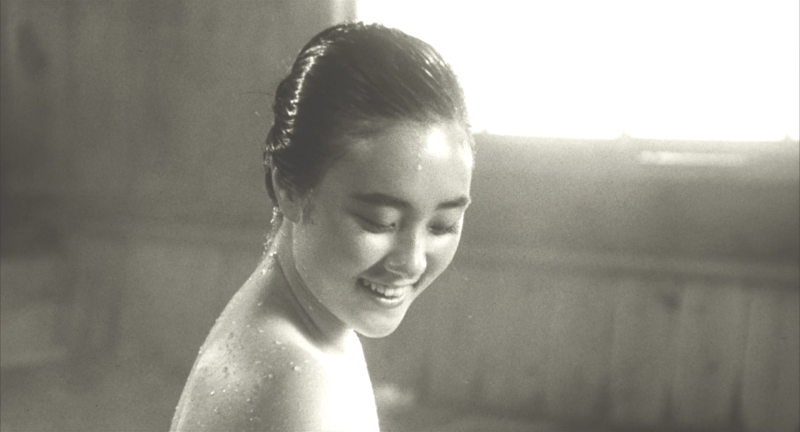
She takes it anyway. By this point, after happening upon her in public and then again when they’re both naked and alone in a public bath, they’re officially in love. The trouble is, it’s a love triangle with the Kawasaki.
For those who know Obayashi only for his crazed phantasmogical cult staple House, the grounded nature of His Motorbike, Her Island may be unexpected. While I found the film on the whole just north of average, it’s not an incompetent endeavor by any measure. One’s mileage will, of course, vary based upon one’s fascination with motorcycles. Fortunately, Cult Epics has seen fit to provide a very wide array of contextualizing bonus features.
The first of two newly produced video essays is “Becoming the Wind: His Motorbike, Her Island and the Biker Movie” by Esther Rosenfield. Rosenfield has done her homework and delivers her findings with confidence. I do wish that her narration about the history of biker movies would’ve been accompanied with clips or at least stills of the earlier films she’s talking about. Instead, in violation of the “show what you’re saying” rule of thumb, we get mostly random clips of this movie while Rosenfeld discusses movies like The Wild One and The Wild Angels. It unfortunately makes concentration unnecessarily difficult.
The second of the two new video essays “Her Island: Onomichi Pt. 1”, by Alex Pratt. In it, he takes as close of an examination as possible of the film’s two major locales. He discusses the added significance of the coastal and mountainous Onomichi having been Obayashi’s hometown, as well as some facts about “her island”, Iwashijima. While very academic and valuable in that respect, there’s a dryness to this piece that could be shored up.
Not to be outdone, audio commentarian extraordinaire Samm Deighan is on hand via an optional additional audio track with wall-to-wall facts, ideas, and thoughts on the film and those who made it. She maintains it’s a kind of coming-of-age tale, focusing on the way Obayashi respectfully depicts his two primary female characters. Deighan possesses the rare gift of being able to talk us through an entire film and not wear us out. Much respect to her.
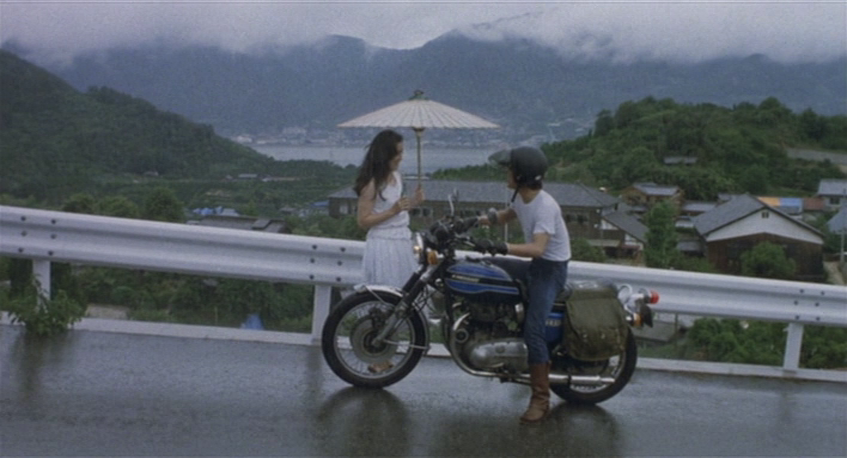
In an archival Interview from who-knows-when or where, director Nobuhiko Obayashi speaks about his decision to shoot certain parts of His Motorbike, Her Island in black and white, as well as the film’s rhythmic editing and how it reinforces the gliding kind of storytelling he was aspiring for. It’s almost always good to hear about such things straight from the filmmaker. This is one of those instances. It goes to show, some folks dream in monochrome and color. Were it not for Obayashi’s creative switching back and forth between color and greyscale, His Motorbike, Her Island would be a little more than a heavy-leaden romance on wheels. That said, fans of Japanese deep-cut cinema will want to seek out this above-and-beyond Blu-ray effort from Cult Epics.
Sporting a very satisfying high-definition transfer and new improved English subtitles, this first pressing of Cult Epics’ presentation of His Motorbike, Her Island includes a 24-page Japanese booklet (pamphlet) reproduction, reversible sleeve with Japanese original poster art and a new slipcase design by Sam Smith.