


The Pain of Parenthood and Prose in Tragic Tale of Shakespeare‘s Family
DIRECTED BY CHLOÉ ZHAO/2025
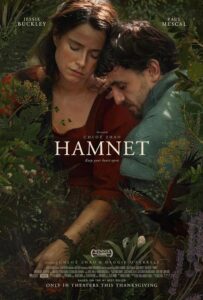
To be or not to be? That is the question that has haunted countless classrooms across the entire world. The written words of William Shakespeare have achieved immortality in the realm of popular culture on a global scale. There are not many mortals who manage to influence their world centuries their death and continuously inspire modern interpretations of their work. With such an intimidating legacy, it is easy to forget that the Bard was once flesh and blood like the rest of us mortals. In Hamnet, director Chloé Zhao humanizes this massive figure by reimagining him not as a gifted virtuoso, but as a simple man who was once a husband and a father. Hamnet is a grim examination on the crushing weight of grief and how we channel that pain for the remainder of our lives.
Based on the 21st century novel of the same name by Maggie O’Farrell, Hamnet is more speculative fiction than fact. According to both the novel and the film, the tragic passing of Agnes and William’s only son Hamnet directly inspired the playwright to create what is perhaps considered his most famous tragedy: “Hamlet”. With only a limited amount of recorded history to build upon, O’Farrell and Zhao imagine the family’s grief and the drastic effect on their lives this tragedy had. The passage of time has erased any chance of accurately understanding the playwright’s thoughts or emotions, so this depiction relies on a collection of scattered historical facts, namely that Hamnet was often interchangeably with Hamlet. Armed with what loose evidence there is to be found, these two women weave their own interpretation of how this family dealt with this loss.
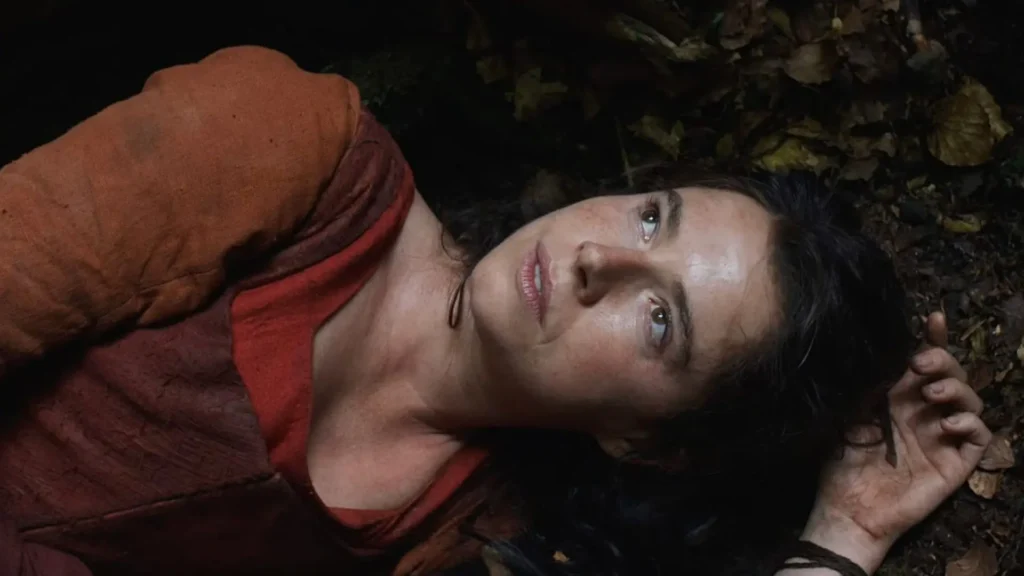
When it comes to plot, Hamnet is fairly cut and dry. The focus here is on a young Agnes (Jessie Buckley) and her first encounter with the famous bard. The locals refer to her as the daughter of a forest witch, but Agnes hardly seems to mind the label. It is quite fitting as well considering the first time we see her Agnes is curled up among the roots of a tree buried deep within the woodlands. There is a definite whimsical air to her behavior, and Agnes has a tangible connection to the natural world surrounding her. Her strange nature catches the attention of the village’s master tutor, a man we are introduced to just as Will (Paul Mescal). Enamored by both her beauty and wilding spirit, the two begin an odd mating ritual. This version of the playwright is less suave genius and significantly more socially inept as he awkwardly stumbles through every interaction with Agnes. As off-putting as their flirting appears, their instant chemistry is palpable, and they embrace each other’s eccentricities without hesitation. They frolic through the woods with the reckless abandonment of new love and their joy makes them impervious even to the disapproval of their parents.
In the blink of an eye, the odd couple are married and have started a family of their own. Their brood consists of their oldest daughter Susanna (Bodhi Rae Breathnach) and the twins, Judith (Olivia Lynes) and Hamnet (Jacobi Jupe). Initially, this small family is brimming with love and affection. Agnes teaches her daughters the possibilities of the forest while Will teaches his son how to play sword fight. For a moment, everything is blissfully peaceful. Which makes it even more jarring when it all goes horribly wrong in an instant. The fallout from Hamlet’s unexpected passing is borderline nuclear. There is no delicate approach to be found. Here, parental grief is portrayed as overwhelming, shrieking, and entirely earth-shattering. Every moment is caught in agonizing detail as the camera tightens in maelstrom that threatens to swallow this once beautiful family whole.
Nothing about the emotion in Hamnet is even remotely subtle. There are guaranteed to be arguments made about the near voyeuristic approach Zhao takes with her direction, and there is some validity there. At certain points, it feels like the audience is being manipulated by such expressive public displays of loss. The agonizing score swells, our lead actors wail in pain, and of course we have no choice but to drown in their sorrow with them. It is every bit uncomfortable as it is effective, as difficult to witness as it is to look away. Perhaps the dramatics are a tad overboard, but can most of us truly criticize how a parent should grieve over such an incomprehensible loss? Outside of the intense display of emotion, Zhao seems unable to avoid giving into cliche territory by tossing references to Shakespeare’s expansive published works here and there. The most egregious is when a distraught William begins to recite the iconic “To be, or not to be” to himself. There are other cheeky nods as well, such as when the children play the roles that will clearly become the three witches from “Macbeth”. These cheeky nods are jarring enough to nearly pull the audience out of the film, but Zhao manages to wrangle them back in by the next scene.
When Hamnet stumbles, the powerhouse talent helps the film back on its feet. For Hamnet, Zhao has wrangled some of the most impressive young actors Ireland currently has to offer. Buckley is remarkably believable as the quirky but compassionate Agnes. She has a magnetic presence that allows her to command the camera with natural confidence. Gladiator II was a lovely opportunity for a blockbuster action flick, but it is films like these where Mescal’s formidable talent shines through. There is a moment where he delivers Shakespeare’s own lines with all the gravity the playwright must have intended, and the result is breathtaking. It seems that talent is genetic here. Critics will rightfully give Jacobi Jupe his well-deserved flowers here for a brilliantly heart-wrenching performance from such a young actor as Hamnet. Likewise, his older brother Noah Jupe is the lynchpin that holds Hamnet’s final third act together.
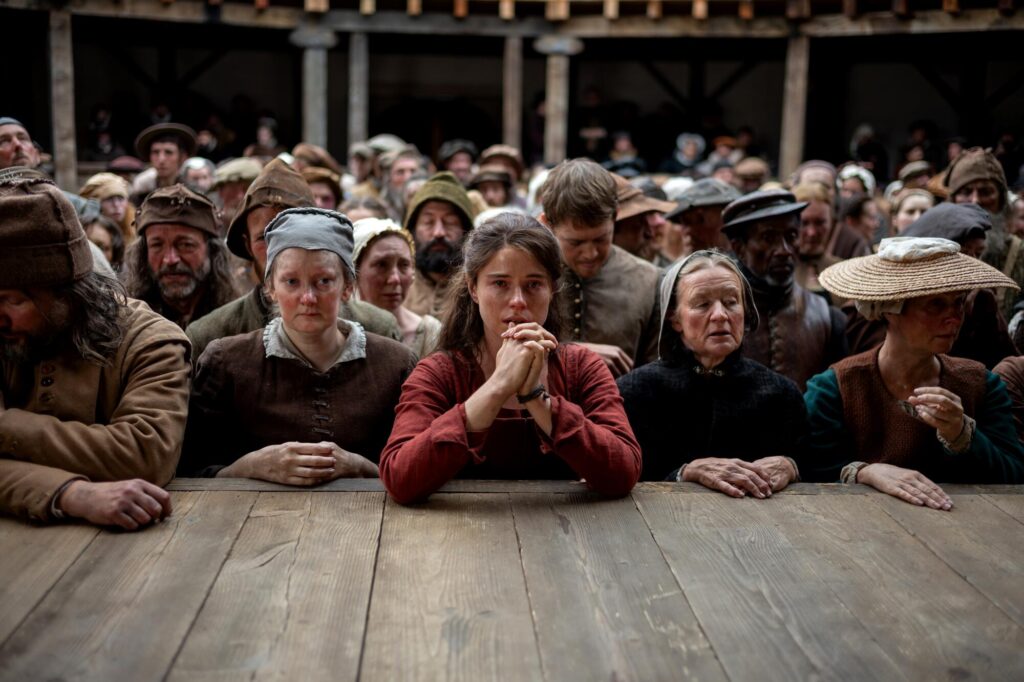
It is this aforementioned last act that truly elevates Hamnet from just good to great. After a tense period following their son’s death, Agnes is reluctantly drawn to the theater by William’s latest production: “Hamlet”. For the first time, she is witness to her husband’s masterpiece. Though “Hamlet” is traditional interpreted as a story about revenge, Hamnet challenges the audience to view this centuries old material in a new light. Here, the Bard’s play is a vessel to communicate his unspeakable agony. Will even takes on the role of Hamlet’s deceased father, covered in white paint and delivering his lines with a trembling voice. Agnes and Will’s trauma morphs into a riveting spectacle on the stage, and it finds a conduit in the form of the young actor playing Hamlet (Noah Jupe). The familial connection between the real-life actors only further deepens the concept that Agnes has a front row seat to the future her son could have had. All this raw emotion culminates into an astounding overhead shot of the entire crowd grasping for the dying boy on stage. It is a breathtakingly visceral display of the ability art has to unify an audience as a collective.
Hamnet may not be completely based in concrete fact, but what it lacks in accuracy it substitutes with its haunting emotional complexity. Though exploration of art as a medium to communicate human connection is nowhere close to an original concept, that does not make it any less satisfying when done so well like it is here. Grief has the power to destroy us, but it can just as easily inspire the need for community. Shakespeare may not be able to rewrite his son’s fate, but through his work he has immortalized Hamnet’s spirit for all of eternity. By creating this story in his memory, their son lives on through every performance. You cannot experience loss without love, and love is the universal language that binds us all.