


Julia Roberts, Andrew Garfield, and Ayo Edebiri Star in Campus Assault Drama
DIRECTOR: LUCA GUADAGNINO/2025
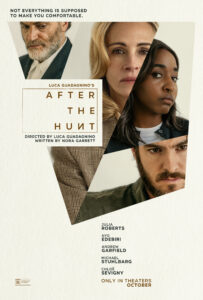
A film that begins with a ticking clock couldn’t help but make me think of timing. Specifically, is After the Hunt a few years too late?
Within the film, the clock counts down toward the final decision on Alma’s (Julia Roberts) tenure at Yale. She and her philosophy department colleague Hank (Andrew Garfield) are both in consideration—that is, until a student’s accusation derails the process. Doctoral candidate Maggie (Ayo Edebiri) claims Hank made unwanted advances, forcing Alma—and the rest of the Ivy League microcosm—to take sides. But the Yale Daily News is writing only part of the story. The rest comes in whispers in hallways and corners, the lines blurring between rumor, opinion, and fact.
Outside the film, the clock has rotated past the height of conversation about sexual assault on campus and in the entertainment industry. A full decade since the tide turned on Bill Cosby and almost as long since Spotlight’s Best Picture win, the Harvey Weinstein bombshells, and the Brock Turner accusations, people know their feelings on #MeToo. (The courts, on the other hand, are less decided.) In 2025, college campuses are in the news for more blatantly political reasons, overshadowing what felt like one of their most pressing discussions not long ago. That may be why After the Hunt goes out of its way to confirm its events take place just before the pandemic, the Israel-Hamas War, and the current administration. I’m not naive enough to believe the conversation couldn’t peak in such a way again—in a few years, we may reevaluate it as timeless instead of as a time capsule because it literalizes a modern Trolley Problem our culture will continue to face. When confronted with mutually exclusive claims about what happened between two people in a private room, whom will we sacrifice on the tracks? Will we believe the accuser and protect the community, or will we believe the defendant and save an individual’s future? Either way, the community can’t remain as it is.
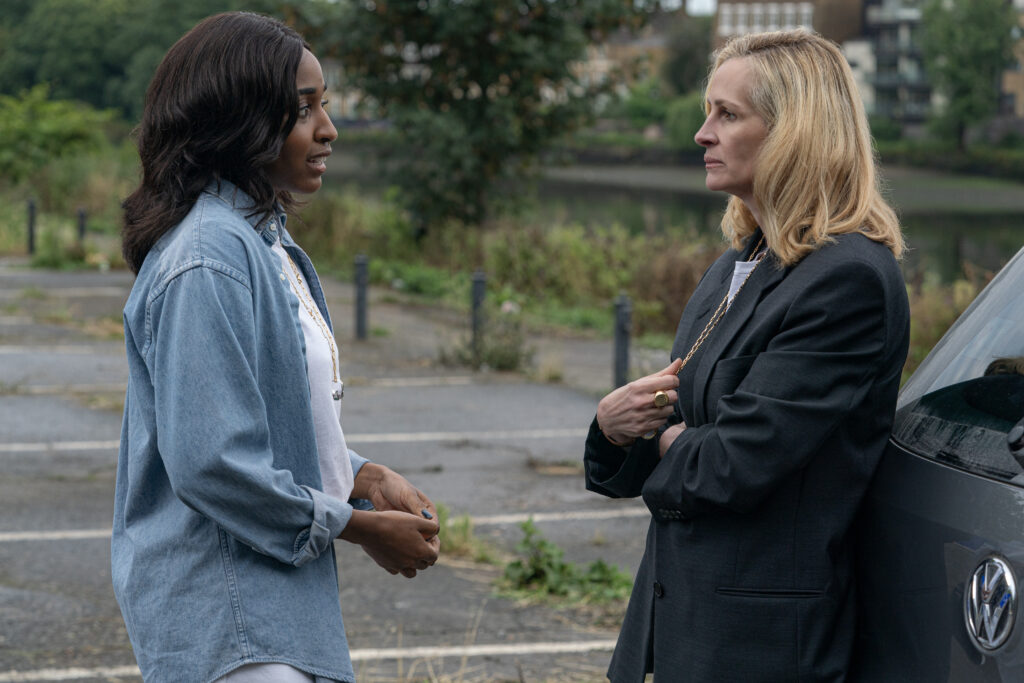
Luca Guadagnino’s drama is best when operating as this academic thought experiment, its actors both realized characters and pieces on the chessboard of a philosophical debate. In its excellent first hour, it’s a ‘70s paranoia thriller, channeling Gene Hackman’s self-doubt in The Conversation and Robert Redford’s confusion as the stakes keep shifting in Three Days of the Condor. But this is no government or corporate conspiracy, nor is it a murder plot. Alma, Hank, and Maggie are most afraid of each other. As observers of their veiled conversations and the online gossip, we’re just as unsure. The camera often focuses on extreme close-ups of faces and hands, only allowing us to see partial interactions. Other times, we watch them through windows or reflected in mirrors.
But like every paranoia thriller, After the Hunt is a tale of power, both formally in institutions and wielded in shadow. Alma and Hank hunt the power that comes with tenure, but they also use their charisma to sway their colleagues in their favor. Maggie works toward a prestigious degree, but she protects herself with her affluent parents’ reputation. Her thesis about performative virtue ethics begs the question: In the era of social media, does intent matter? When someone’s words and behavior can be viewed apart from knowing them, what explanation can save them from the collective’s consensus? In this climate, virtue signaling is a form of power, so why the Yale faculty and students do what they do matters less than their alignment with their peers, especially when qualities like age, race, gender, and wealth provide convenient motives. Does Hank’s white male status provide him with a historically biased advantage to his career? Did Maggie’s upbringing afford her privileges she didn’t earn? Does Alma’s title control her students’ futures with little oversight? Yes, yes, and yes. But Hank’s commitment as an educator, Maggie’s disadvantages as a queer woman of color, and Alma’s struggles against sexism can be true, too. They also represent generational clashes, with Alma’s Boomer-esque self-reliance, Hank’s Gen X desire for authenticity, and Maggie’s Zillennial need for emotional safety fighting for priority. And those are just the predetermined reasons for their behavior—what if they happen to do the “right” thing because it helps them get ahead?
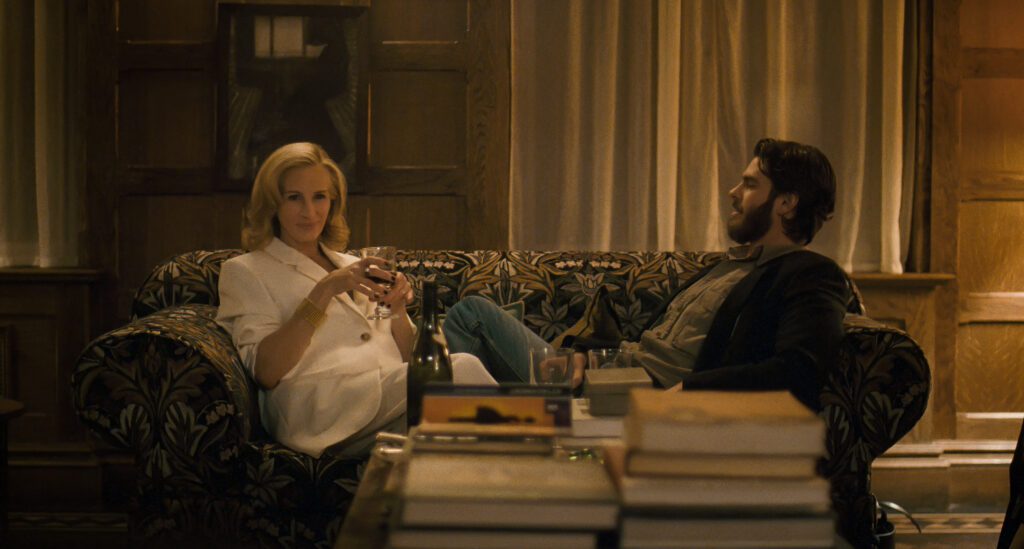
The film doesn’t collapse into “old man yells at cloud” territory, but its premise begins unraveling in the second hour as it favors the Boomer/Gen X perspective more and more. Of our three main characters, Maggie’s development feels the most uneven, especially once Alma begins making declarations about their history we never see. And though I’ve quite enjoyed Edebiri’s work in Inside Out 2, on late night shows, and on Letterboxd, her comedy background makes some of Maggie’s Zillennial tendencies border on satire. Roberts, Garfield, and supporting players Michael Stuhlbarg and Chloë Sevigny may find moments of levity, but they stay sincere even when exhibiting bad behavior. (Spoiler alert!) The film fumbles its grasp on its argument in a fourth wall-breaking conclusion that tries to wrap up its moral dilemma with a neat bow. This clumsy tack-on may as well be the conclusion of Psycho with its attempts at analysis of the previous two hours. (End spoiler alert!)
After the Hunt ends up more successful as an artifact to think about and discuss than as an artifact itself, but parts of the sum deserve acknowledgement. Roberts’s alternating winsome/gelid Alma is the exact kind of role her magnetism deserves. As the truth literally begins to eat her from the inside out, the role evolves from cerebral to physical without falling into theatrics. A movie star of her caliber can use just her body language to explain the marriage she tolerates and her coziness with her colleagues, and it deepens the thematic tension between privacy and a public life. (The tailored suits and wardrobe work courtesy of costume designer Giulia Piersanti and Roberts’s longtime costumer Francisca Vega don’t hurt either.) And something about Ivy League locations set to propulsive Trent Reznor/Atticus Ross scores must agree with Garfield, who keeps you teetering on his villain status because he never reduces Hank to what you’d expect. (His narrative absence is another reason the second half flounders.) It may be my favorite Garfield performance yet, one I hope stays in consideration through Awards Season.
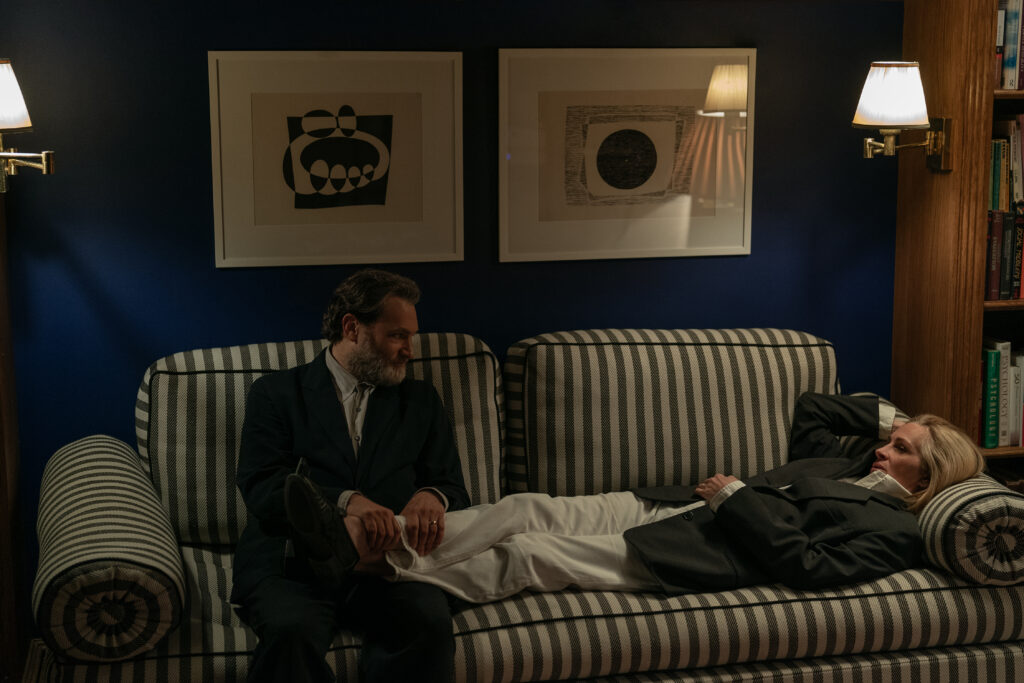
First-time screenwriter Nora Garrett deserves one more shout-out. A subtler theme at the core is one we don’t explore enough in our screen era: We don’t know who we are until we see ourselves reflected back to us. Every character defines themselves by others’ standards in some way, and they can only succumb to that expectation until they’re aware of it. That refraction? Just another issue of timing.