


The Beauty of the Badlands in Engaging Docudrama
DIRECTED BY KATE BEECROFT/2025
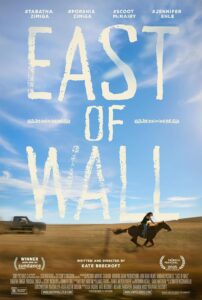
Far away from the hustle of suburbia and the shadows of cities, a different kind of American story unfolds. In the sweeping scenery of the Badlands, writer and director Kate Beecroft has discovered a hidden gem. A strange marriage of documentary and fiction, East of Wall examines the trials of life on a ranch in South Dakota.
This particular horse ranch is inhabited almost entirely by a gaggle of free-spirited teenagers. Overseeing all of them is widowed horse-whisperer Tabitha Zimiga, played very fittingly by herself. In fact, a majority of this cast is composed of the real subjects portraying a slightly fictionalized version of themselves. Struggling financially to maintain the property, Tabitha and her rambunctious crew have resorted to auctioning off horses, both in-person and through social media. Nearly every single one of these kids has a knack for riding, especially Porshia. It is through Tabitha’s daughter that we receive much of the emotionally driven narration. Both mother and daughter find themselves floundering in their grief, and it is this shared emotion that threatens their relationship.
It is never made entirely clear if the events of the film actually occurred. If the casting did not make it explicitly clear though, it would be a good guess to say that writer and director Kate Beecroft is drawing from Zimiga’s real-life experiences. Sprinkled within the non-actors are a few professionals. Most notable are Scoot McNairy as a wealthy Texan who has his eye on the ranch, and Jennifer Ehle as Tabitha’s rough-around-the-edges mother. These two blend seamlessly into the environment which is a testament to their skill. However, it is Tabitha that commands the screen. Sure, it could be argued that it is not so difficult to play oneself, but that does not make Zimiga’s performance any less captivating. Her tough but generous heart is on full display, and the raw vulnerability shown on-screen anchors East of Wall. One particular scene has her describing the details of her husband’s suicide. Tabitha’s raw delivery drips with all the anger and heartbreak that accompany grief.

Beecroft does an impressive job here as a newcomer. It won’t take audiences long to understand this is an amateur film yet, coincidentally, that is exactly what makes it engaging. The personal nature of this work could easily feel voyeuristic. Instead, Beecroft handles the Zimiga family with classy respect. There is a sense of humility behind the camera as this very real family opens their home for the world to see. At the same time, Beecroft does not shy away from the gritty reality of the world she has been welcomed into. In what is perhaps the most riveting scene, a group of middle-aged women discuss the abuse and hardships they endure in their own homes. When the focus pivots to Tabitha, she goes into detail about the night of her husband’s suicide. Tabitha’s raw delivery drips with all the anger and heartbreak that accompany grief. Beecroft gives these women a space to feel human and to connect, possibly on a significantly larger scale than they ever imagined.
The plot itself may be a little bare boned when you look a little closer, but the drama unfolds organically and maintains a steady pace. East of Wall is a strong beginning to Beecroft’s career, and an intimate portrait of American life. It shines as a low-budget, indie project with little restriction. Whether it be the blatant authenticity or the overall grounded nature to the entire story, it is a film that is hard to brush aside. As gruff as it is poetic, East of Wall dedicates the spotlight to its characters that are flawed by still striving for good in their removed little corner of the world.
