

The Director of the Festival Hit THE REBRAND

Kaye Adelaide’s The Rebrand is a film that sneaks up on you. At first glance, it plays like a comedy — awkward, sharp, and often laugh-out-loud in ways that feel organic to its characters. But as the story unfolds, that same sense of wrongness that fuels the comedy begins to shift into something darker. The laughter curdles, the atmosphere tightens, and by the end, the film has descended into genuine horror. It isn’t two movies smashed together, as so many horror comedies risk becoming. Instead, it’s a single world where both humor and dread coexist, feeding off the same energy. In my review at ZekeFilm, I called it “wrong in all the right ways,” because it finds a way to take aloofness, awkwardness, and weirdness that’s hilarious at one moment and deeply unsettling the next.
When I spoke with Adelaide about the film, she began with the simple fact that she wanted to make a feature. After years of shorts, she was ready to attempt something longer, to stretch her storytelling into a form that could sustain more layers and rhythms. “The project started with the cast.” She wrote with them in mind, knowing their strengths and quirks — and from there the concept grew into something that could both play to their abilities and challenge them. The script itself wasn’t a traditional screenplay at first, but a twenty-page outline. “Every scene had a starting point and an end point, but how the characters got from A to B was left open,” she states. That openness gave the film an improvisational looseness, allowing the cast to find moments of comedy and unease in real time, while Adelaide kept the larger structure in place.
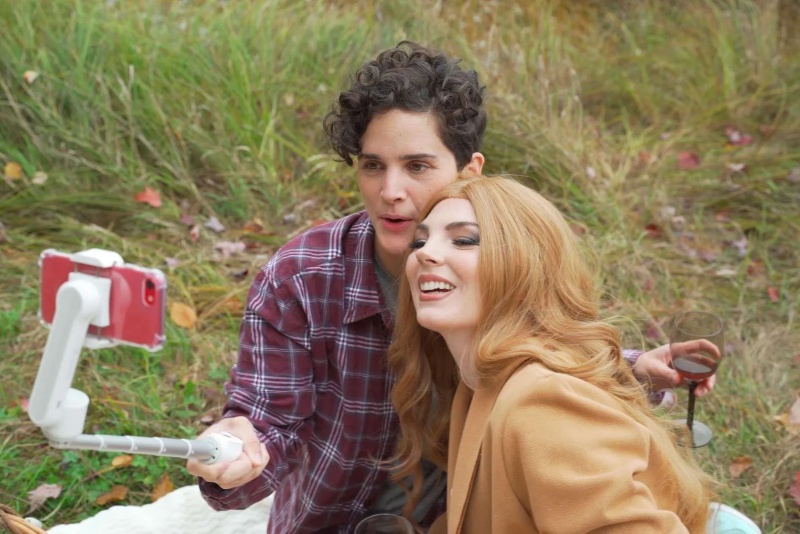
Though some viewers have pointed out uncanny resemblances to real-world influencer couples, Adelaide explained that she wasn’t modeling anyone in particular. She looked at lesbian influencers for aesthetics, but the deeper influence came from her own experiences with narcissists, and people pushing boundaries in the film world. “I’ve been on shoots where boundaries were pushed so far it felt like I was basically kidnapped,” she said, describing how those moments informed Blair and Thistle’s passive-aggressive manipulation. Their behavior is heightened, but it comes from something familiar and lived-in.
That same approach informed the balance between comedy and horror. Some payoffs were carefully planted early on, while others emerged on set, found in the moment through improvisation. Adelaide described the film as a combination of things she planned and things that just happened, and that hybrid process makes sense of how the humor and dread feel like two sides of the same coin. The outline gave her control of the arc, but the freedom she gave her actors meant they could explore the strange, awkward, funny behaviors that later turn into something unsettling.

One aspect of the film that stands out in the landscape of queer horror is its willingness to present queer characters as flawed. Blair and Thistle are not idealized or sanitized. They’re manipulative, sometimes cruel, and often absurd — and that’s what makes them compelling. “If you want to integrate all characters into all film roles, you need them to be more than just angelical characters,” Adelaide said. It wasn’t a soapbox statement so much as a storytelling philosophy: characters who feel full, messy, and contradictory are always more engaging than characters hemmed in by expectations. For me, it felt like an evolution in representation, much like what Bottoms did in comedy, where queer characters aren’t flawless icons but messy people who can be just as funny, awkward, and unlikeable as anyone else.
Nicole (Naomi Silver-Vézina), the videographer hired by Blair and Thistle (Andi E McQueen and Nancy Webb), adds another layer of tension by being heavily pregnant. Adelaide told me that this was a deliberate choice. “I wasn’t sure if Blair and Thistle would feel threatening to a non-pregnant character,” she said, “but a pregnant character immediately raises the stakes.” The pregnancy also made Nicole’s financial vulnerability more believable, and her continued presence on set all the more unsettling.
The decision to center the story on influencers wasn’t about making a broad cultural statement. Adelaide explained that it was more functional than satirical: she needed a believable reason for her characters to keep filming. “In early found footage films, people kept recording because they’d just gotten camcorders and it was the novelty. Now, we’ve circled back to a place where people are always filming,” she said. Influencer culture gave her the perfect justification without forcing commentary.

Visually, The Rebrand plays with contrasts. The curated look of the influencers’ rooms, bright and glossy, sits against the muted tones of Nicole’s world. That juxtaposition was intentional, though it came with production challenges. The crew had only two days in the Airbnb, and afterward, they had to remake parts of Adelaide’s own apartment to match. The clash between colorful brightness and sterile emptiness mirrored the contrast between the curated influencer façade and the darker reality creeping underneath.
On the festival circuit, the film has been warmly received, winning Best Film at seven festivals so far. Adelaide admitted the reaction has exceeded her expectations. Early cuts of the movie leaned more toward comedy, but after some initial screenings she pushed the final act deeper into horror. “We added more red lighting and a darker score,” she said, “and that really tipped it into horror.” That revision gave the film a more decisive tonal shift, one that embraced its horror identity without losing the comedic DNA that makes it unique.
As for what comes next, Adelaide plans to take The Rebrand through a few more festivals while working toward distribution. She also has a new short, Transvengence, which is intended as the seed for a bigger-budget feature, and she recently won a pitch fund at TIFF for a script called Father-Phobic, which she plans to make soon. And for those who want more from the film’s cast, Nancy Thistle, who plays Blair, has a podcast called Total Relaxation that Adelaide describes as “a lot of fun.”
The Rebrand is proof that queer characters don’t need to be sanitized or flawless to matter. They can be manipulative, messy, funny, and terrifying — fully human in all the ways that make them interesting. Adelaide has created a film that takes comedy and horror from the same source, showing how both can emerge from the wrongness of people and the spaces they occupy. It’s a film that feels alive, improvisational, and deeply unsettling, and one that marks Adelaide as a filmmaker to watch.